

The Senate leader says 32 state assemblies have approved the constitutional amendment, clearing the required threshold, as questions remain over the final legislative steps and the proposed policing framework.
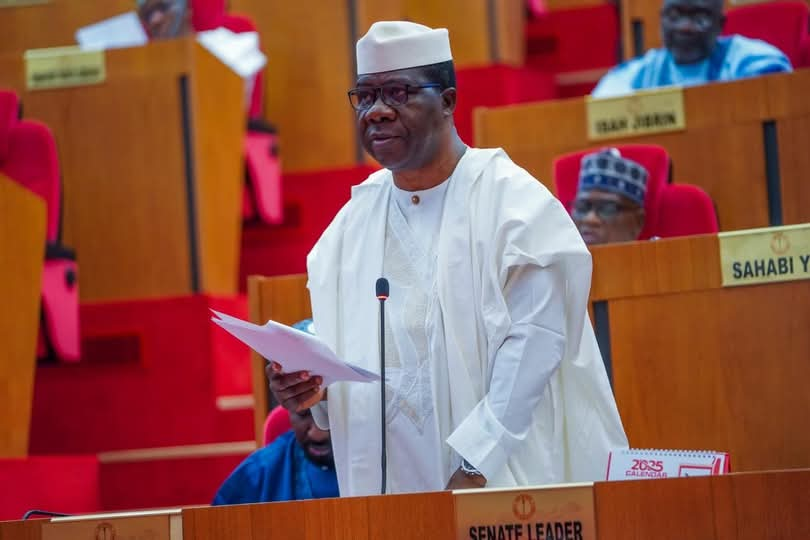
The National Assembly is expected to transmit the State Police (Constitution Alteration) Bill, 2026, to President Bola Tinubu this week, Senate Leader Opeyemi Bamidele has said.
Bamidele disclosed this on Friday night after receiving The Sun Senator of the Year Award. He said 32 of Nigeria’s 36 state Houses of Assembly had approved the proposed constitutional amendment, exceeding the minimum 24 required under Section 9(2) of the 1999 Constitution.
According to him, four state assemblies are yet to submit their reports, but their outstanding responses will not prevent the National Assembly from proceeding.
“We are now expecting four State Houses of Assembly to turn in their reports on or before the National Assembly reconvenes on November 17, 2026,” he said.
He added that lawmakers must move forward regardless of whether the remaining reports arrive, saying the National Assembly was now under obligation to transmit the bill to the president.
The National Assembly had transmitted the constitutional amendment to all 36 state assemblies on September 16 for consideration and approval. The Senate subsequently gave the outstanding assemblies until November 15 to communicate their decisions.
State police bill crosses constitutional threshold
Section 9(2) of the Constitution requires a constitutional amendment to receive support from at least two-thirds of all members of both chambers of the National Assembly and approval through resolutions by at least two-thirds of the state assemblies.
For Nigeria’s 36 states, that means at least 24 state assemblies must approve the proposal. The 32 approvals reported by Bamidele therefore exceed the state-level requirement.
The proposed amendment seeks to establish a Federal Police Service alongside State Police Services, changing the country’s current centralised policing structure.
Bamidele described the proposal as a major step towards decentralising policing after more than 15 years of unsuccessful attempts to reform the system.
He said the initiative was not intended to create ethnic or state armies but to establish state-led, community-based policing under constitutional safeguards.
Under the proposed arrangement, state police services would operate alongside the federal police structure. Reports on the proposed framework indicate that state governors would have a role in appointing state police commissioners, subject to confirmation by their respective assemblies.
However, the precise structure, funding arrangements, oversight mechanisms and safeguards against political interference remain important issues for public scrutiny.
Does the bill require Tinubu’s assent?
Although Bamidele says the National Assembly will transmit the bill to Tinubu for assent, the constitutional requirement for presidential approval of amendments has long been disputed.
Section 9 of the Constitution sets out the procedure for altering its provisions but does not expressly mention presidential assent. However, a 2010 Federal High Court ruling in the case brought by former Nigerian Bar Association president Olisa Agbakoba against the National Assembly held that presidential assent was required for a constitutional amendment to become valid.
The Policy and Legal Advocacy Centre has documented the opposing legal interpretations, noting that some constitutional experts argue that state ratification completes the amendment process without presidential involvement.
The National Assembly’s current online guide to the constitutional alteration process also states that presidential assent is not required after the necessary state approvals. The conflicting interpretations mean the precise legal route remains a matter of debate.
The National Assembly is expected to resume on November 17, when lawmakers can clarify the next steps and the status of the outstanding state reports.
Even if the amendment clears the remaining legislative hurdles, establishing state police will require more than changing the Constitution. Funding, recruitment, training, accountability, jurisdiction and safeguards against the misuse of police powers will determine how the proposed system operates.
For now, the reported approvals mark progress in the constitutional process, but state police have not yet been established.