

By Fattyma Ibrahim
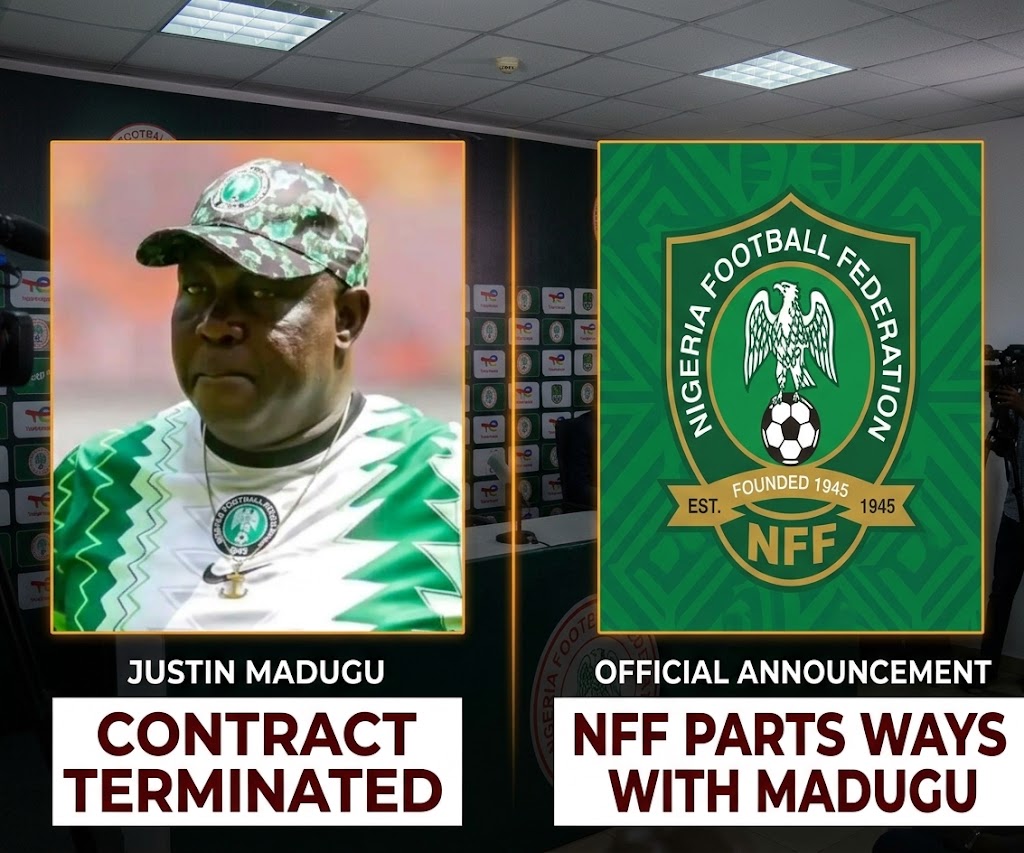
The NFF’s dismissal of Justine Madugu and the Super Falcons’ technical crew, days after a World Cup qualification miss, is examined against the fact that he led the same team to a continental title under the same federation barely a year earlier. This piece argues the sacking sidesteps harder questions about funding, player development, and the NFF’s own institutional instability, and sets out what the federation’s fact-finding committee would need to do to be more than accountability theatre.
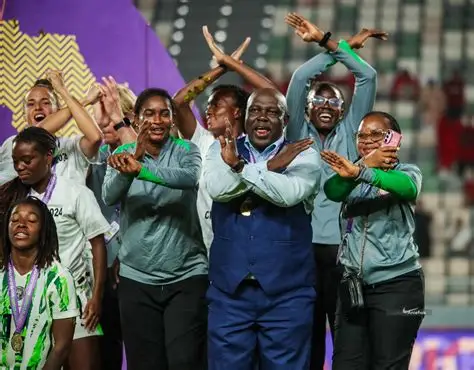
Barely a year ago, Justine Madugu stood in Rabat as the coach who had just delivered Nigeria’s 10th Women’s Africa Cup of Nations title, an achievement that earned him recognition as coach of the tournament. This week, the same man was shown the door, along with his entire technical crew, after the Super Falcons failed to qualify for the 2027 FIFA Women’s World Cup, a competition they have appeared at every edition since it began in 1991.
The contrast is jarring enough to demand a question the Nigeria Football Federation (NFF) seems uninterested in asking: if the coach is the same, and the federation around him is the same, what actually changed between the triumph and the collapse?
The Convenient Answer
The easy answer, and the one the NFF has effectively given by acting so swiftly, is that Madugu changed: that his player selections faltered, his tactics grew stale, and the buck stopped with him. There is a surface plausibility to this. Public scrutiny of his choices intensified throughout the WAFCON campaign, and a quarter-final exit to Cameroon, followed by a playoff loss to South Africa that sealed the World Cup miss, is a genuinely poor run of results for a team of the Falcons’ pedigree. Accountability for coaching decisions is not an unreasonable demand, and it would be dishonest to pretend tactics and selection played no role at all.
But this is precisely why the sacking is too convenient. It lets everyone else off the hook.
A coach can be removed by Monday afternoon with a terse statement on X; a broken development pipeline cannot be fixed with a press release. When a federation’s first and loudest response to failure is to remove the most visible, most easily replaceable person in the structure, it is worth asking whether that response is about fixing the problem or about being seen to respond to it.
What the Sacking Sidesteps
Consider what the coaching change conveniently sidesteps. Nigerian women’s football has long faced questions over the level and consistency of investment it receives, despite delivering some of the country’s most consistent continental success. A development pipeline that cannot reliably produce depth behind an ageing core of stars will eventually show its limits, no matter who is picking the team, and a single bad tournament is often the moment those limits become visible, not the moment they were created. None of this is captured in a statement asking a technical crew to “step down with immediate effect.”
A NFF Under Its Own Pressure
Then there is the NFF itself. The federation that sacked Madugu is not simply facing vague “instability”, it is facing direct intervention from its own regulator. Days after the Falcons’ playoff exit, the National Sports Commission (NSC) cancelled the NFF’s elective congress, which had been scheduled for September 27 in Lafia, Nasarawa State, where incumbent president Ibrahim Gusau was seeking a second term. In its place, the NSC is reportedly preparing to install a three-month “normalisation committee” to run the federation’s affairs while it works out fresh electoral guidelines and broader reforms.
The timing is not incidental. The NSC had initially been inclined to let Gusau’s re-election bid proceed, but the qualification failures of Nigeria’s national teams first the Super Eagles’ failure to qualify for the 2026 men’s World Cup despite an expanded African allocation, then the Falcons’ own World Cup exit, changed that thinking within government. The Gusau administration has also recorded seven distinct “failures” since taking office, with the men’s World Cup miss cited as the most damaging. Stakeholders had separately raised concerns that the electoral process itself was structured to favour Gusau’s re-election, with one aspirant saying he could not secure the zonal endorsements needed to contest.
This is the backdrop against which Madugu’s sacking should be read. It is not simply that the NFF is “unsettled at the top”, it is an institution whose leadership may not survive to the election it had already scheduled, now facing a federal regulator stepping in to reorganise it and reportedly briefing FIFA to pre-empt any suspension threat over outside interference in the federation’s affairs.
An institution under this kind of external pressure has every incentive to produce a fast, visible scalp of its own before one is imposed on it, and very little incentive to conduct the slower, more uncomfortable audit of its funding priorities, competition structures and player pathway that a genuine post-mortem would require.
Not everyone agrees that the external fix is the right one either. Former Super Eagles forward Victor Ikpeba has publicly warned against rushing into a normalisation committee, cautioning that it could carry its own risks for Nigerian football.
The Fact-Finding Committee: The Real Test
To be fair to the NFF, it has not stopped at the sacking alone. The federation has also convened a six-member fact-finding committee, chaired by former general secretary Fanny Amun and including figures with considerable experience in Nigerian football: Desire Oparanozie, Mutiu Adepoju, Ladan Bosso and Alex Mana. On paper, this is the right instinct: to establish what actually went wrong rather than simply confirm the decision the federation had already made.
Whether it functions that way is the real test.
That test should be measured by a simple standard: does the committee’s eventual report examine the federation’s own choices, how the women’s game is funded relative to the men’s, how depth is built beneath the senior squad, and how technical appointments are made and reviewed, with the same rigor it presumably applies to Madugu’s selections and tactics? A report that lands only on individual failings, after a coach has already been removed before the investigation even began, will have answered very little.
It will simply have dressed the scapegoat in the language of due process.
Conclusion
Nigerian football has been here before, and it will be here again if nothing changes beneath the coaching box. The Super Eagles’ own World Cup miss this year, under a different technical setup entirely, suggests the country’s problem is not confined to one dugout. If the fact-finding committee’s work ends with Madugu’s name and nowhere else, the NFF will have bought itself a news cycle’s worth of accountability theatre and set the stage for another coach, doing everything the last one did, to inherit the same collapse a few years from now.
The NFF has answered the question of who takes the blame. It has not yet answered the harder one: who fixes the system. The question after Madugu should therefore not simply be who replaces him, but whether that person will inherit a fundamentally different one. If the answer is no, the NFF may have changed the coach without changing a single condition that produced the failure and left the real question still sitting unanswered.