

The first meeting between the three leaders produced a joint declaration on nuclear risks, energy and UN reform, but left Ukraine and Iran out of its final text.
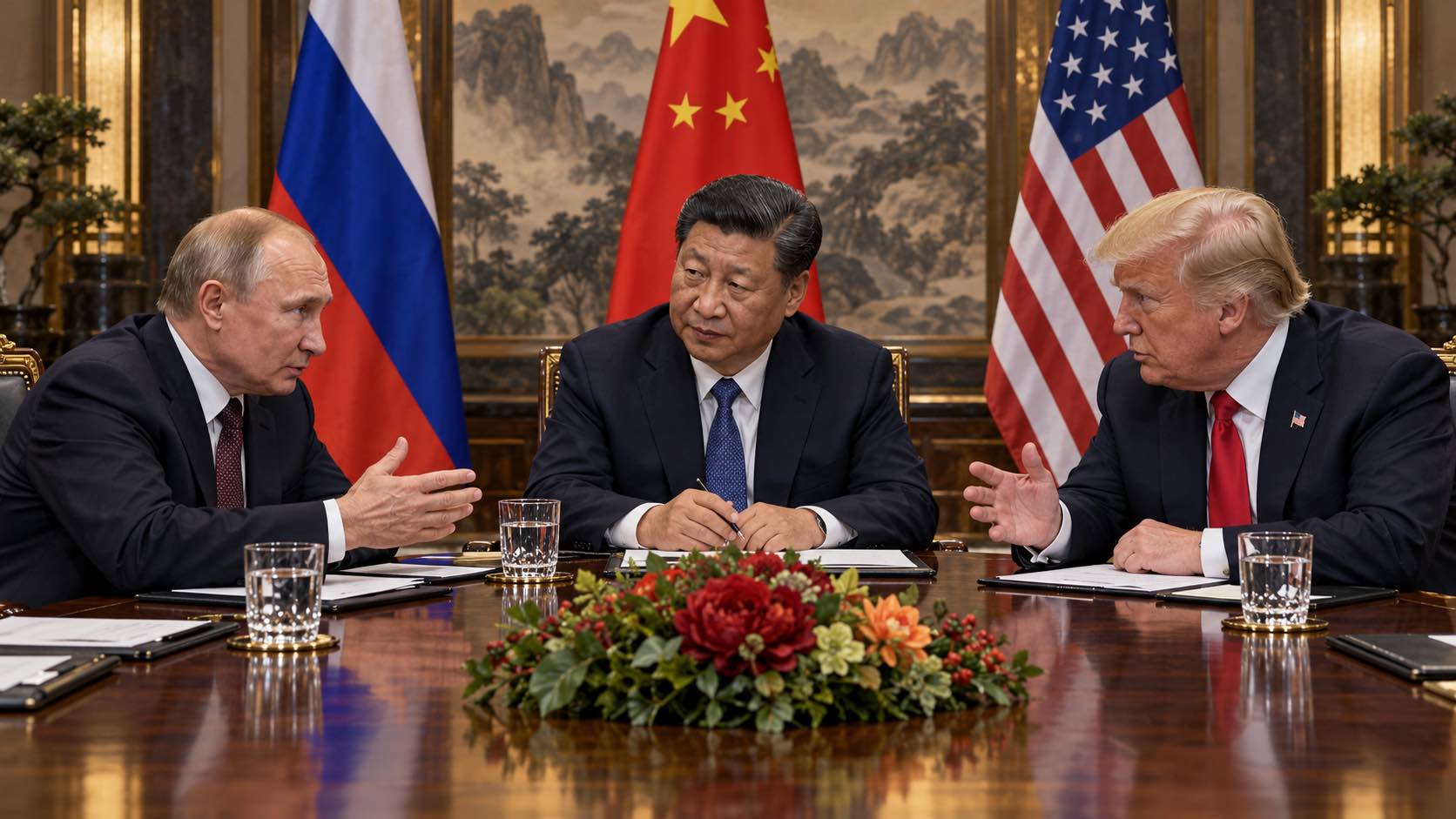
US President Donald Trump, Chinese President Xi Jinping and Russian President Vladimir Putin have held their first-ever trilateral summit in Shenzhen, China, bringing together the leaders of three major global powers for talks on international security, nuclear weapons and economic cooperation.
The meeting took place on Thursday, November 19, at Kylin Villa on the sidelines of the Asia-Pacific Economic Cooperation (APEC) summit.
The three leaders described the gathering as historic, with Trump saying they had a shared responsibility to maintain dialogue on issues affecting the international community.
“As presidents of three of the world’s largest countries, we have a special responsibility to maintain open, respectful and productive dialogue on issues impacting not just our people but the entire planet,” he said.
The meeting lasted about 80 minutes and followed separate bilateral discussions between Trump and Xi, and Trump and Putin.
In his opening remarks, Trump called for cooperation among the three countries to reduce nuclear weapons and prevent proliferation, describing the United States, China and Russia as the world’s three largest nuclear powers.
Xi called for peaceful relations among major powers, warning that confrontation could lead to global instability. Putin, meanwhile, proposed discussions on global and regional economic relations, food and energy security, and the settlement of regional conflicts, including the war in Ukraine.
What Trump, Xi and Putin agreed
Following the summit, the three countries issued a four-point joint declaration titled China-Russia-US Heads of State Declaration toward Peace.
The document commits the three permanent members of the United Nations Security Council to pursuing reforms that would enable the organisation to respond more effectively to global challenges.
It also states that the countries plan to increase the production and supply of refined petroleum products and reaffirmed the importance of stable energy flows.
On international law, the leaders said state consent and immunity for government officials were important principles, adding that the International Criminal Court and similar bodies must not abuse their jurisdiction.
The declaration also reaffirmed that a nuclear war cannot be won and must never be fought. The three countries agreed to conduct dialogue on reducing nuclear risks and preventing the proliferation of nuclear weapons.
However, the declaration made no reference to the wars in Ukraine and Iran, despite the conflicts featuring in the leaders’ opening remarks and discussions ahead of the summit.
The omission was particularly notable for Ukraine, which was not represented at the meeting. Putin and Trump both referred to the conflict in their opening remarks, while the Kremlin later said the issue had been discussed.
The declaration also did not outline a timetable, specific commitments or mechanisms for implementing the proposed cooperation.
Trump’s warm exchanges with Xi and Putin draw attention
Before the trilateral meeting, Trump held separate discussions with Xi and Putin, describing both leaders as friends.
During his encounter with Putin, Trump said the two had maintained a good relationship for years and expressed optimism about what their discussions could achieve.
The exchanges attracted attention in Europe, particularly as Ukraine’s allies gathered in Berlin to discuss the war and support for Kyiv.
Polish Prime Minister Donald Tusk appeared to react to Trump’s warm greeting of Putin, posting on X: “God, protect us from such friends.”
The summit also drew comparisons with the 1945 Yalta Conference, where the leaders of the United States, Britain and the Soviet Union discussed the post-war international order. Analysts have cautioned, however, against assuming that the Shenzhen meeting will produce a comparable realignment.
The gathering nevertheless carries diplomatic significance. It brought Washington, Beijing and Moscow together at a time of tensions over Ukraine, Iran, nuclear weapons, trade and international institutions.
For Russia and China, the meeting also offered an opportunity to present themselves as central players in discussions about the future of global governance.
But the declaration’s broad commitments leave important questions unresolved, particularly over nuclear arms control, the conflicts in Ukraine and Iran, and the role of international institutions.
The summit has established a platform for dialogue among the three powers. Whether that engagement produces concrete changes in their policies or resolves any of the conflicts discussed remains uncertain.