

The March and March movement also called for South Africa to quit the UN Refugee Convention, as renewed protests add to tensions between Pretoria and Abuja.
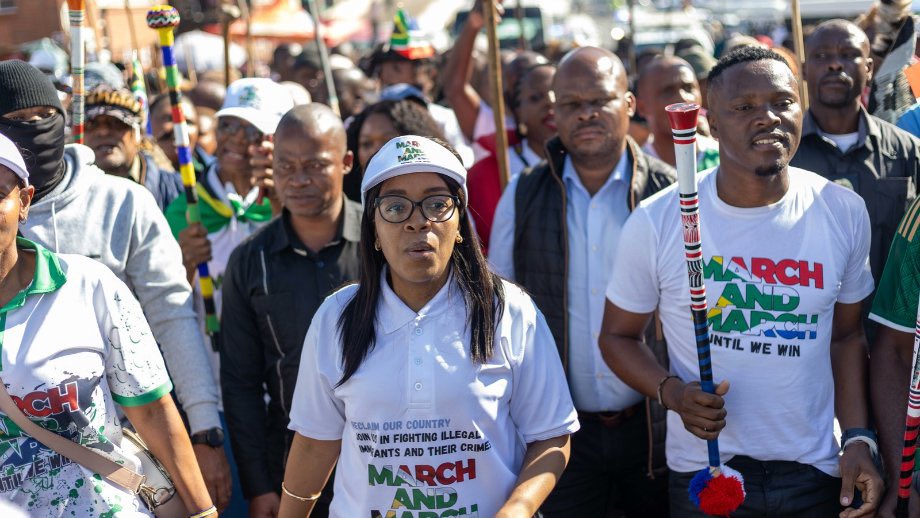
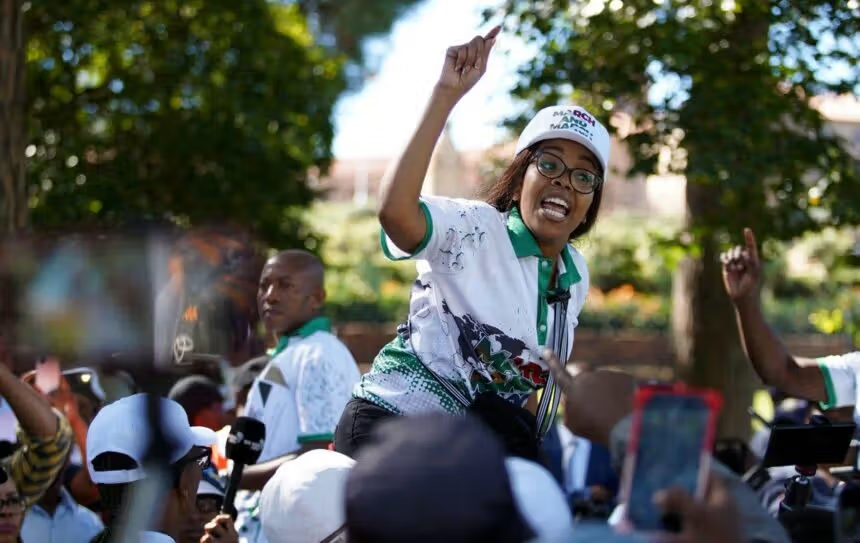
Demonstrators from South Africa’s anti-migrant March and March movement have demanded that the government ban Nigerians from entering the country, during a fresh protest in Pretoria on Wednesday.
The protesters, led by the group’s leader, Jacinta Ngobese-Zuma, staged a demonstration in Sunnyside, a Pretoria suburb with a sizeable Nigerian community, popularly nicknamed “Little Lagos”.
Ngobese-Zuma challenged Nigerians living in the neighbourhood to explain how the area acquired the nickname and questioned their presence in the community.
“I’m being told here that we’ve entered Sunnyside, the home of Nigerians. I’m inviting Nigerians to come out let’s talk to each other. We want to know who gave you this place and called it Nigeria. Who gave you permission to call this place Lagos or whatever you call it?” she asked.
The group’s legal representative, Xolani Zuma, called on the South African government to prohibit Nigerians from entering the country, accusing them of involvement in drug trafficking.
“The state must ban Nigerians from South Africa. They must ban Nigerians until they stop selling drugs to our people. The rest of Africa we are fine, but we do not want Nigerians in South Africa anymore, that is what we are saying,” he said.
The accusations were made by the protest organisers and were not accompanied by evidence establishing criminal conduct by Nigerians as a group.
March and March seeks withdrawal from refugee convention
Beyond its demand for a ban on Nigerians, the movement called on South Africa to withdraw from the 1951 United Nations Convention relating to the Status of Refugees.
Ngobese-Zuma described the agreement as “not sustainable and not feasible”, arguing that migrants place additional pressure on public resources and contribute to frustration among South African citizens.
The protesters also demanded tighter immigration controls and faster deportation of undocumented foreign nationals. They marched to the Department of Home Affairs in Pretoria to submit their demands.
The 1951 Refugee Convention establishes international standards for the protection and treatment of refugees. Its central principle, non-refoulement, prohibits countries from returning refugees to territories where their lives or freedom would be threatened by persecution.
The United Nations High Commissioner for Refugees says the principle is also part of customary international law and therefore applies to states regardless of whether they are parties to the Convention.
The South African government has not announced a policy to ban Nigerians in response to the demonstration. The demands remain those of the protest movement.
Fresh protest comes amid Nigeria-South Africa tensions
The demonstration comes amid renewed diplomatic tensions between Nigeria and South Africa over xenophobic attacks and the treatment of Nigerian nationals.
In July, both countries agreed to ease tensions following talks in Abuja between their foreign affairs officials. South Africa pledged to pursue those responsible for attacks on foreign nationals, while Nigeria said it was compiling claims relating to property losses suffered by its citizens.
Nigeria also repatriated citizens who wanted to leave South Africa amid security concerns. The country’s Acting High Commissioner to South Africa, Ambassador Ajayi Alexander, said in September that 1,695 Nigerians had returned through government-sponsored arrangements and private assistance.
The figure comprised 1,490 Nigerians evacuated through government-sponsored arrangements and 205 who returned with support from private individuals.
The latest protest also follows a diplomatic disagreement over the presentation of credentials by Nigeria’s High Commissioner to South Africa, Femi Fani-Kayode, to President Cyril Ramaphosa.
Fani-Kayode accused the South African presidency of deliberately excluding his speech from the livestream of the November 13 ceremony, during which 14 other ambassadors and high commissioners also presented their credentials.
The South African presidency subsequently released a separate recording of his speech. Its spokesperson, Vincent Magwenya, rejected the allegation of deliberate exclusion and described the interruption as a technical or operational issue.
Fani-Kayode had described the omission as disrespectful to Nigeria but said Ramaphosa intervened after he raised the matter.
The high commissioner has also spoken about concerns affecting Nigerians in South Africa, describing those responsible for xenophobic attacks as a minority who do not represent the majority of South Africans.
He has said Nigeria would not sever diplomatic relations with South Africa, while warning that patience within the Nigerian government was wearing thin.
The latest demonstration adds to concerns about the safety of foreign nationals in South Africa, particularly Nigerians, amid recurring anti-immigrant protests and calls for stricter immigration enforcement.
While the protest movement has framed its demands around immigration and public resources, its call for a blanket ban on Nigerians has raised questions about the treatment of an entire nationality based on allegations of criminal conduct.