


The directive covers providers serving Nigerian residents, including crypto exchanges, trading platforms and digital asset custody services, with a separate December 31 deadline for portal integration.
The Nigeria Revenue Service (NRS) and the Joint Revenue Board (JRB) have given virtual asset service providers (VASPs) until November 30, 2026, to register on a newly deployed tax portal, warning that operators who miss the deadline could face penalties and other enforcement measures.
The agencies announced the requirement in a joint public notice on Friday, November 20, saying the portal would facilitate tax administration and registration for anti-money laundering, counter-terrorist financing and counter-proliferation financing (AML/CFT/CPF) compliance.
The directive applies to persons providing virtual asset services in Nigeria or to people resident in the country, regardless of whether the service provider has a physical presence in Nigeria.
The agencies also set December 31, 2026, as the deadline for affected operators to complete the required integration with the portal.
Who must register on the VASP portal?
The notice covers businesses and other persons involved in exchanging virtual assets for conventional currencies or other digital assets, transferring digital assets, and providing custody or safekeeping services.
It also applies to operators of virtual asset exchanges and trading platforms, as well as providers of payment, settlement, remittance and money transfer services involving digital assets.
Other covered activities include the issuance, distribution and redemption of virtual assets, staking, lending, borrowing and other financial services involving digital assets.
The agencies said the requirement applies regardless of the description or business name under which an operator provides the services.
“All persons operating or providing virtual asset services in Nigeria or to persons resident in Nigeria, whether or not physically present in Nigeria, are required to register on the VASP Tax Portal for tax compliance and AML/CFT/CPF purposes,” the notice said.
Two deadlines for operators
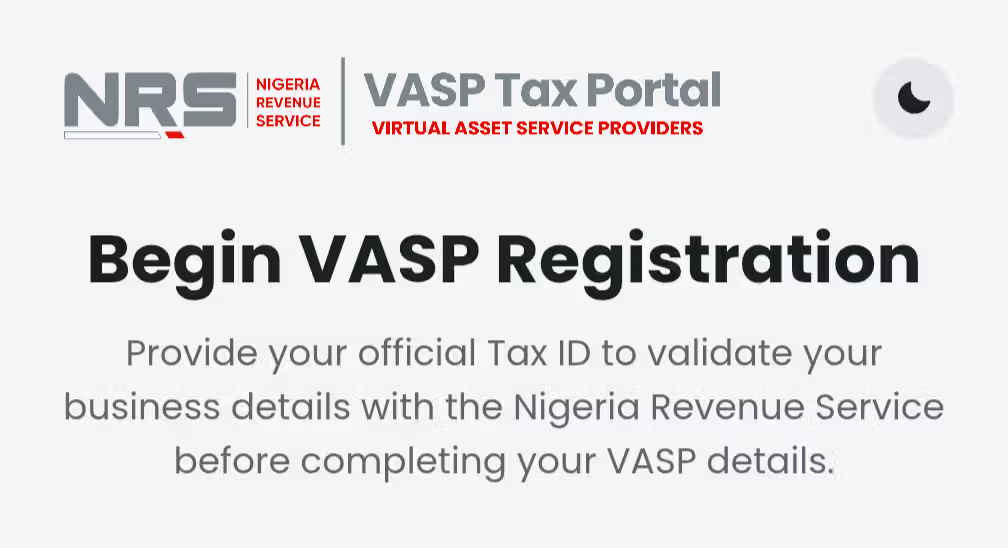
The registration process has two stages. Affected operators must complete and submit the registration form by November 30, 2026, and complete the required integration with the VASP Tax Portal by December 31.
The agencies said registration would require both submission of the form and integration with the platform.
The registration form is available through the NRS portal at vasp.nrs.gov.ng/register.
They warned that operators who fail to meet the stipulated timelines would be subject to penalties and other enforcement measures under relevant laws.
Portal does not introduce new taxes
The NRS and JRB said the portal was deployed under Section 71 of the Nigeria Tax Administration Act (NTAA), 2025, which provides for the use of technology to automate tax administration processes.
They also cited the applicable requirements of Recommendation 15 of the Financial Action Task Force (FATF), which addresses anti-money laundering and counter-terrorist financing risks associated with virtual assets and service providers.
The agencies clarified that the portal does not introduce new taxes or create additional tax obligations. Instead, it provides the technology for administering tax obligations that already apply to virtual asset activities and facilitating the required AML/CFT/CPF registration.
“The VASP Tax Portal does not impose any new tax or create any new tax obligation,” the notice stated.
The agencies added that the phased implementation of the portal would not suspend obligations already imposed under existing laws.
They also stressed that registration on the platform does not automatically grant a business a licence or authorisation to provide virtual asset services in Nigeria. Operators must therefore continue to meet any separate licensing or regulatory requirements applicable to their activities.
The notice follows the provisions of the Nigeria Tax Act and the NTAA, 2025, which establish tax obligations for persons engaged in virtual asset activities, including registration, record-keeping, reporting and payment of applicable taxes.