

By Fattyma Ibrahim
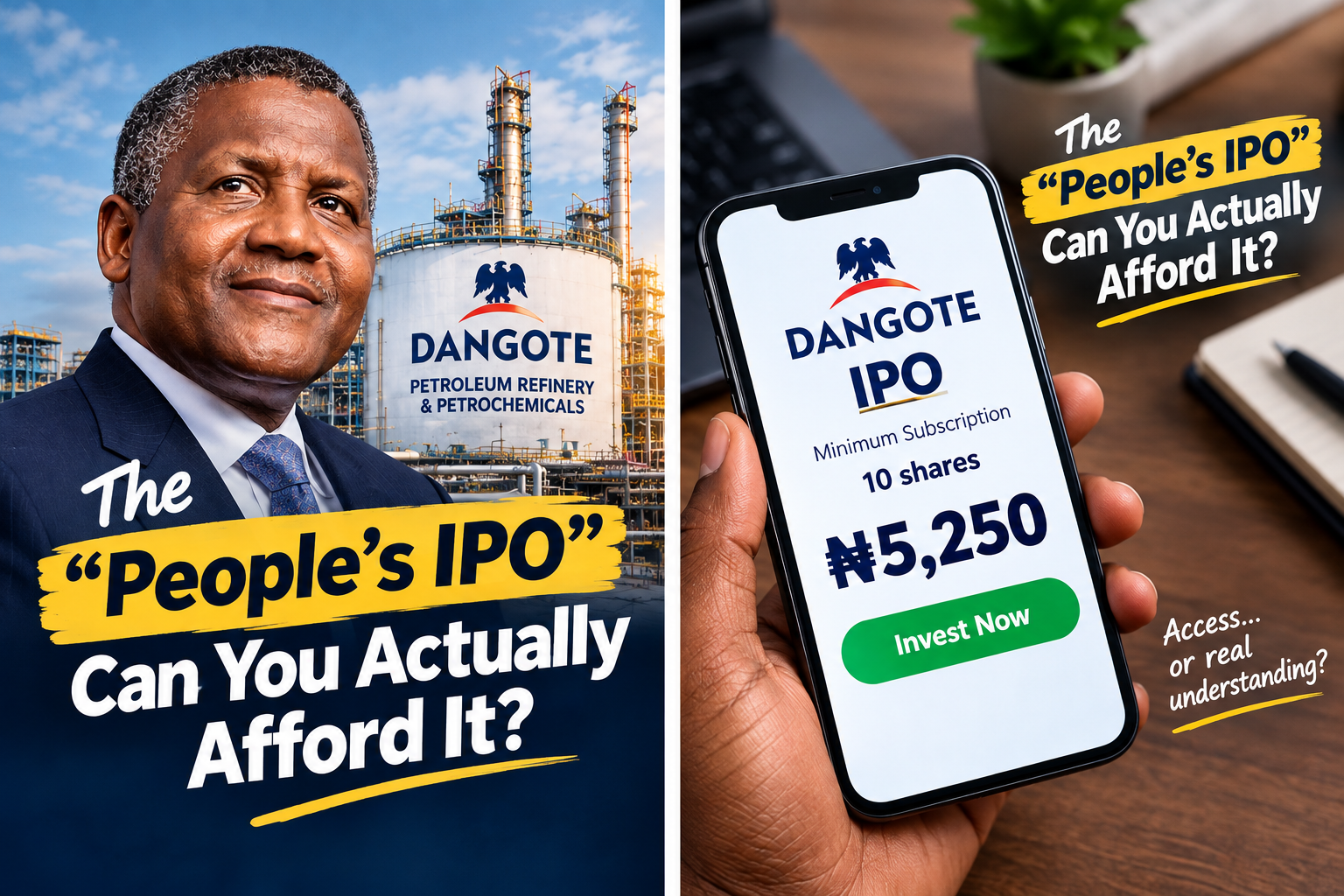
Dangote Petroleum Refinery’s initial public offering has been marketed as a “People’s IPO,” with a minimum subscription of just ₦5,250. This piece argues that a low entry price is not the same as genuine accessibility, and that the more important question for ordinary Nigerians is not whether they can afford ten shares, but whether they understand what they would be buying.
On paper, ₦5,250 does not look like a lot of money.
That is the minimum amount needed to buy 10 shares in Dangote Petroleum Refinery and Petrochemicals as its much-anticipated initial public offering (IPO) opens to investors. Dangote has called it a “People’s IPO,” presenting the offer as an opportunity for ordinary Nigerians and other African investors to own a piece of one of the continent’s biggest industrial projects. The minimum subscription of 10 shares at ₦525 each certainly makes the offer look accessible.
But there is an important question beneath the excitement: is something truly affordable simply because the minimum price is low?
For some Nigerians, ₦5,250 may be spare change. For others, it could be lunch money, transport fare, part of a food budget, or the difference between meeting an immediate need and putting money into an investment that may not produce an immediate return.
That distinction matters.
₦5,250 Is Not the Same Amount to Everyone
It is easy to look at ₦5,250 as a relatively small entry point into the stock market. But Nigerians do not live on spreadsheets.
A household deciding what to do with its last ₦5,250 is making a very different calculation from an investor deciding whether to put ₦525,000 into the same IPO.
Nigeria’s cost-of-living pressures have not disappeared simply because some inflation indicators have moderated. Food and transport costs remain significant pressures on household budgets. In the first quarter of 2026, for example, the average cost of preparing a pot of jollof rice for a family of five was reported at ₦30,435.
So, yes, a Nigerian may be able to find ₦5,250. The more useful question is whether that person can comfortably set it aside as investment capital, there is a difference between having ₦5,250 and having ₦5,250 that you do not need for anything else.
That difference is where the “People’s IPO” argument becomes more complicated.
Making an Investment Available Is Not the Same as Making It Accessible
The Dangote IPO is unquestionably lowering the financial barrier to entering the capital market.
An investor does not need millions of naira to participate. Ten shares are enough to get started, and the offer is being made available through digital investment platforms, potentially making the process easier for people who have never bought shares before. That is a positive thing.
Nigeria needs more people participating in its capital market. Ownership of major companies should not be something reserved exclusively for wealthy investors and institutions. But accessibility has at least two sides.
There is financial access, which asks: Can I afford the minimum investment?
Then there is financial understanding, which asks: Do I actually understand what I am buying? The second question may be the more important one.
Do People Know What They Are Buying?
There is a danger whenever an investment opportunity becomes a national conversation. People can become interested because everyone else is interested.
Dangote is one of the most recognisable business names in Nigeria. His refinery has become a symbol of Nigerian industrial ambition, and the IPO is being presented as a historic opportunity for ordinary Nigerians to participate in its ownership.
But buying shares because it is “Dangote” is not the same as making an informed investment decision.
An investor should understand that buying shares does not mean simply putting money somewhere and waiting for it to increase. There are questions about the company’s valuation, profitability, future performance, dividends, market conditions and the possibility that the value of the shares may fall.
The IPO values the refinery at roughly $48 billion, while the company is seeking about ₦2.15 trillion from the sale of 4.1 billion shares at ₦525 each.
Those are enormous numbers. For a first-time investor, however, the important question is much simpler: Why am I buying this share, and what do I expect from it?
That is where financial literacy becomes critical. The Securities and Exchange Commission itself promotes investor education and financial literacy as part of efforts to encourage informed participation in Nigeria’s capital market.
An IPO that brings millions of new investors into the market is potentially good for the economy. An IPO that brings millions of people into the market without enough understanding of what they are doing is a different story.
Ten Shares Can Make You an Investor. But Does It Make You an Owner in Any Meaningful Sense?
Technically, yes.If you buy the minimum 10 shares, you own shares in the company, but there is a bigger question about what ownership means.
Someone who invests ₦5,250 and someone who invests ₦5 million are both shareholders. Their legal status may be the same, but their financial exposure and potential returns are obviously very different.
That is not a criticism of the IPO. It is simply the reality of investing, and perhaps this is why the phrase “People’s IPO” deserves some scrutiny.
If the idea is that ordinary Nigerians can finally buy into a major Nigerian company, then the IPO does represent something significant.
But if the suggestion is that the IPO will suddenly make ordinary Nigerians substantial participants in the wealth generated by the refinery, that requires a more careful conversation. The minimum investment creates an opportunity for participation. It does not necessarily create financial equality.
There Is Still Something Genuinely Important About This IPO
It would be unfair to dismiss the “People’s IPO” idea altogether.
Nigeria has spent years talking about financial inclusion. Giving people the opportunity to own shares in one of the country’s most important companies could encourage a new generation of retail investors.
It could also introduce people to the stock market who previously thought investing was something only bankers, wealthy Nigerians or people with inside knowledge could do.
That matters, perhaps someone who starts with 10 Dangote shares will eventually learn about other companies, mutual funds, bonds and other investment products. Perhaps the ₦5,250 investor of today becomes a more financially confident investor tomorrow.
That would be a meaningful outcome. But that will not happen simply because the entry price is ₦5,250. It will happen if people understand what they are buying.
So, Is It Really a “People’s IPO”?
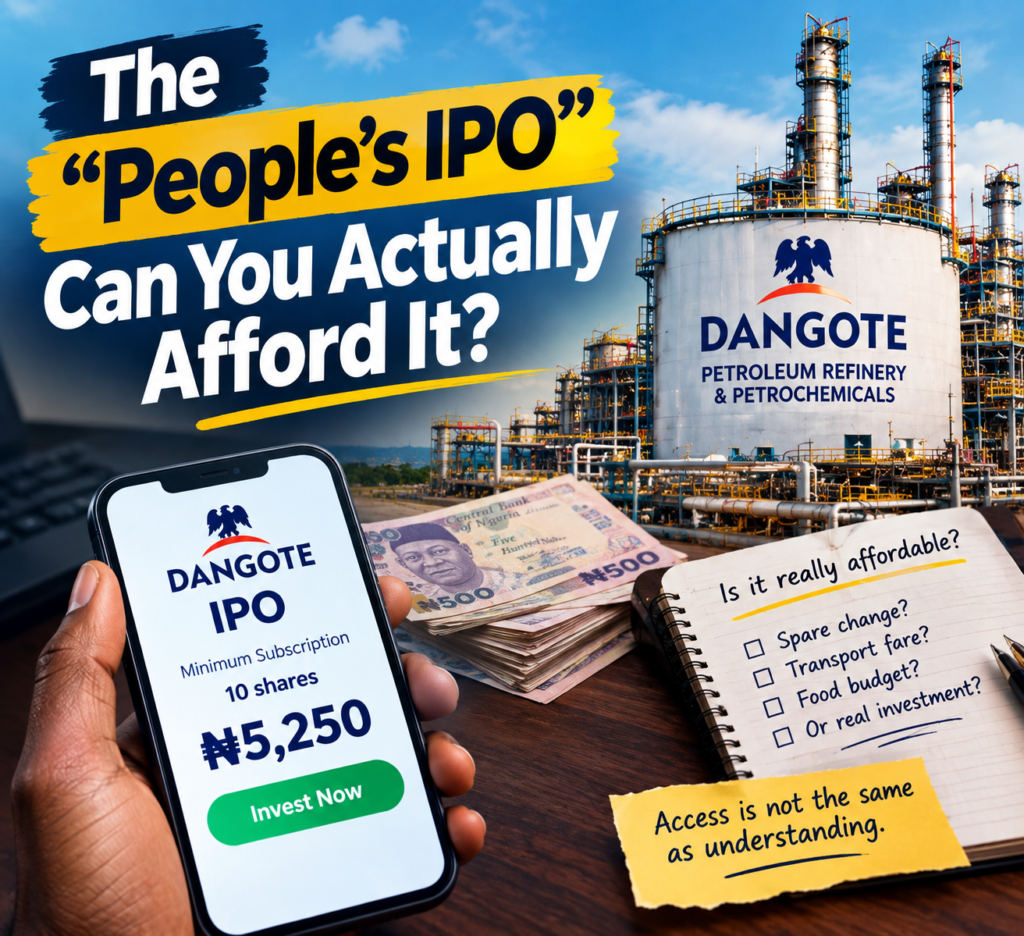
Perhaps the better answer is: it is a People’s IPO in terms of access, but the real test is whether Nigerians can turn that access into informed ownership.
A low minimum investment is a good starting point. It tells the person with ₦5,250 that the stock market is not necessarily closed to them. But it should not tell them that they have to invest.
There is a difference between “I can afford to buy this” and “I understand why I should buy this.” The first is affordability. The second is financial literacy. And for an IPO being marketed as an opportunity for ordinary people, the second may ultimately matter more than the first.
Dangote’s refinery IPO could broaden participation in Nigeria’s capital market. It could bring new retail investors into the system and give ordinary Nigerians a chance to own a small piece of a company that has become central to the country’s economic story.
But if the “People’s IPO” is going to mean more than a catchy label, the people buying those shares need more than access. They need information. They need financial literacy. And, most importantly, they need the freedom to decide whether ₦5,250 is better invested in Dangote shares, or whether, for them, it is still needed somewhere else.