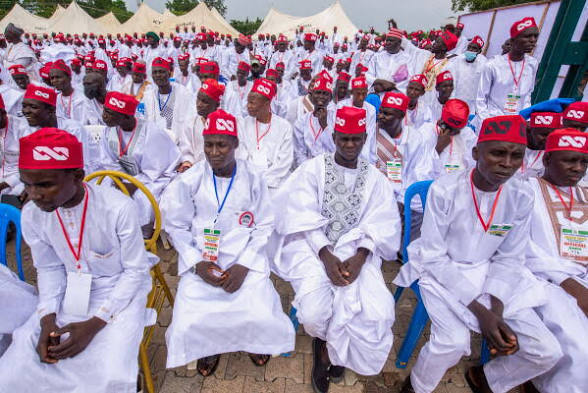


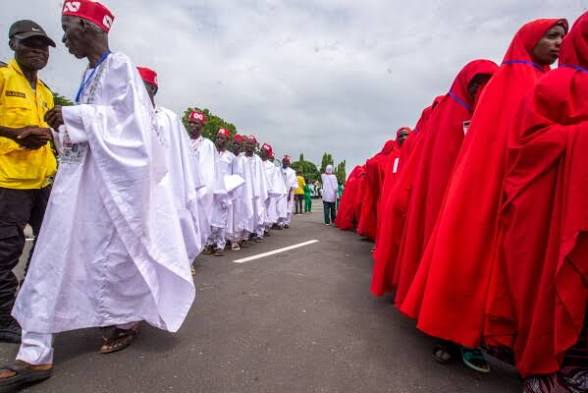
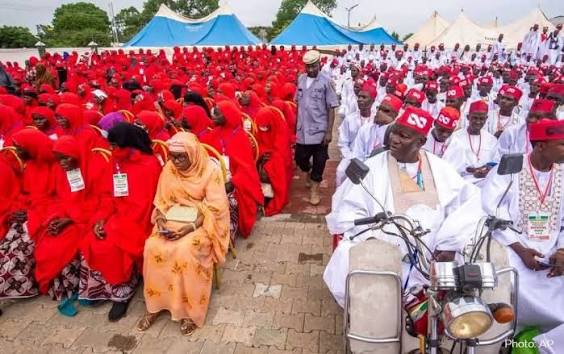
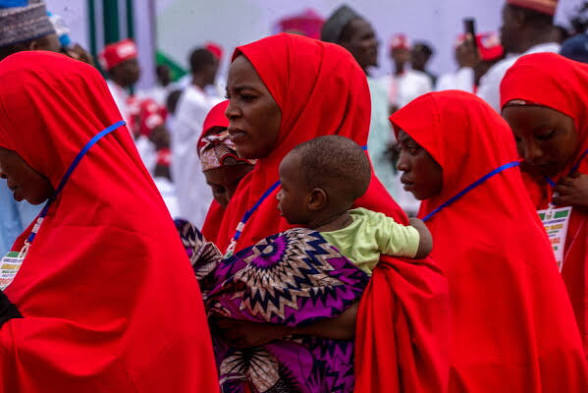
Last week, the Kano State Government held one of the biggest events on its 2026 calendar: a mass wedding for 1,500 couples, organised under the state’s “Auren Gata” programme. The state paid the dowries, handed out ₦200,000 and furniture to each bride, and put the total bill at more than ₦1.5 billion. The governor, Abba Kabir Yusuf, promised to hold these mass weddings during his campaign trail in 2023, and has now fulfilled his promise. Ceremonies were held simultaneously at the Central Mosque in Kano metropolis and across the state’s 44 local government areas, with ordinary suitors first passing through HIV, Hepatitis and genotype screening organised by the Hisbah Board.
As atavistic as the idea of marrying off vulnerable masses may come across, state-sponsored mass weddings of this order and grime have become a matter of administrative course in certain areas of Nigeria.
Kano’s programme did not appear from nowhere. The state has run versions of it for years. In 2012, it hosted a mass wedding for 250 divorcees, widows and unmarried women specifically to shed its reputation as Nigeria’s “divorce capital.” An investigation by FIJ found that Kano alone spent over ₦1.6 billion on mass weddings across a four-year stretch. This year, an open letter circulating among commentators noted that Kano approved funding for 3,000 couples, Katsina sponsored 1,000, and Zamfara backed 100 more, meaning the practice is not one governor’s pet project but a regional habit, repeated year after year, state after state.
It has also, at times, gone badly wrong. In 2024, a planned mass wedding for about 100 orphans in Niger State where some feared to be underage girls whose parents had been killed by bandits, drew national outrage and a court order from Nigeria’s Women’s Affairs Minister to stop it. The organisers said local clerics had asked the State Assembly Speaker to fund it. That episode showed how easily “welfare” can slide into something far more troubling when children with no say in the matter are the ones being married off.
Northern Nigeria is not short of problems that money could actually fix. Kano, Jigawa and Katsina together account for close to a third of Nigeria’s 18.3 million out-of-school children, according to UNICEF’s Kano field office. FIJ’s review of Kano’s own 2026 budget found that the state allocated just ₦135 million to a programme for out-of-school and married adolescent girls, and roughly ₦46 million to build 20 mobile learning centres, and that by the end of the first quarter, none of that money had even been disbursed. Add the two line items together and they still come to barely a tenth of what the state spent celebrating 1,500 weddings in a single week.
Divorce, meanwhile, is not a fringe problem in the region. It is one of the reasons these programmes exist in the first place. Kano’s 2012 mass wedding was explicitly designed to fight the state’s image as home to Nigeria’s highest divorce rate, with unofficial estimates suggesting that as many as one in three marriages in the north fails within three years. Marrying thousands of couples in a hurry, with little vetting beyond medical screening, does nothing to change the economic desperation, illiteracy and lack of family support that drive those breakups in the first place. Commentators have put this plainly: mass weddings pair “illiteracy with illiteracy,” pushing young, often unemployed and unskilled people into marriage and parenthood without giving them any of the tools to sustain either.
When those marriages collapse, the children are the ones left exposed, and the almajiri boys begging at traffic lights and the girls hawking sachet water with babies strapped to their backs are, as one open letter to northern leaders put it, not some abstract underclass. They are the children of the weddings the region cheered a decade earlier.
It’s worth starting from a fair premise: welfare is genuinely a government’s job. Nigeria’s constitution says as much. Section 14(2) of the Fundamental Objectives and Directive Principles makes the security and welfare of citizens the primary purpose of government, alongside protecting lives and property. So the instinct behind mass wedding schemes, that the state owes its people tangible improvements in their living standards, isn’t wrong. The problem is what these schemes are being asked to substitute for.
In a region defined by deep poverty, weak education outcomes and thin economic opportunity, the real question is whether mass weddings deserve any priority at all in the welfare conversation. A 2022 Multidimensional Poverty Index study found that roughly two-thirds of Nigeria’s poor live in the north, with a state like Sokoto reaching a poverty rate as high as 91%. Against that backdrop, a wedding ceremony is not a poverty-reduction tool. Education is, and the historical record backs this up. Post-war South Korea, one of the poorest countries on earth in the 1950s, rebuilt itself through an aggressive push into mass education, which produced the skilled workforce behind its later industrial rise.
India’s Kerala tells a similar story: despite starting the late 1970s well behind the national income average, it transformed itself through decades of investment in mass literacy, healthcare, land reform, and notably, policies that pushed back the age at which girls married, rather than accelerating it.
Other regions that have escaped poverty traps generally lean on the same toolkit: universal education, health system reform, women’s empowerment, rural investment and housing policy. Northern Nigeria, by contrast, remains stuck. Kano, Katsina and Jigawa alone account for 16% of Nigeria’s 10.2 million out-of-school children as of 2025 (UNICEF), and child and maternal mortality rates in the north far outstrip the rest of the country.
Given all this, mass wedding schemes don’t just fail to help. They arguably make things worse, driving up birth rates in a region already struggling with maternal and child mortality. Put plainly, these programmes reflect a mismatch between the policy and the problem: at best a well-intentioned dodge that lets leaders avoid the harder work of real development, and at worst a practice that risks normalizing early marriage in a region where child marriage is already common.
If the north wants genuine welfare gains, its political and traditional leadership needs to commit to evidence-based fixes: mass literacy drives, health system reform, serious action on insecurity, and durable economic policy, rather than ceremonial gestures. Much of the region’s economic infrastructure has already crumbled from years of neglect and worsening insecurity, and that’s where investment is actually needed. Without that change in priorities, the north will keep cycling through the same underdevelopment.