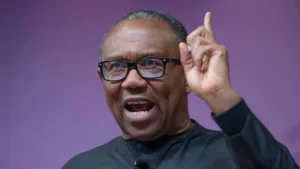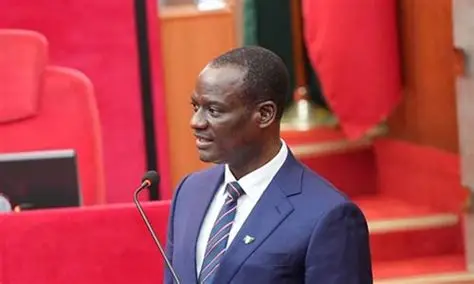
Finance Minister Taiwo Oyedele says subnational governments get 85% of Nigeria’s resources, as the Senate moves to raise the federal share.
Finance Minister and Coordinating Minister of the Economy Taiwo Oyedele says state and local governments receive about 85 per cent of Nigeria’s resources, leaving the federal government with 15 per cent despite its extensive responsibilities.
Oyedele spoke on Wednesday at Chatham House in London, during a discussion on Nigeria’s economic outlook, progress on reforms and prospects for inclusive growth.
He said the federal government is the most deprived tier of government relative to its responsibilities. These include defence, internal security, foreign affairs and the conduct of elections. He added that it also gets involved in basic education and primary healthcare, and needs more resources to perform these roles effectively.
“Based on data, the center is the most deprived of resources yet it has the most responsibilities. Of all Nigerian resources, roughly 85 percent are assigned to subnational. Only 15 percent to the federal government,” Oyedele said.
What Oyedele said about Nigeria’s revenue allocation

“In Nigeria, the federal government collects no income tax from individuals,” he said. Under the 2025 tax laws, state internal revenue services collect taxes on individuals.
Oyedele cited the distribution of value-added tax (VAT), saying 90 per cent goes to subnational governments and the federal government receives 10 per cent. The 90 per cent covers states and local governments together. Under the revised formula in the 2025 tax laws, which took effect in January 2026, states receive 55 per cent, local governments 35 per cent and the federal government 10 per cent.
He said states also retain revenue from stamp duties, while the federal government relies only on its share of the federation account.
“When they talk about the formula of 52 point something percent of federal government, what they are not telling you is that 52 point whatever percentage is a percentage of a smaller portion of the federation account,” he added.
The reported remarks did not say which data underlie the 85 per cent figure, and it has not been independently verified.
FG plans to transfer some responsibilities to states
Oyedele said the federal government plans to transfer some responsibilities to states, which he said are better positioned to perform them. The aim is also to improve the centre’s ability to generate revenue without imposing an additional burden on Nigerians.
“That way you have extra resources to influence decisions at the subnational level. It’s called federal transfers,” he said.
Under the arrangement he described, the federal government could fund states to improve basic education, support agriculture and build access roads linking farms to markets. He said such transfers could encourage states to prioritise projects with direct economic and social benefits, rather than spending heavily on other infrastructure.
Where the revenue allocation debate stands
The current formula gives the federal government 52.68 per cent of revenue in the federation account, states 26.72 per cent and local governments 20.60 per cent.
On 3 February, the Senate began the process of amending the 1999 Constitution to allow an upward review of that formula in the federal government’s favour. It said the federal share no longer meets the government’s expanding responsibilities, including federal roads and internal security.
Others favour moving resources the other way. The Revenue Mobilisation Allocation and Fiscal Commission (RMAFC) began a fresh review of the formula in 2025. An earlier proposal from the commission would have cut the federal share to 45.17 per cent, raising states to 29.79 per cent and local governments to 21.04 per cent. Governors have also contested revenue rules before, including the VAT sharing arrangement in the 2025 tax laws.
Any constitutional change needs approval from two-thirds of both chambers of the National Assembly and at least 24 state Houses of Assembly.