


Abuja | 23 July, 2026
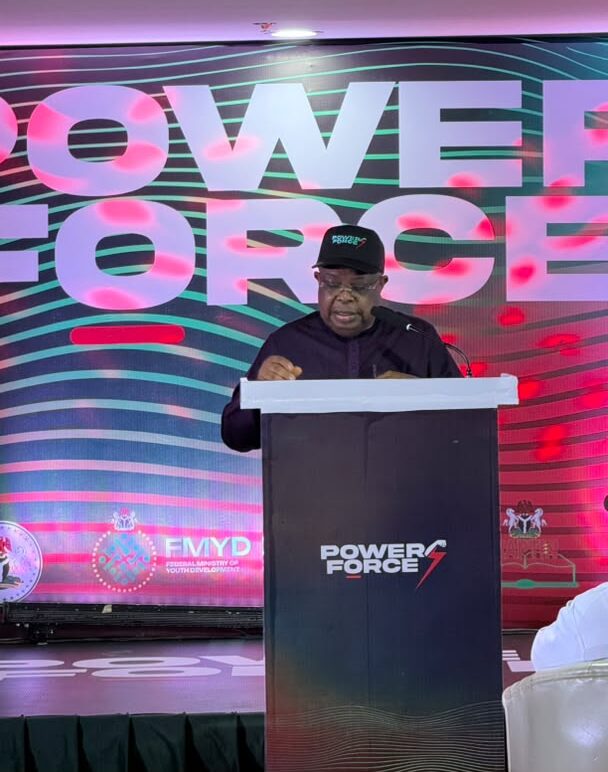
The Federal Government on Thursday, July 23, 2026, officially launched the Power Force Programme in Abuja to train and certify 5,000 young Nigerians as smart meter installers, describing the initiative as a critical step towards closing the country’s metering gap, strengthening the electricity sector and creating employment opportunities for youths.
Below is the full text of the speech delivered by the Minister of Power, Hon. Joseph Olasukanmi Tegbe at the official flag-off of the Power Force Programme in Abuja:
Protocol.
1. His Excellency, the Executive Governor of Kwara State and Chairman, Nigeria Governors Forum, Alhaji AbdulRahman AbdulRazaq;
2. The Honourable Minister of Youth Development, HON. Ayodele Olawande;
3. SA to the President on Energy and Executive Secretary Presidential Metering Initiative, Olu Verheijen;
4. Special Adviser to the President on Power, Mr. Rilwan Lanre Babalola
5. Director General, National Power Training Institute of Nigeria (NAPTIN), Ahmed Bolaji Nagode;
6. Director General, Nigerian Electricity Management Services Agency (NEMSA), Engr. Adesayo Olusegun Michael;
7. Distinguished ladies and gentlemen.
Good morning.
It is both a pleasure and a privilege to join you this morning for the Official Flagoff of Power Force Programme; a landmark initiative that embodies our collective determination to transform Nigeria’s electricity sector by investing both in infrastructure and people.
2. Permit me, at the outset, to commend the Nigeria Governors’ Forum, the Presidential Metering Initiative (PMI), the Federal Ministry of Youth Development, NAPTIN, NEMSA, our Distribution Companies, Development Partners and every stakeholder whose collaboration has made this programme a reality. Today’s event is a compelling evidence that when institutions work together with a common purpose, meaningful national progress becomes possible.
3. I am particularly delighted to welcome the first cohort of trainees. You are not ordinary participants in a training programme; you are pioneers of a new generation of highly skilled professionals who will play a defining role in modernising Nigeria’s electricity industry.
4. Distinguished ladies and gentlemen, one of the greatest structural challenges confronting the Nigerian Electricity Supply Industry is the persistent liquidity deficit. Every segment of the value chain depends upon timely and adequate revenue collection. Yet, for many years, inadequate metering has denied the sector the financial certainty required to sustain investment, improve service delivery and expand electricity access.
5. Where electricity consumed cannot be accurately measured, revenue cannot be accurately collected. Where revenue is uncertain, investments decline, infrastructure deteriorates, and ultimately, consumers suffer. The metering gap, therefore, is not just a technical problem; it is one of the principal causes of the liquidity challenges that have constrained the growth of our power sector.
6. The administration of His Excellency, President Bola Ahmed Tinubu, GCFR, fully appreciates this reality. Since assuming office, Mr President has pursued bold and audacious reforms designed to restore financial sustainability across the electricity market while ensuring that fairness, transparency and accountability remain at the heart of the system.
7. His guiding principle is both simple and just: every Nigerian deserves to pay only for the actual electricity consumed, and every service provider deserves to be paid for the electricity genuinely supplied. That principle is what smart metering makes possible.
8. Metering has a multiplier effect across the value chain. Metering removes disputes. It replaces estimation with accuracy, uncertainty with confidence, and suspicion with trust. It empowers consumers to manage their electricity usage whilst providing DisCos with reliable revenue streams to improve service delivery. In doing so, it strengthens the entire Nigerian Electricity Supply Industry.
9. This is why the Federal Government has continued to prioritise interventions aimed at restoring liquidity and consumer confidence across the market. Through ongoing reforms, improved market discipline, settlement initiatives and targeted financial interventions, we are addressing legacy challenges whilst laying the foundations for a commercially viable electricity industry capable of attracting sustained private investment.
10. Ladies and gentlemen, one particularly encouraging development deserves special recognition. The recent withdrawal of the court action instituted by the Association of Meter Asset Providers of Nigeria (AMMON) marks an important milestone for our industry. That singular decision has removed a significant obstacle to the accelerated deployment of electricity meters across the country.
11. I wish to sincerely commend AMMON for embracing dialogue in the national interest. I equally appreciate the Presidential Metering Initiative, the Nigerian Electricity Regulatory Commission, Bureau of Public Enterprises (BPE), Meter Asset Providers and every stakeholder whose constructive engagement made this breakthrough possible.
12. Today, I wish to assure every electricity consumer across our nation that this Administration remains unwavering in its commitment to closing Nigeria’s metering gap.
13. The dearth of skilled workforce has long been identified as a showstopper to Government’s drive to closing the metering gap. This is precisely why the Power Force Programme is a significant step. We are deliberately building the skilled workforce required to install these meters efficiently, professionally and at scale.
14. Meters do not install themselves. Behind every successful metering programme must stand thousands of competent, certified and dedicated technicians.
15. The 5,000 young Nigerians being trained under this initiative will become the backbone of Nigeria’s smart metering workforce. They will help ensure that millions of households and businesses receive professionally installed meters that meet the highest technical and safety standards.
16. Beyond strengthening the power sector, this programme creates meaningful employment, equips our young people with future-ready technical skills, supports local content development and stimulates economic growth. It demonstrates that our electricity reforms are not merely about equipment and technology; they are equally about creating opportunities, building human capital and securing livelihoods.
17. The transformation of Nigeria’s electricity sector will not occur overnight. It requires consistency, partnership, technical excellence and an unwavering commitment to reform.
18. I am encouraged because I see all these ingredients gathered in this room today.
19.To our trainees, I urge you to approach this opportunity with discipline, professionalism and pride. The skills you acquire here will not only shape your careers; they will contribute directly to Nigeria’s economic transformation.
20. To our partners, I thank you for your confidence, collaboration and shared commitment to national development.
21. And to the Nigerian people, let me assure you that better days lie ahead. We are steadily building an electricity sector that is more transparent, more accountable, more sustainable and more responsive to the needs of every citizen.
Thank you, and God bless the Federal Republic of Nigeria