

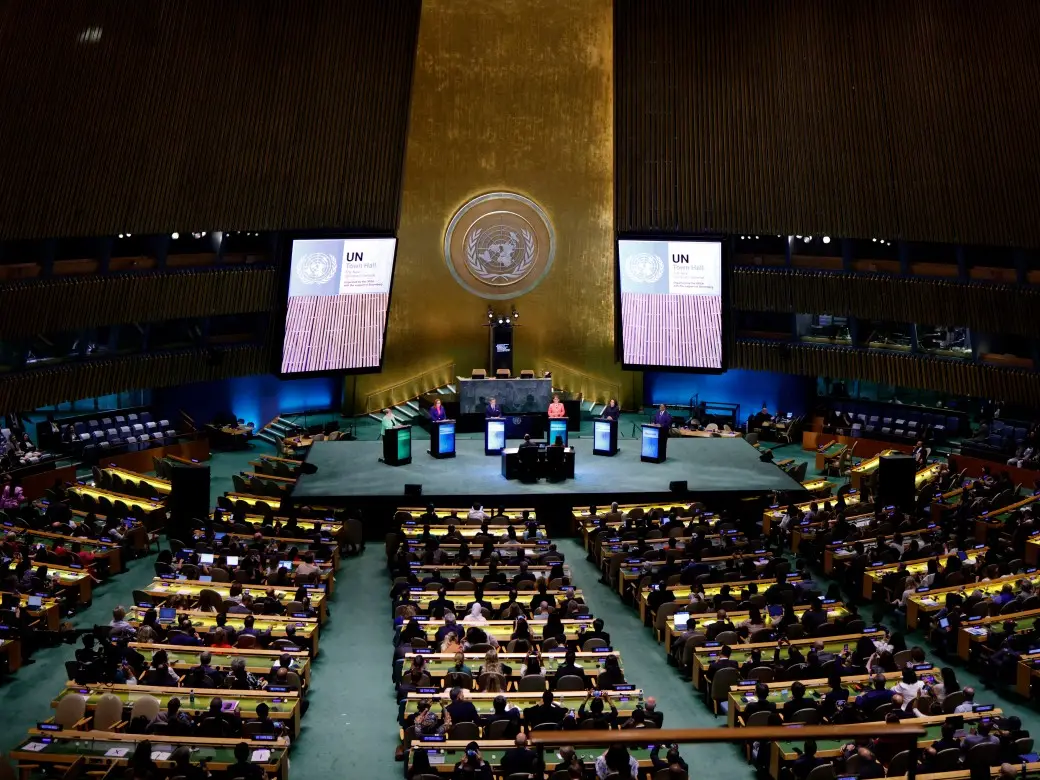
Every September, world leaders, diplomats and government officials gather in New York for one of the biggest events on the international diplomatic calendar: the United Nations General Assembly (UNGA).
The 81st session of the UN General Assembly, known as UNGA81, opened on September 8, 2026, with the high-level week and annual General Debate taking place from September 22 to 28. Nearly 130 heads of state and government are expected to attend in person.
But what exactly happens at the UN General Assembly, and why does it matter?
What is the UN General Assembly?
The UN General Assembly is the United Nations’ main deliberative and policymaking body. It brings together all 193 UN Member States, with each country having one vote.
Unlike the UN Security Council, where five permanent members have veto power, the General Assembly gives every member state an equal vote. It discusses issues ranging from international peace and security to climate change, development, human rights and the UN budget.
The Assembly’s regular session begins in September and continues through December, with further meetings held when necessary.
What will happen during UNGA81?
The part of the General Assembly that attracts the most global attention is the General Debate.
During this period, presidents, prime ministers and other senior representatives take turns addressing the Assembly. They use their speeches to outline their countries’ priorities and positions on major international issues.
For UNGA81, the General Debate is taking place from September 22 to 26 and September 28 at UN Headquarters in New York. The theme of the 81st session is “Restoring trust, managing transformation: A United Nations that delivers for all.”
However, the General Debate is only one part of UNGA.
What issues are discussed at UNGA?
The General Assembly considers a wide range of global issues. Countries negotiate and debate topics including peace and security, economic development, humanitarian affairs, human rights, international law and environmental challenges.
UNGA81 also includes several high-level meetings focused on specific issues. These include climate action and a just transition, sea-level rise, pandemic prevention and preparedness, the right to development, racial discrimination and nuclear disarmament.
These meetings give governments an opportunity to make commitments, negotiate political declarations and coordinate international responses to shared problems.
Does the UN General Assembly make laws?
Not exactly. The General Assembly can adopt resolutions and decisions, but most General Assembly resolutions are not legally binding on member states in the same way that certain decisions of the UN Security Council can be.
However, its resolutions can carry significant political and diplomatic weight. The Assembly also plays an important role in developing international norms and standards.
The General Assembly can also make important institutional decisions, including approving the UN budget, electing non-permanent members of the Security Council and appointing the Secretary-General following a recommendation from the Security Council.
How does voting work at UNGA?
Every UN member state has one vote.
For most questions, a simple majority is enough. However, important issues such as budgetary questions, admission of new members and certain peace and security recommendations require a two-thirds majority of members present and voting.
Much of the detailed work also happens outside the main General Assembly Hall. The Assembly has six Main Committees covering areas including disarmament, economic affairs, social and humanitarian issues, political affairs, administration and budgeting, and international law.
Why is UNGA important?
UNGA is one of the few places where almost every country in the world can speak in the same forum.
For governments, it is an opportunity to present national priorities, negotiate with other countries and participate in discussions on issues that cross national borders. For journalists and the public, it provides a window into how governments are responding to major global challenges.
UNGA81 is therefore more than a series of speeches. Behind the high-profile addresses are negotiations, meetings, resolutions and diplomatic discussions that form part of the United Nations’ continuing work throughout the year.
Vice President Kashim Shettima will lead Nigeria’s delegation to the 81st session of the General Assembly of the United Nations (UNGA) in New York, marking the third consecutive year he has represented the country at the annual gathering.
In a statement issued on Sunday, Stanley Nkwocha, Senior Special Assistant to the President on Media and Communications in the Office of the Vice President, said President Bola Tinubu had mandated Shettima to represent him at the event.