

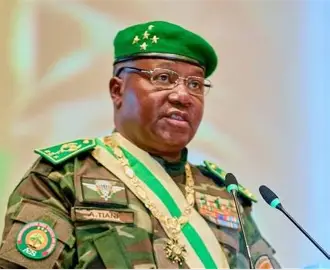
Nigeria has urged restraint after Niger’s military government said it foiled a coup attempt by mutinous soldiers, following hours of gunfire and explosions in Niamey that left the junta leader’s whereabouts briefly unclear.
Nigeria has warned against the use of force to settle political disputes in the Republic of Niger, after Niger’s ruling military junta said soldiers within its own armed forces attempted a coup against it on Saturday, August 29, 2026.
Sustained gunfire and explosions were heard in several parts of Niamey, Niger’s capital, from the early hours of Saturday, as attackers targeted Diori Hamani International Airport, which houses Base 101, a major military installation, located about 10km from the presidential palace.
Assailants also reportedly attempted to breach the security perimeter around the presidency. It was the third attack on the airport complex in 2026, following earlier assaults claimed by an Islamic State affiliate in January and by al-Qaeda-linked group JNIM in June though this latest incident was distinct in being attributed to mutinous soldiers rather than jihadist militants.
What Happened
Niger’s defence ministry said dissident soldiers took officers hostage at the base and opened fire on “sensitive sites” in the capital. State television, after being knocked off air for several hours, later broadcast a message describing an attempted coup by young soldiers and stating that it had been defeated.
According to security sources and analysts, the uprising involved hundreds of disaffected soldiers, including troops drawn from frontline localities such as Ouallam, Tera and Dosso, where Nigerien forces have suffered heavy casualties in the fight against jihadist groups a detail that has fuelled speculation that frustration over battlefield losses may have been a driving factor behind the mutiny.
The whereabouts of junta leader General Abdourahamane Tiani were unclear for a period on Saturday, with no statement or public appearance from him reported until later.
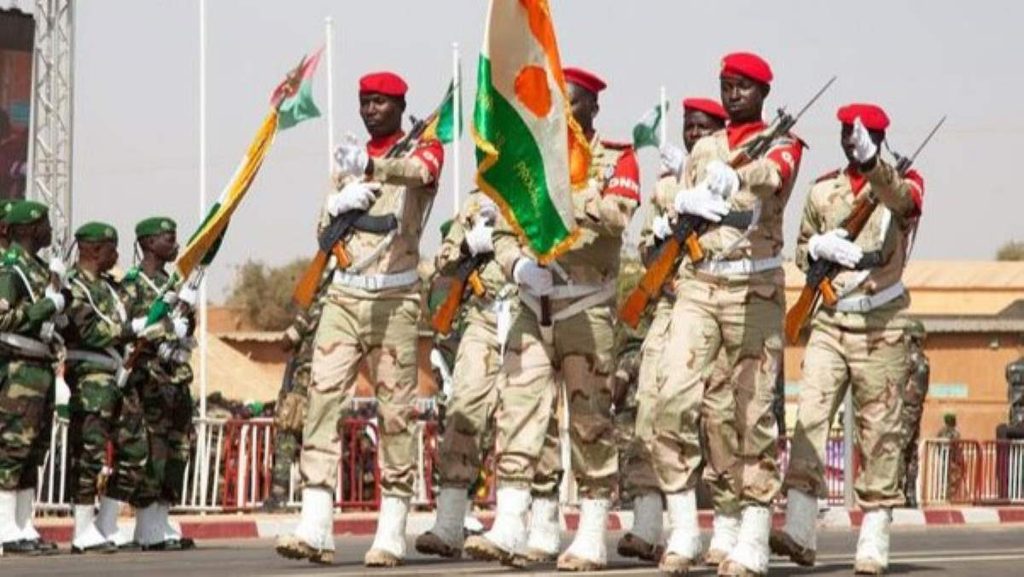
By Sunday, August 30, Niger’s army said it had regained control of the airbase, with Russia confirming its African Corps forces assisted the government and Algeria dispatching fighter jets and a refuelling tanker in support of Tiani’s administration. Reports citing state television said dozens of soldiers were killed or arrested in the operation, though no official casualty toll had been issued as of the latest reporting, and multiple civilians were also reported injured.
Nigeria’s Response
In a statement on Sunday, Oluwafemi Adeniyi, spokesperson for Nigeria’s foreign ministry, said the country was concerned about the political and security situation in Niger and hoped for peace, security, democracy and development in the neighbouring country.
“The Government of Nigeria views with deep concern the current political and security situation in the Republic of Niger,” the statement read. “It notes that, as a neighbour with which it shares close historical, fraternal and cultural bonds, the Federal Government of Nigeria is keenly desirous to see that peace, security, democracy and development reign supreme in the country.”
The statement added: “It notes that a peaceful, secure and stable situation in Niger will impact positively and directly on Nigeria, the sub-region and the Sahel. Any resort to the use of force to settle political differences detracts from this objective.”
Nigeria urged Niger’s authorities to work toward an “inclusive and participatory” return to stability and constitutional order in the interest of regional peace.
Niger has experienced six coups d’état since gaining independence from France in 1960. Tiani himself seized power in a July 2023 coup that ousted democratically elected President Mohamed Bazoum. Since then, his government has distanced Niger from France and other Western partners while deepening military ties with Russia, and has, alongside Mali and Burkina Faso, withdrawn from the Economic Community of West African States (ECOWAS) to form the Alliance of Sahel States (AES), arguing that a regional bloc under military leadership would respond more effectively to jihadist insurgencies in the region.
Saturday’s mutiny underscores that Niger’s ruling military coalition faces not only ongoing jihadist insurgency across the Sahel, but also signs of discontent within its own ranks, a dynamic likely to renew scrutiny of Tiani’s central promise on seizing power: restoring security to the country.