

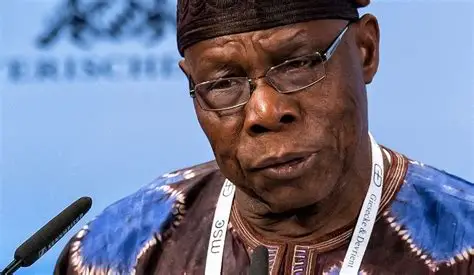
Former President Olusegun Obasanjo says South Africa would not have ended apartheid when it did without Nigeria’s support for the anti-apartheid struggle.
Former President Olusegun Obasanjo says apartheid would not have ended in South Africa without Nigeria’s support for the struggle against white minority rule.
South Africa held its first democratic, non-racial elections in 1994, marking the end of apartheid rule.
Speaking during an interview on C-Suite Café, hosted by Ikem Okuhu, the former president, who served as Nigeria’s military head of state between 1976 and 1979 and later as civilian president from 1999 to 2007, said Nigeria’s involvement in the anti-apartheid struggle was driven by the belief that no black person should be treated as inferior because of their skin colour.
“We were not doing what we did in South Africa or in Southern Africa or decolonisation anywhere for our personal gain or for our country. We did it for our race. I believe that no black man anywhere or black person anywhere should be regarded as an inferior human being because of his colour,” Obasanjo said.
“Enlightened Self-Interest”
Obasanjo described Nigeria’s role in the abolition of apartheid as “enlightened self-interest,” adding that the West African country did not support the struggle with the expectation of receiving anything in return.
“And for me, and I believe for Nigeria at that time and even now, we should be proud of what we did because without Nigeria, South Africa would not have got rid of apartheid when it got rid of it. That is true,” Obasanjo said.
The former president said Nigeria worked with several African and international leaders in the campaign against apartheid, including Julius Nyerere of Tanzania, Kenneth Kaunda of Zambia, Samora Machel of Mozambique, former US President Jimmy Carter, former British Prime Minister James Callaghan, and Swedish Prime Minister Olof Palme.
Criticism of Xenophobic Attacks
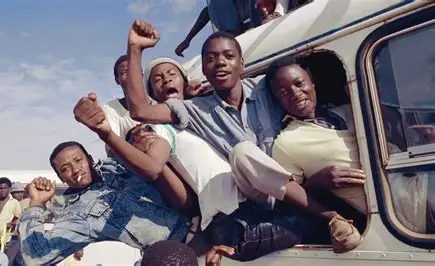
Obasanjo criticised xenophobic attacks against African migrants in South Africa, saying the country’s leaders had not done enough to address the problem. He acknowledged that some migrants may be in the country illegally or may have committed crimes, but said such violations could not justify mob attacks on their homes and businesses.
“I do not believe that you use illegality to treat illegality, asking and encouraging area boys and area girls to break into their houses and break into their shops,” he said.
Obasanjo rejected arguments that migrants were taking jobs from South Africans, noting that some migrants contribute to the economy by creating jobs.
A Diplomatic Rift Deepens
Obasanjo’s comments come at a tense point in Nigeria-South Africa relations. Last week, the National Assembly suspended all official visits to South Africa and resolved to boycott legislative activities hosted or organised by the country, until further notice, citing continued reports of Nigerians being killed, injured, displaced, and forced to abandon businesses and property amid the ongoing violence.
The decision followed months of renewed hostility toward African migrants in South Africa. Nigeria began evacuating citizens from the country in June, with the first batch of 258 returnees arriving in Lagos on June 11; by July 9, the number evacuated had risen to about 1,000, with further batches of returnees arriving in August. President Bola Tinubu has since raised the issue at the African Union, calling for collective continental action and urging that xenophobic and Afrophobic attacks in South Africa be placed on the agenda of the AU’s 40th Ordinary Session, scheduled for January 2027.
About 100 Nigerians have been reportedly killed in mob and hate-related attacks in South Africa since 2022.