
Nigeria’s fake food scare has exposed a deeper crisis of trust, as Nigerians demand evidence from NAFDAC and stronger food safety enforcement.
A few months ago, I bought a bottle of soy sauce that turned out to be fake. I didn’t find out until I was halfway through the bottle, by then, it had already gone into more meals than I’d like to admit.
That small, unremarkable experience is probably more common than any of us realise, which is likely why the current wave of panic has spread so fast and struck such a nerve.
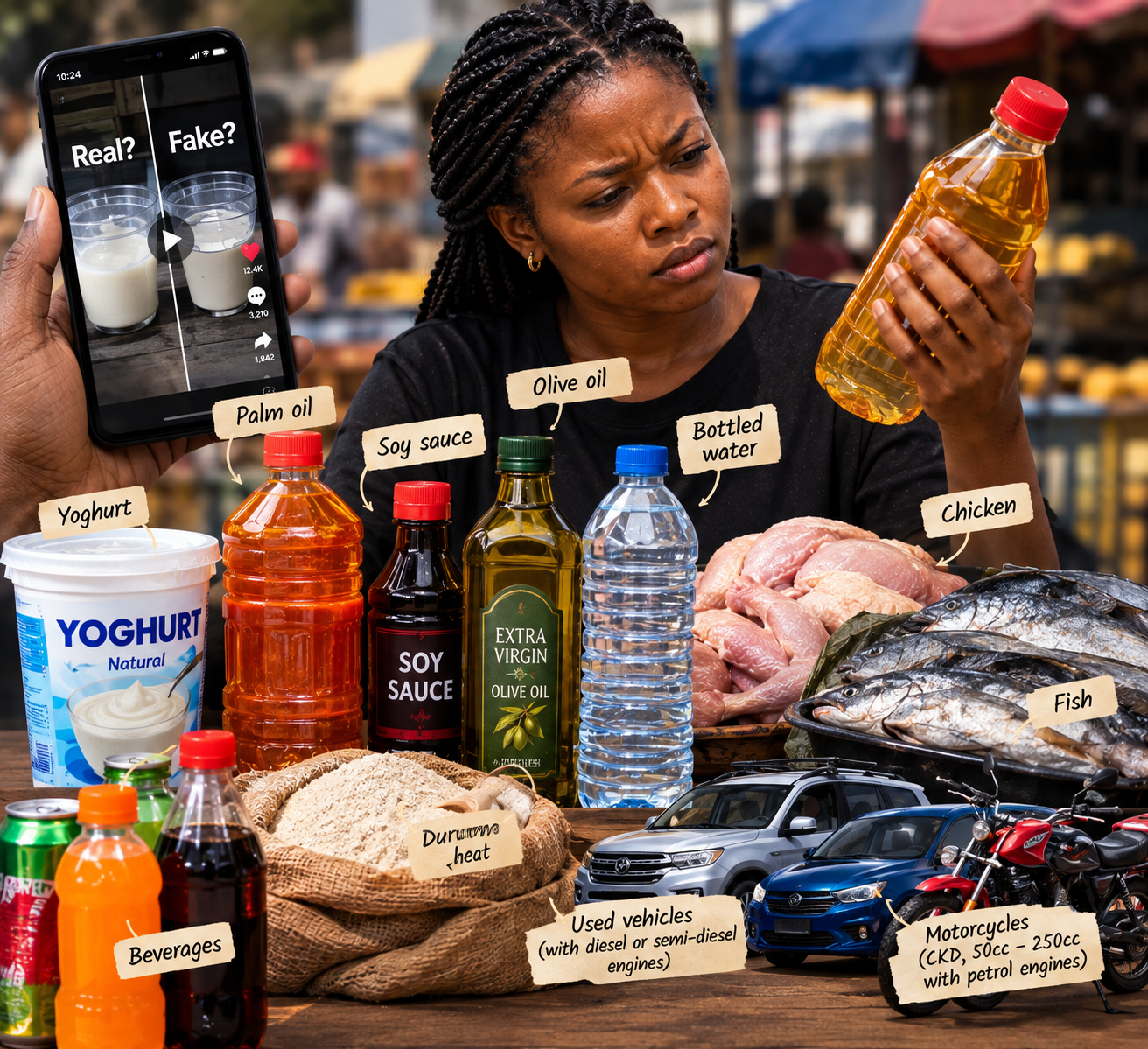
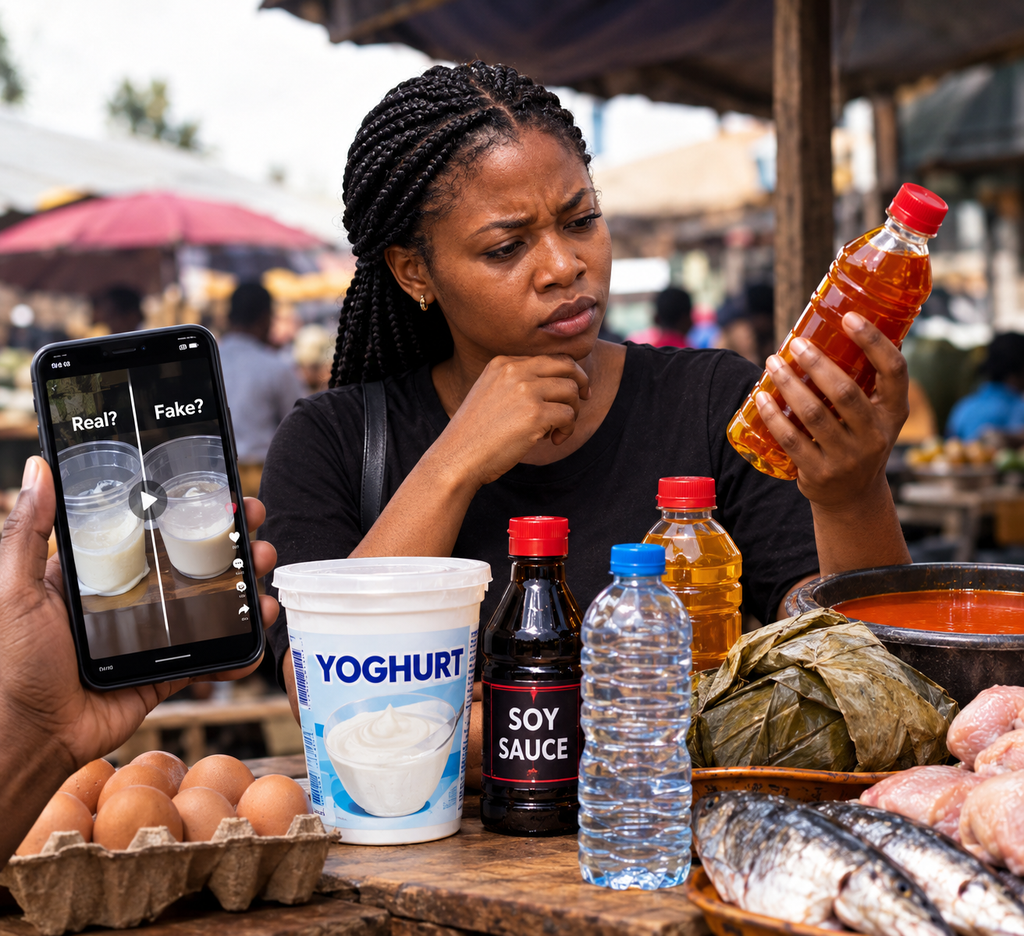
For a few weeks now, Nigerians have been pouring yoghurt into clear cups, holding palm oil up to the light, and swapping videos comparing “real” and “fake” versions of everyday groceries.
The panic, triggered by a newspaper report questioning the safety of widely consumed items, yoghurt, palm oil, soy sauce, olive oil, chicken, fish, bottled water and beverages, has become one of the biggest consumer-trust stories of the year. It deserves to be treated as exactly that: a trust crisis, not a communications problem to be managed away.
NAFDAC’s Response
NAFDAC’s response so far has leaned heavily on the latter. Director-General Mojisola Adeyeye has spent recent briefings reminding Nigerians that social media allegations “alone” cannot establish that a product is counterfeit, and that viral comparisons are often “emotionally driven and perhaps commercially motivated.” She is not wrong on the science: pouring two yoghurts into cups and comparing thickness is not a laboratory test, and unverified claims can unfairly damage legitimate businesses. But the agency’s emphasis on discrediting the discourse, rather than accelerating the testing, risks reading as defensiveness dressed up as caution.
The Numbers Cut Both Ways
The numbers NAFDAC itself has released cut both ways. The agency reports that its Post-Marketing Surveillance Directorate visited 5,738 facilities and sampled 7,210 product brands between May and July alone; food and water made up the largest share, with 1,808 facilities visited and 3,633 products sampled. It has secured 64 convictions and destroyed more than ₦1.5 trillion worth of counterfeit and substandard goods since last year. These are not the numbers of an agency doing nothing. But they are also not, on their own, an answer to the specific products Nigerians are asking about right now. Nearly two weeks after the panic began, the public still does not have laboratory results confirming or debunking the yoghurt, the palm oil, or the soy sauce in question. In a vacuum of hard data, suspicion fills the space, and NAFDAC, not the social media users it is correcting, bears the cost of that vacuum.
The Admission That Matters Most
The more revealing admission came almost as an aside: NAFDAC’s director-general acknowledged the agency does not have “direct and absolute regulatory oversight” over unbranded palm oil, fufu, and other traditionally packaged staples sold in Nigeria’s open markets, precisely the informal channels through which most Nigerians, especially lower-income households, buy their food. This is not a small gap. It is arguably the gap. Branded, packaged products sold in supermarkets are the ones most likely to carry a NAFDAC number, face inspection, and show up in seizure statistics. The palm oil scooped from a drum in a local market, or the fufu wrapped in leaves at a roadside stall, exists largely outside that system, even as NAFDAC’s own director-general flagged “grave concern” over both being adulterated with azo dyes, bleach and other hazardous chemicals.
Naming the Gap Isn’t Closing It
Adeyeye is right that this cannot be NAFDAC’s job alone, and her call for state and local governments to strengthen monitoring within their jurisdictions is a reasonable one. But naming the gap is not the same as closing it. Nigeria has had a National Policy on Food Safety and Quality and an accompanying 2023 implementation plan for three years. If sub-national enforcement of open-market food safety were working, this conversation would look very different today. The federal government cannot keep pointing to a coordination framework that exists on paper while millions of Nigerians buy staple foods every day with no meaningful safety net behind them.
Reassurance Is Not Regulation
None of this means every viral claim should be taken at face value, NAFDAC’s caution about unverified social media narratives is fair, and businesses should not be tried by video comparison. But the agency’s credibility will ultimately be judged less by how firmly it pushes back on Twitter threads and more by how quickly it delivers actual test results on the specific products Nigerians are asking about, and how seriously it presses states to close the open-market gap it has already admitted exists. Reassurance without evidence is not regulation. It is public relations, and Nigerians, rightly, are no longer settling for it.