


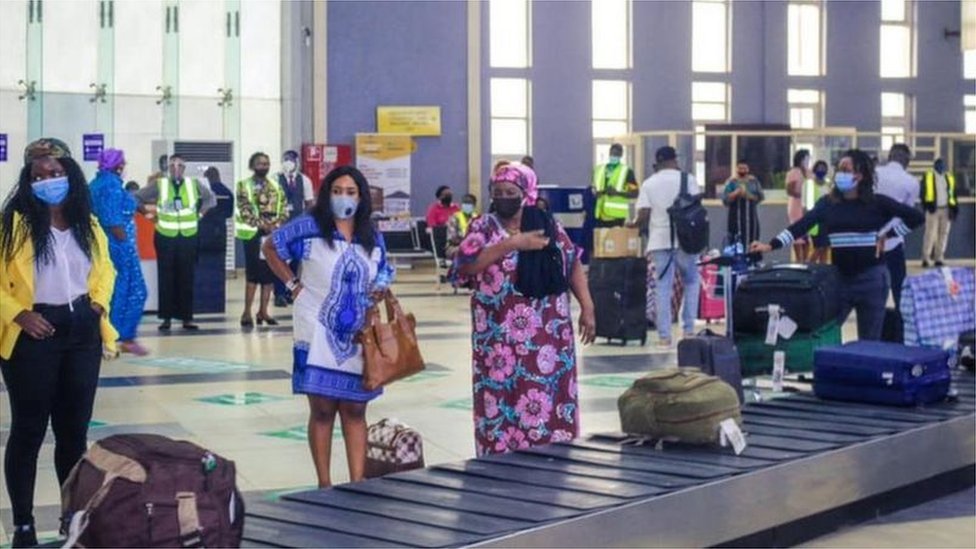
The NCAA is moving to make RFID baggage tracking mandatory at Nigerian airports, letting passengers monitor checked luggage in real time from check-in to arrival.
The Nigeria Civil Aviation Authority (NCAA) says it is preparing to mandate the use of Radio Frequency Identification (RFID) baggage tracking technology at Nigerian airports.
The system would replace the current barcode-based framework, allowing passengers to track checked luggage in real time from check-in to baggage reclaim.
The plan was disclosed by Michael Achimugu, NCAA’s director of public affairs and consumer protection, at a stakeholder engagement forum on Tuesday, and separately at a technology modernisation briefing the authority organised in Lagos for airlines, ground handlers and other aviation stakeholders, according to Punch.
Why the Change
Achimugu said baggage-related complaints remain one of the biggest challenges facing air travellers, ranked only behind flight delays and cancellations.
“One of the biggest complaints in the industry has been that of baggage,” he said, noting that passengers frequently deal with bags that are short-landed, missing, lost or destroyed.
The new system would let passengers track their bags via a phone app, showing whether luggage has left the check-in area, reached the boarding gate, or been loaded onto the correct aircraft. “Air passengers can track the location of their bags from check-in to arrival at destination,” Achimugu said, according to Premium Times.
According to Leadership, RFID readers installed along conveyor belts and ramp-loading areas would allow airlines and ground handlers to detect and flag misrouted baggage before it is loaded onto a flight, making it “virtually impossible,” in Achimugu’s words, to load a bag bound for Kano onto a Lagos-bound flight. If a bag still fails to arrive with its owner, passengers would be able to tell the airline exactly where the bag currently is, rather than simply reporting it missing.
Achimugu said existing regulations allow airlines up to seven days to locate and reconcile missing baggage with a passenger, but the new technology should cut that significantly. “Missing or misrouted luggage can be identified and located instantly,” he said, according to Leadership.
Status of the Rollout
The initiative has not yet commenced but is at an advanced stage, Achimugu said. A contractor has already been introduced to airlines, and discussions are ongoing on integrating the technology with individual airlines’ systems. The NCAA is reviewing existing regulations to make automated baggage tracking mandatory for all carriers, and a contract is expected to be signed shortly.
According to AllAfrica, the Minister of Aviation and Aerospace Development, Festus Keyamo, has already approved the relevant agencies to review the technology and report back, and consultations on possible implementation challenges have taken place. “All great evolutions must begin from a point,” Achimugu said, though he did not give a specific commencement date, AllAfrica reported.
Achimugu credited the initiative to Nigeria’s current aviation leadership, saying, “Due to a listening minister, a proactive DGCA, and a vibrant MD FAAN,” the country was about to enter a new era in civil aviation, Punch reported in a separate report.
The NCAA is involved as the regulator that receives most baggage-related complaints and oversees service providers, Achimugu said, adding that the Federal Airports Authority of Nigeria (FAAN), which owns airport infrastructure, would work directly with the contractor, alongside ground handlers.
RFID uses electronic tags read by scanners to identify and track items as they move through different points in a process; it is already used for baggage tracking in other countries. Premium Times reported that the push for the new system follows a case in February in which the NCAA engaged Kenya Airways and affected passengers over compensation after reports of missing iPhones and other valuables from checked luggage on the airline’s flights.
The NCAA also plans to introduce a dedicated mobile application to let passengers monitor their baggage throughout their journey, according to Leadership.