

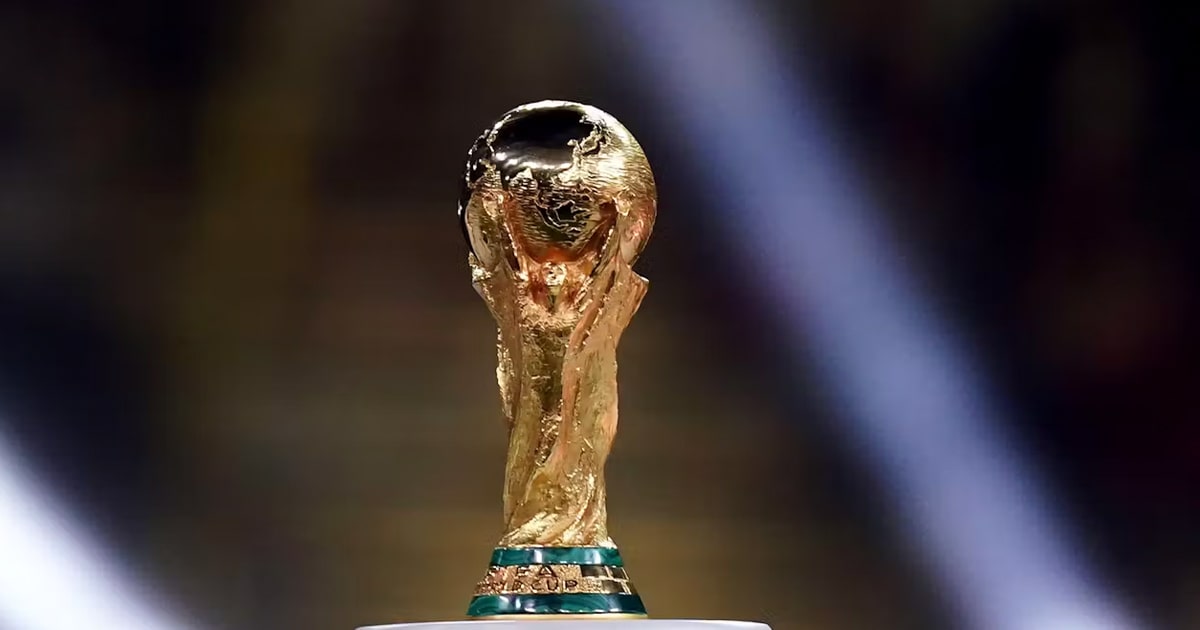
Just days after celebrating what appeared to be another successful FIFA World Cup, Gianni Infantino found himself at the centre of one of the biggest governance crises of his presidency.
Spain had defeated Argentina in the final of the first-ever 48-team World Cup on July 19 in East Rutherford, New Jersey, capping a tournament FIFA hailed as a success. Infantino appeared politically secure ahead of the FIFA presidential election in March 2027, with Confederación Sudamericana de Fútbol (CONMEBOL), the Asian Football Confederation (AFC) and the Confederation of African Football (CAF) having publicly backed his bid for another term. He had also met with US President Donald Trump just days before the final.
Then, in less than a week, a proposal intended to transform football’s commercial future triggered a global backlash that threatened to divide the sport.
Tuesday, July 28 — The Announcement
FIFA formally unveiled FIFA Forward Enterprise (FFE) a proposed commercial subsidiary that would consolidate FIFA’s commercial rights (broadcasting, sponsorship, ticketing, licensing) and tournament operations for the World Cup and Club World Cup, then sell roughly 20% of the entity to outside investors.
Reported figures varied slightly by outlet but converged around FIFA raising up to $4.2 billion by selling about 20% of the new commercial entity, valuing the business at approximately $20 billion. Under the plan, according to Variety’s later reporting, each FIFA member country would have received an initial $20 million payment, plus a doubling of its annual stipend to $5 million.
The lead investor group was Thrive Eternal, an American venture capital firm founded by Joshua Kushner, younger brother of Jared Kushner, Donald Trump’s son-in-law. CNN reported there was no announced direct tie to the president himself but noted that Infantino’s close relationship with Trump made the optics uncomfortable given the timing, especially with reports that Infantino was expected to become commissioner of the new entity after securing a further term as FIFA president.
Wednesday–Thursday, July 29 and –30 — The Revolt Begins
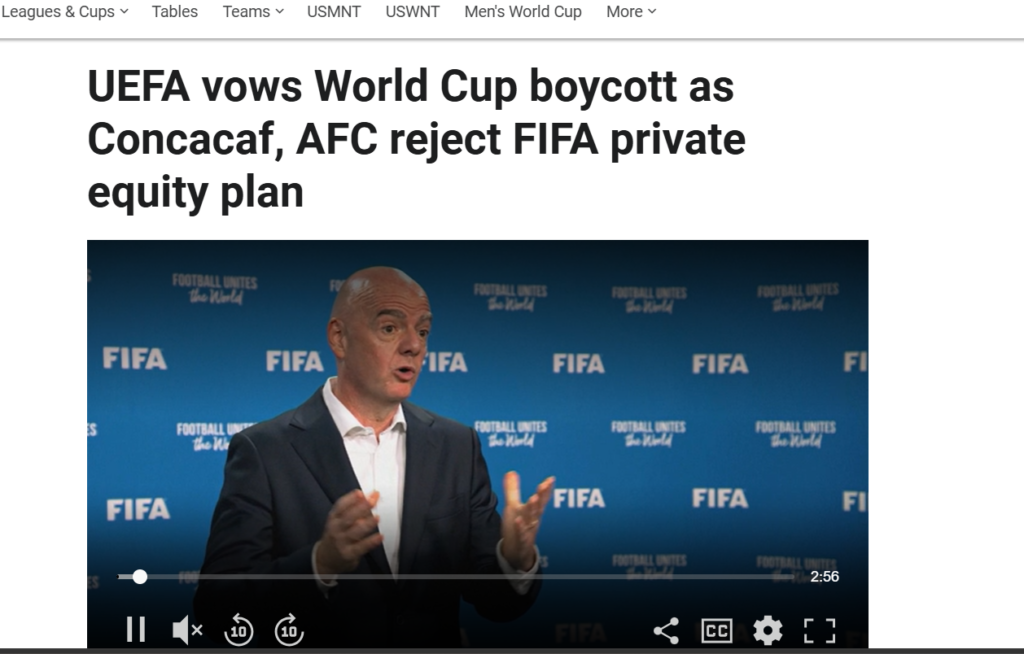
Criticism built quickly and from multiple directions, including public pushback from UK Prime Minister Andy Burnham. UEFA president Aleksander Ceferin convened an emergency virtual meeting of all 55 UEFA member associations.
Thursday, July 30: UEFA’s 55 members voted unanimously, 55–0, to boycott all FIFA competitions, not just the World Cup, but everything if FFE proceeded. UEFA’s statement was blunt, describing the World Cup as one of football’s greatest sporting legacies, built over generations by players, national teams, and supporters across every continent, and insisting it could never be treated as an investment product.
UEFA and it’s national associations will not participate in FIFA competitions, the European soccer body said after an urgent online meeting of its 55 member nations.
Somethings are simply too important to sell, “UEFA said in a statement. “The FIFA world cup belongs to football. It always will. And so long as Europe has a voice. It will never be for sale
CNN laid out exactly what that boycott would have meant in practice: World Cup champion Spain, along with semifinalists France and England, would not have played in the 2030 World Cup. It also would have gutted the 2027 Women’s World Cup in Brazil, where three of the four semifinalists including defending champion Spain were European nations.
CONCACAF (41 members) rejected the plan the same day, convening its own meeting of member association presidents and pressing FIFA on why its existing reserves reported to total billions of dollars with no debt couldn’t fund development directly instead of bringing in outside investors.
Friday, July 31 —FIFA Defends Proposal Before Withdrawing It
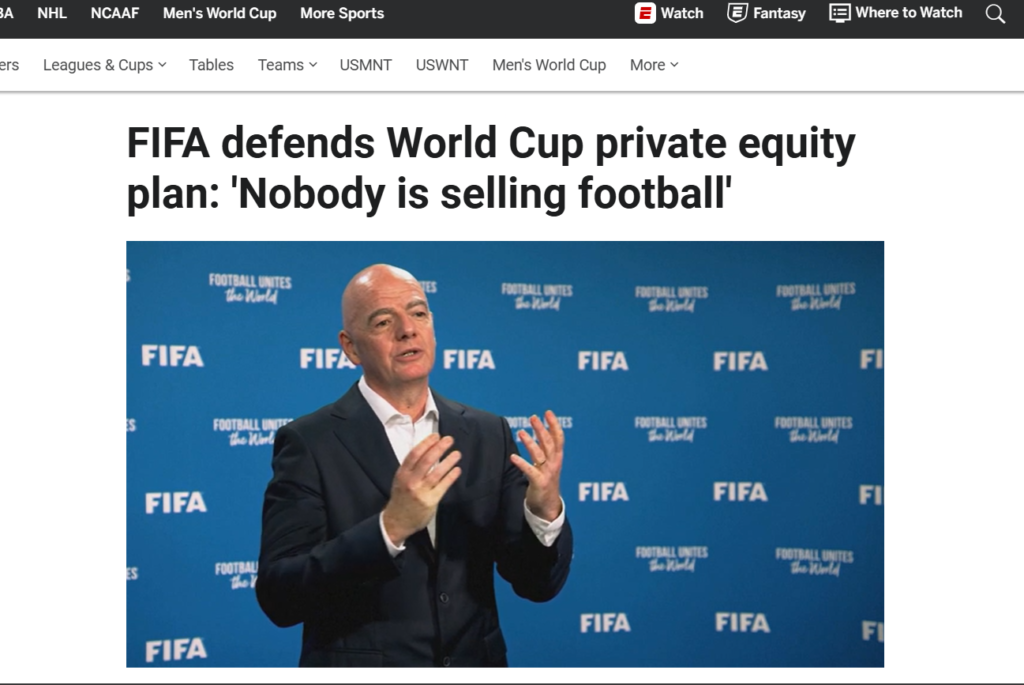
Morning: FIFA issued a defense of the plan, insisting that nobody was selling football and that the proposal was only ever meant to give member associations meaningful ownership of football’s commercial opportunity in their own countries. FIFA placed part of the blame for the backlash on what it called erroneous media reporting, and said its consultation process with member associations would continue rather than halt.
FIFA’s commercial activities would remain unchanged. FFE would not be established. Nobody is selling football. This is not something FIFA would ever entertain”
The AFC (46 members) rejected the plan shortly after, becoming the third confederation to do so. Its statement pointed to the divisions that had already opened up across the football world and concluded that the proposed FFE could not realistically achieve the broad consensus needed to move forward, calling for an urgent review of FIFA’s governance and consultation processes.
Internal collapse: Senior adviser Carlos Cordeiro a former US Soccer Federation president, ex-Goldman Sachs banker, and Infantino’s own representative on the White House World Cup Task Force resigned in protest. He didn’t hold back, describing the plan as a bad deal for FIFA’s member associations, for football, and for the long-term future of the game. He also pointed out that FIFA already sat on billions in reserves with no debt, and had generated roughly $15 billion in revenue between 2022 and 2026 meaning, in his view, that FIFA already had the financial capacity to fund development without bringing in outside investors at all.
Cordeiro’s resignation didn’t stay contained. FIFA’s own chief operating officer, Kevin Lamour, told the Associated Press that staff had felt deceived by the lack of transparency around the project. US Soccer also came out against the plan. Separately, FIFPRO, the global players’ union, proposed a joint meeting between FIFA, UEFA, CONMEBOL, the European Club Association, and the World Leagues Association, arguing that decisions capable of reshaping the sport’s future needed to be debated with everyone who has a stake in its governance, confederations, leagues, clubs, and players rather than pushed through from the top down.
Reports also surfaced that, even as the backlash intensified, FIFA had set a September 19 deadline for individual national federations to declare their support for the plan, reportedly attaching a $40 million incentive to a yes vote. Critics read this as FIFA shifting strategy — trying to buy support association by association after failing to win over entire confederations collectively.
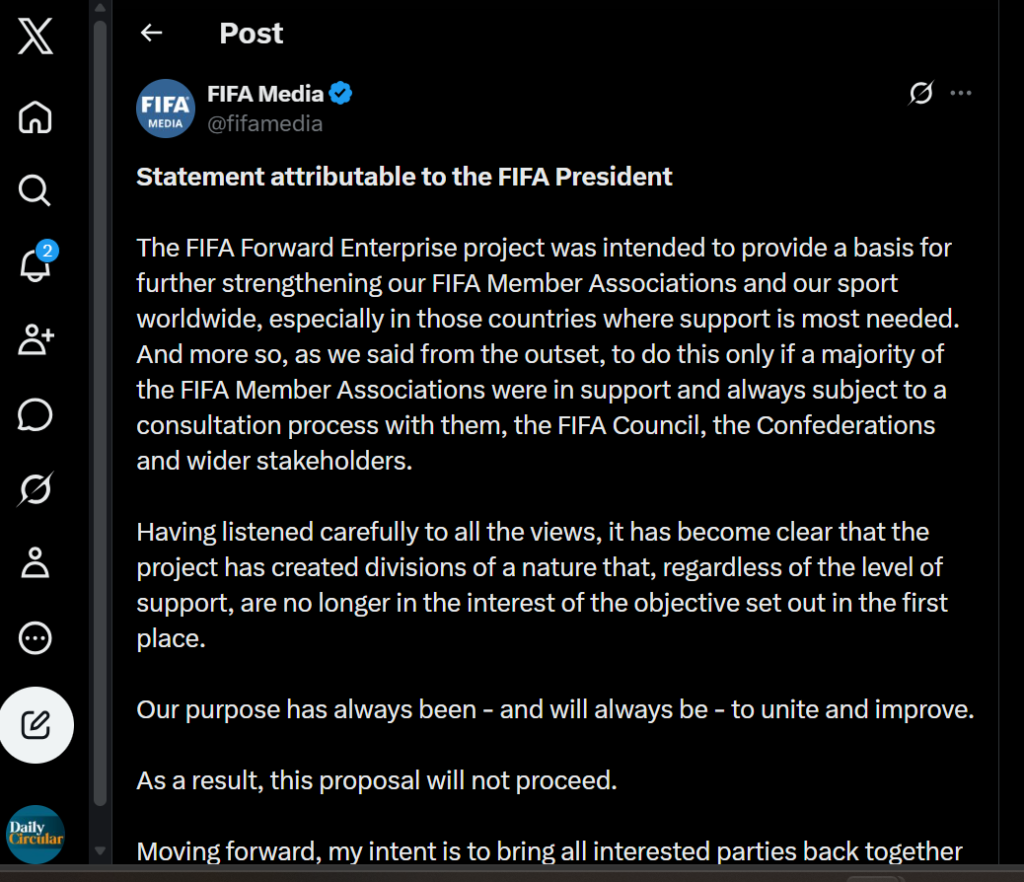
Evening — the reversal: Late Friday, at 11:30 PM, Infantino withdrew FIFA Forward Enterprise entirely. His statement, released through FIFA’s official channels, explained that after listening carefully to all the views raised, it had become clear the project had created divisions that were no longer in the interest of its original purpose regardless of how much support it might technically still have had. He said FIFA’s purpose has always been to unite and improve the game, and that as a result, the proposal would not proceed. He added that he intended to bring stakeholders back together “in the coming days and weeks” to find other ways to support underfunded football nations.
Saturday, August 1 — Aftermath
AFC president Shaikh Salman bin Ebrahim Al Khalifa welcomed the reversal, thanking the AFC’s member associations for staying united throughout the process. He stressed that the future of global football must always be shaped through proper consultation and collective dialogue, and reaffirmed that the AFC stood ready to support any future initiative that strengthens unity within the football family and delivers real benefits to all stakeholders.
Cordeiro’s resignation, viewed in hindsight, carries even more weight now that the plan has collapsed: his warning that the deal was bad for member associations, bad for football, and bad for the game’s long-term future turned out to anticipate almost exactly the argument that ultimately sank the proposal.
One financial detail that only became clear in the aftermath, reported by Variety: under the original pitch, every FIFA member country would have received that initial $20 million payment plus a doubling of its annual stipend to $5 million, the exact kind of direct payout FIFA had been counting on to win over smaller, less wealthy federations even as the major confederations revolted.
What this means for Infantino personally
This is arguably the most important thread going forward. Multiple outlets, including Variety, now describe Infantino’s position heading into his re-election bid at the March 2027 FIFA Congress as genuinely uncertain. Withdrawing the plan avoided an active boycott, but it did nothing to undo the underlying fact it revealed, that three of FIFA’s six confederations, representing well over half of all member associations, were prepared to publicly break with him, and that dissent had reached his own hand-picked advisers and senior staff.
Full Timeline
| Date | Event |
|---|---|
| Tue, July 28 | FIFA unveils FFE: ~20% stake sale, ~$4.2B raise, ~$20B valuation, lead investor Thrive Eternal (Joshua Kushner). |
| Wed, July 29 | Criticism mounts, including from UK PM Andy Burnham; UEFA calls an emergency meeting. |
| Thu, July 30 | UEFA votes 55–0 to boycott all FIFA competitions if FFE proceeds. CONCACAF (41 members) rejects the plan. |
| Fri, July 31 (AM) | FIFA defends the plan — insists nobody is selling football, blames media reporting, says consultation continues. |
| Fri, July 31 | AFC (46 members) rejects the plan. Cordeiro resigns. FIFA COO says staff felt deceived. US Soccer rejects it. FIFPRO proposes a joint stakeholder meeting. A September 19 deadline and $40 million incentive for individual federations reportedly surface. |
| Fri, July 31 (PM) | Infantino withdraws FFE entirely, citing irreconcilable divisions within football. |
| Sat, Aug 1 | AFC publicly welcomes the reversal; Infantino signals intent to regroup with stakeholders in the coming weeks. |
Nine days, start to finish. The collapse of FIFA Forward Enterprise is about far more than a failed commercial proposal. It exposed deep divisions over how football should be governed, how decisions affecting the global game should be made, and how much power should rest with FIFA’s president. With the 2027 FIFA presidential election approaching, the episode has become the biggest political test of Gianni Infantino’s leadership since he took office.
Editor’s note: This explainer is based on reporting by FIFA, UEFA, Reuters, Associated Press, CNN, Variety, and other publicly available statements and documents as of August 1, 2026.