

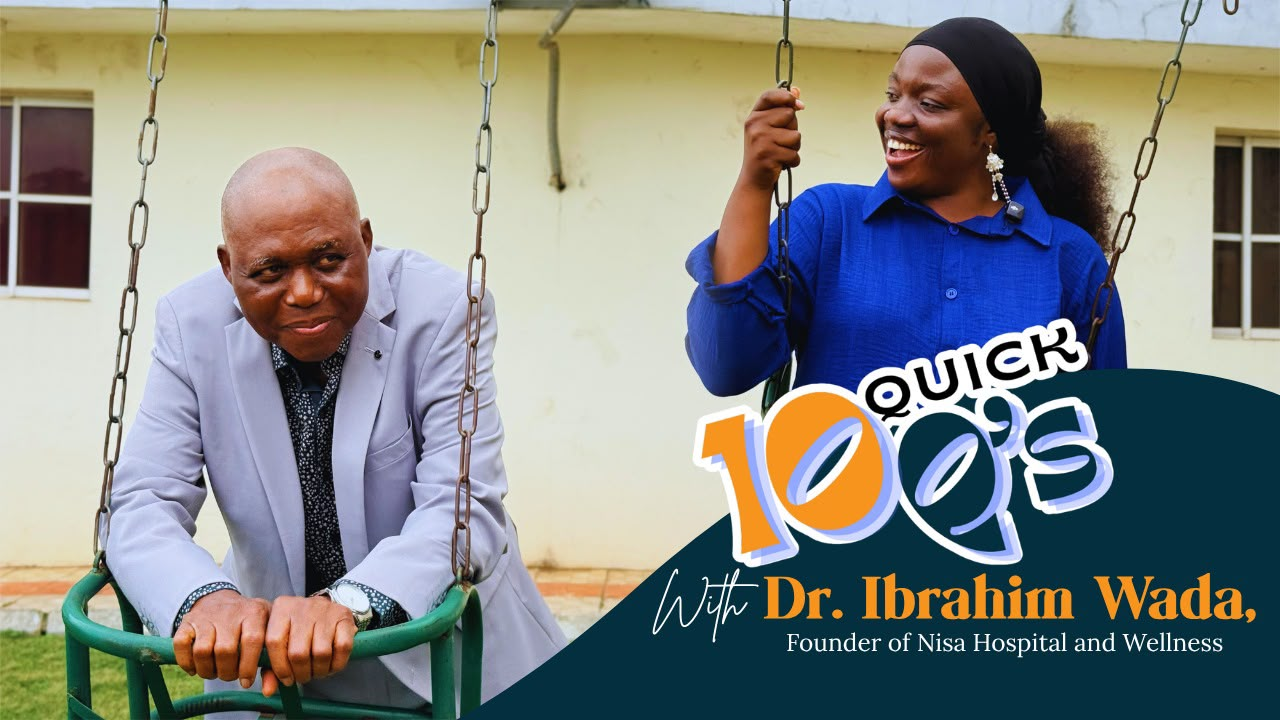
Every week, we throw 10 questions at someone whose mind we find fascinating — the thinkers, founders, innovators, policymakers, builders, and culture-shapers quietly changing how we see the world and inspiring us to do things not just differently, but better-differently. First thoughts only.
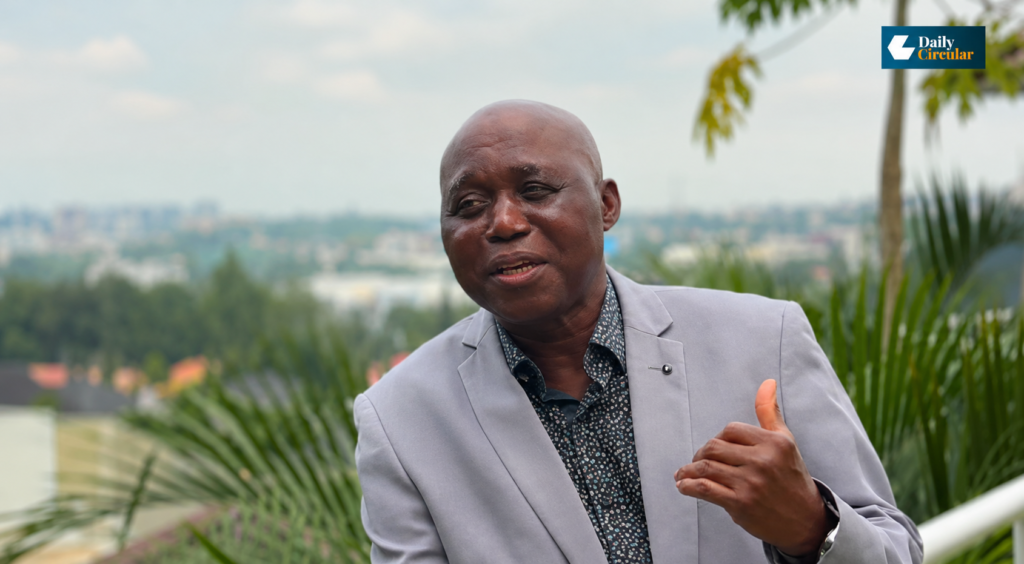
This week, meet Dr Ibrahim Wada, chief executive of Nisa Premier Hospital in Jabi and Garki General Hospital, and one of the pioneers of in vitro fertilisation in Nigeria. A gynaecologist by training and a fertility specialist by calling, he studied at Ahmadu Bello University before travelling to the United Kingdom to specialise, then returned home to help deliver the country’s first government-verified IVF birth in 1998.
His work has quietly changed thousands of Nigerian families, one embryo, one procedure, one second chance at a time.
What does it take to bring a technology home to a country that was not ready for it, and stay long enough to watch it become ordinary?
Read as Dr Wada shares his thoughts on faith, loss, leadership, and the one piece of advice he would give his younger self:
From newspaper clippings to ABU: how a childhood instinct became a career
- Did you already have your eye on reproductive medicine growing up, or is that something you found along the way?
Thank you for that. Yes, MBBS 1980, ABU. Even as a child I knew I was going to be a doctor, and I think that’s unique, because some people are made for certain roles in life. I remember, probably as young as seven, eight, nine, I was interested in all the medical articles in newspapers. Something told me I was going to be a doctor, and I’m glad that came to pass. But becoming a gynaecologist was a different story, back in medical school.
Someone who is my friend’s mum but is also my mum in many ways, because we grew up in the village, and wherever you go, you eat, you drink, and this mum in particular treated us like her own son. While I was in medical school, she passed away. This woman died during childbirth. For me, I had taken a cue from that. I needed to become a gynaecologist to prevent such nice human beings from premature death in childbirth, and I’m glad I became one.
Then they asked, why did you have to become a fertility specialist? I had seen enough of my hard work and the help of God save lives. When I was training to become a gynaecologist, before going to the UK, I knew there was a big group of women and their husbands who could not have children, and at that time the technology called in vitro fertilisation, IVF, was coming to the world. They said, why come home? There’s no one trained like I was, with the opportunity of a federal scholarship and prayers to Almighty God that were answered, who would abandon his people. So I had to come home. That was for me to add my little bit to the advancement of medicine in this country.
Breakthroughs, babies, and building a name: the early years of IVF in Nigeria
- You’re widely regarded as one of the pioneers of in vitro fertilisation in Nigeria. Can you take us back to the early days? What was the biggest hurdle doing IVF here?
I first of all thank God that I came home, and there was a breakthrough in 1998. Baby Hanatu was born, and I immediately went to inform the Minister of Health and the Minister of Science and Technology, because perhaps no child had been presented to a third party like the government for verification. Here you are, this is how we did it, these are the parents, that’s the baby, come and check us. It was during our bachelor’s time, and I was so happy that the minister came on a visit after due verification.
It was in our hands in 1999 that we had the first conception using intracytoplasmic sperm injection. He was producing semen but there were no sperm cells in it, so in his case we had to go and draw sperm from his testis and use an instrument called the ICSI machine to inject the sperm, because at that small quantity they can’t do it on their own. That was the breakthrough in ICSI, where you remove sperm from a man surgically, use the machine to inject it into his wife’s eggs, and a baby resulted. The first case resulted in a young lady, and that man has completed his family. He’s a very happy one.
What about the freezing of human embryos? For the first time, we introduced that also. We had to find the science to preserve human embryos for a long time. That was another breakthrough, and our first child was born in 2001. He’s a big guy now, and I’m very, very grateful that Almighty God allowed me to be at the forefront and to witness this in my own lifetime.
So my coming back from England has not been in vain. But most importantly, once we overcame the science in the country, we started training people left, right and centre, and the growth in IVF in the last 20 or so years has been astronomical, almost everywhere now, not just the main cities. Either they learn directly from me, or from people I trained, majority.
- Tell us the moment you decided to found the Nisa Medical Group exactly 30 years ago. Was there a particular gap that needed to be filled?
Yes, and that gap was because when I came home, I didn’t want to do private practice. I just wanted it in government, so that everyone can access it. That was at Gwagwalada. Unfortunately, government systems are slow for young people like me. So after one and a half years, I knew if I didn’t do something, then my brain will start dying slowly. So that’s what gave birth to Nisa. Nisa means women, from Arabic.
- There have been some controversy as to whose Nigeria’s first qualified IVF baby is: Hanatu Kuchi, born at your hospital in Abuja on February 11th, 1998, or another baby almost a decade earlier in Lagos. So what’s your take, and what’s the correct version?
My take is that the baby born in Lagos ten years before Hanatu was the first one. But third-party verification is important. We are grateful to the pioneers, in a way that they even removed the light from the ice and had done their own very best. The difference with Hanatu, the only difference, is that we invited the government to verify it. And I think a lot of the press twisted things here and there and created that controversy when there was none, because there was no time I lost communication with them.
A second chance, twice over: faith, purpose, and the story behind the title
- One of your books is titled A Second Chance: In Vitro Fertilisation, Baby Hanatu and I. What’s the story behind the “second chance” in the title?
The first chance is nature. The second chance is science. That’s as far as baby Hanatu and scientific breakthroughs are concerned. For me as a person, the first chance was when I trained in Nigeria, and I saw those women who could not have babies no matter how hard they tried. So I brought them a second chance. My return to Nigeria is the second chance to make a great difference, to the life of Nigerian science and to the life of needy patients. I have brought them a second chance. I, as a person, have also brought them a second chance.
- Do you think that the Nigerian public has generally stopped stigmatising fertility treatment and regarding it as inferior to natural conception?
There are two aspects of the Nigerian public. They’re educated and aware, I can vouch for them, that with my encounters, they have no more stigma. But what about the huge population of people in my village and yours, people in all the rural areas? There is still stigma. What does that mean? We still have much more work to do, one of which is what we are doing now, enlightening people. As far as fertility is concerned, it’s a shared responsibility between men and women, not women alone. There are solutions now, and we are seeing the products with our very eyes. Yes, many of us cannot afford it, but the technology has now stepped into the public domain, which was my original reason for coming back to Nigeria, not for any private practice. God knows it was I had to do it. And I said I’m an accidental private practitioner rather than a determined private practitioner.
It’s everywhere, it’s becoming everywhere approachable. Other people abroad see Nigeria as a cheap place to rush to, to do their IVF. Unfortunately, many of our people cannot afford yet. I advocate very loudly that IVF and infertility care should be part of the national health insurance. Let us be our brothers and sisters’ keepers. What is too expensive for them should be added, not malaria and typhoid and all those things, they’ve been managing on those levels for years. Where they need the help of the NHIA is where they have big problems: cancer, God forbid, major surgeries, in vitro fertilisation, and so on.
Leading without the luxury of resources: lessons from a career in public health
- You’ve held senior posts from National Hospital to Garki Hospital to Nisa Premier. What’s the most important leadership lesson you’ve learned in your career?
I think it’s the diversity of our people, and the fact that too many of the people you are leading are not exposed. They’ve not been to the promised land. And so when you are trying to say this is the best direction, based on your exposure, guidance and all that, getting the human capital to follow you, that was very, very difficult. I think the second part of it was the skill set, because of the falling standards of our education. So you want to achieve mighty things with people who, at the beginning, don’t think it can be done anyway. You’re just wasting everybody’s time until you persevere. So you have to do like ten people’s job to guide them to success, and let them believe, then they follow.
Of course, the kind of resources you need to execute big things are never there in one piece: not the electricity, which is fleeting, not the water supply, which is a struggle, not communication, not transportation. If there was anywhere that advanced science would not thrive, it was the Nigeria of old, where I was leading a lot of people. Then I only have one very positive addition to this. When I came back, in our hospital in Gwagwalada, too many women were dying of childbirth still, and I thought that Nigeria hadn’t really moved from the time I was in Jos.
So I needed to lead a squad against maternal death, and I will remember that success till my last day. We removed the constraints of resources. I found the money and said this money is to prevent people dying. Need IV fluids? You got IV fluids. Need to be operated? You were operated. We removed the equation of money, because my savings from abroad in particular, I exposed it to this experiment. Thank God I did. In the next six months, instead of losing seven people, we lost one at the end of the experiment, and even that was something that was beyond my control. So what lesson was learned there? You could lead Nigerians to a world-class level of success, and motivation, leadership and provision of resources would produce results here like anywhere else.
Life beyond the clinic: golf, travel, and staying curious
- So away from the clinic, how do you switch off? What keeps you grounded?
I like to see myself as a traveller first and then golfer next, and the two are connected. So I travel a lot within Nigeria and also outside Nigeria for golfing and sightseeing, getting in touch with nature. I’m happy that I’m now at a point when that is becoming a priority more than work. It used to be work-life. So golf has everything in it. It’s called the game of life. You make the best friends you can ever have on the golf course, and it keeps all your systems working. So I’m not the only one who’s addicted to it. Too many people are, and it’s just nice.
- Would you say all this travelling has inspired what you have here?
I think to some extent, yes, because it allows you to explore, and not take a simple idea and stick with it. Take it, turn it this way, that way, until you get the best out of it. I think yes.
What Dr Ibrahim Wada would tell his 1980 self
- If you could give your 1980 self, fresh out of ABU, any advice, what would it be?
It would be that the life ahead is tougher than the one you’ve lived so far. I grew up as a child wanting to become a doctor, so I was ready to pay the price.