


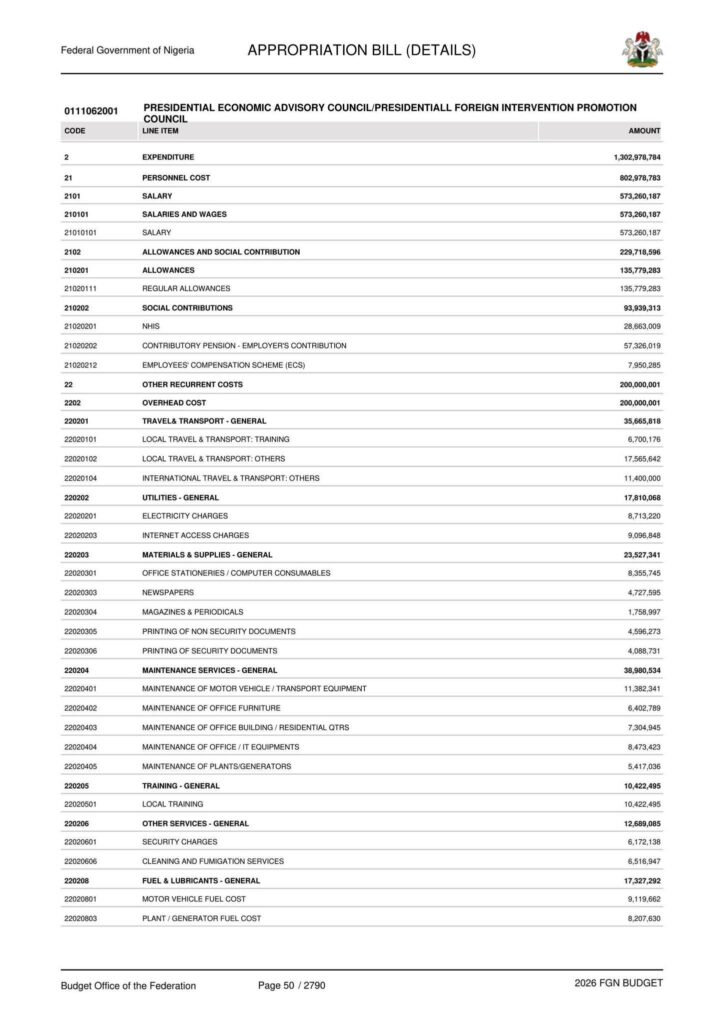
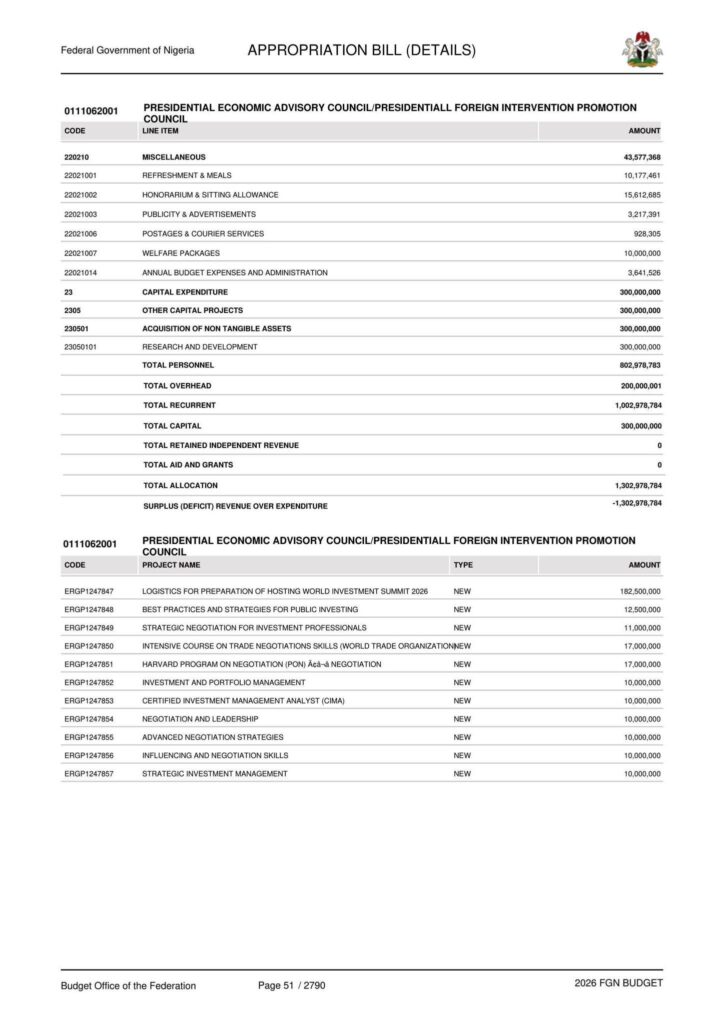
Claim: A non-existent government agency, the Presidential Foreign Intervention Promotion Council (PFIPC) chaired by Prince Adeniyi Adeyemi Matthew received a ₦1.3 billion allocation in Nigeria’s 2026 Appropriation Bill.
Verdict: TRUE — but with important context.
What we found
A review of Nigeria’s 2026 Appropriation Bill and the final Appropriation Act confirms that an entity listed as the Presidential Foreign Intervention Promotion Council (PFIPC) appears in the budget with a capital allocation of approximately ₦1.3 billion. The allocation is contained in the State House section of the budget documents.
However, the presence of an organisation in an appropriation law does not, by itself, establish that the organisation legally exists or was lawfully created.
The controversy arose after the Presidency stated that the PFIPC is not a recognised government agency and alleged that documents used to portray it as an official presidential body were forged. In a statement issued on July 1, 2026, the Presidency described the council as a fictitious entity and said criminal proceedings were already underway against Adeniyi Adeyemi Matthew over alleged forgery, impersonation and related offences.
Does the budget prove the agency existed?
No.
Under Nigerian law, an appropriation bill or appropriation act authorises government spending. It is not the legal instrument that establishes a ministry, department, agency or presidential council.
Government entities are typically created through legislation, executive orders, constitutional provisions or other lawful executive instruments, not merely by appearing as a line item in the budget.
Therefore, while the budget confirms that money was earmarked for the PFIPC, it does not independently prove that the council was legally constituted.
Why the issue matters
The controversy has generated two separate questions:
- First, why did the PFIPC appear in the national budget if the Presidency now says it never existed?
- Second, if the agency was indeed fictitious, how did it pass through the budget preparation, review and approval processes without being detected?
Those questions remain matters of public interest, but they are separate from the criminal allegations currently before the court.
What about the criminal case?
Matthew has denied wrongdoing and has made counter-allegations against senior government officials. Those allegations have not been proven in court.
As of publication, no court has determined whether the PFIPC was fraudulently inserted into the budget, whether public officials were involved, or whether the accused committed the offences alleged against him. Those issues remain before the courts.
The claim that the Presidential Foreign Intervention Promotion Council received approximately ₦1.3 billion in the 2026 budget is supported by the official appropriation documents.
However, the budget allocation alone does not prove that the PFIPC was a legally established government agency. That is precisely the issue at the centre of the ongoing controversy and criminal proceedings.
Verdict: TRUE — the allocation appears in the budget, but this should not be interpreted as proof that the agency legally existed.