


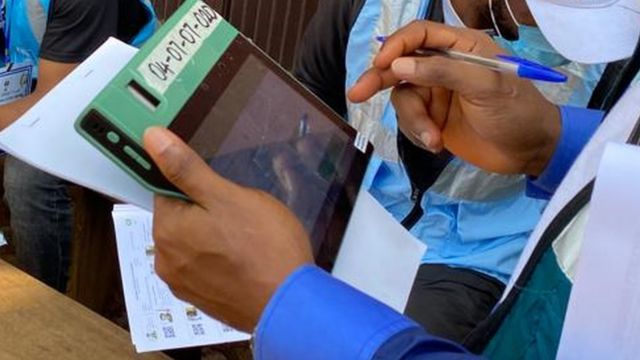
The commission says digital records of uploaded results will remain intact after concerns over early uploads and repeated device use during previous elections.
The Independent National Electoral Commission (INEC) has pledged to preserve the metadata attached to election results uploaded to its Result Viewing Portal (IReV) during the 2027 general elections.
The commission’s Director of Information and Communication Technology, Lawrence Bayode, gave the assurance on Tuesday in Abuja at a stakeholder roundtable on election results tabulation organised by Yiaga Africa.
The commitment followed concerns raised by a participant from MundX Analytics, an election observatory technology platform, over the possibility that metadata attached to uploaded result sheets could be deleted.
Metadata provides digital information about an upload, including when it was submitted, the device used and the location from which it was uploaded. These details can help observers trace the movement of result sheets and independently examine the circumstances surrounding their submission.
The MundX representative cited findings from a review of results uploaded to IReV during previous elections, which allegedly identified instances of result sheets uploaded before voting began.
According to the participant, some results were uploaded as early as 5am on election day, while multiple result sheets were reportedly uploaded using the same mobile device.
The participant said the patterns raised questions about the integrity of the upload process and reinforced the need to retain metadata for independent scrutiny. However, the claims were not independently established at the meeting as evidence of electoral manipulation.
Responding, Mr Bayode assured stakeholders that INEC would not alter the original digital records attached to uploaded results.
“I can assure you those metadata will remain intact,” he said.
He added that he could not speak for the handling of metadata during previous elections but confirmed that the commission still had the records for elections conducted in the Federal Capital Territory, Ekiti and Osun states.
According to him, the results uploaded during those elections showed greater consistency, with no discrepancies identified on the portal.
Why INEC’s IReV metadata matters
IReV was introduced to allow voters, political parties, election observers and the media to view scanned copies of polling unit result sheets, known as Form EC8A.
The metadata attached to these uploads provides an additional layer of information that can help establish when and how result sheets entered the portal.
Preserving the records could therefore support independent checks where questions arise about the timing, source or handling of uploaded results.
However, retaining metadata does not, on its own, establish that an election result is accurate or that an irregularity has occurred. Its value depends partly on whether the records can be independently examined and used to verify concerns.
The pledge comes amid wider questions about the transparency of INEC’s result management system ahead of the 2027 elections.
At the same roundtable, Mr Bayode disclosed that the commission would not be able to publish results from ward, local government and state collation centres on IReV during the 2027 general elections.
He said the infrastructure required to upload Forms EC8B, EC8C and EC8D, which contain results from those levels, had not been developed or tested.
“We have not built the system; we have not tested the system,” he said.
The limitation means IReV will continue to provide public access to polling unit results without showing the subsequent stages of collation. Yiaga Africa’s Executive Director, Samson Itodo, said the organisation had previously recommended that INEC publish the additional result forms to improve transparency and allow stakeholders to compare figures across collation stages.
INEC has also maintained that IReV serves as a transparency platform and that the portal’s uploaded results are not used for the commission’s official collation and declaration of election results.
As preparations for the 2027 elections continue, the commission’s pledge to preserve metadata is a step towards greater transparency. But stakeholders will also want clear procedures for protecting the records, accessing them when necessary and independently verifying the results throughout the collation process.