



Since Dr Dele Alake assumed office as Minister of Solid Minerals Development in August 2023, Nigeria’s mining sector has undergone a significant transformation, with measurable gains in revenue, investment, enforcement, and continental influence.
At the heart of these changes is a seven-point agenda focused on sanitising the industry, curbing financial leakages, prosecuting offenders, restoring investor confidence, accelerating mineral licence issuance, encouraging local value addition, and attracting credible investors.
The most striking indicator of progress in the mining industry has been the sector’s revenue growth. Revenue from the sector increased from N16 billion in 2023 to N38 billion in 2024, and is projected to exceed N70 billion by the end of 2025. The improvement followed the implementation of Alake’s seven-point agenda, which focuses on reforms, transparency, investor confidence, and local value addition.
A key driver of growth has been aggressive housekeeping of the sector’s licence registry, directly tied to the agenda’s goal of sanitising the industry and curbing financial leakages. The ministry revoked 1,633 mining licences in late 2023 for non-payment of annual service fees, and revoked a further 924 dormant licences in early 2024, with the aim of repositioning the sector to attract more serious investors.
Tackling Illegal Mining
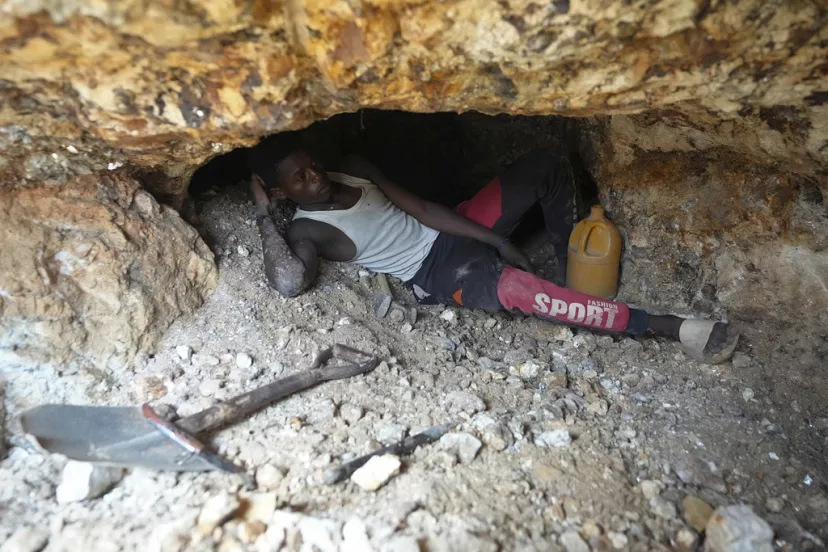
The agenda’s commitment to prosecuting offenders and restoring law and order in the sector has yielded concrete results. To address the persistent challenge of illegal mining, the ministry established the Mining Marshals, who have reclaimed 90 sites from illegal miners and bandits, prosecuted over 300 suspects, and monitored 450 sites threatened by illicit activities. Alake has outlined plans to expand the Marshals’ operations to cover all 774 local government areas of the country. Nationwide satellite surveillance of mining sites is also billed to come on stream in 2026 to bolster their capacity.
Attracting Investment
Restoring investor confidence and attracting credible investors are central pillars of the seven-point agenda, and the numbers reflect progress on both fronts. Lithium factories are springing up, a $400 million rare earth metals plant is in the offing, and it is estimated that close to $1.5 billion in Foreign Direct Investment has been attracted to the sector since 2023. Investments in lithium processing alone grossed $1.3 billion since September 2023.
To facilitate investor access and accelerate licence issuance, another agenda priority, the Nigeria Minerals Decision Support System (NMRDSS), a web-based platform, was established to serve as a repository of geoscientific and geo-economic data on Nigeria’s mineral resources, featuring interactive mapping, geological data, and infrastructure details.
Cooperative Federalism
The minister introduced the principle of cooperative federalism to encourage states to apply for mining licences and operate as Limited Liability Companies, which has produced results including joint venture partnerships yielding investments in Nasarawa, Kaduna, Abuja, and Oyo, among others.
Continental Leadership and Local Value Addition
The agenda’s emphasis on local value addition, making processing or refining mandatory before mineral exports, has resonated far beyond Nigeria’s borders. Nigeria’s push for local value addition gained traction across Africa, leading to the establishment of the Africa Minerals Strategy Group (AMSG). The AMSG was established in January 2023 by 16 founding member states and has since grown to 31. African ministers of solid minerals unanimously elected Alake as its pioneer chairman.
The trajectory is unmistakably upward, and Nigeria’s mining sector is increasingly being taken seriously both at home and across Africa.