



There is something deeply disturbing about how quickly suspicion can become a death sentence in Nigeria.
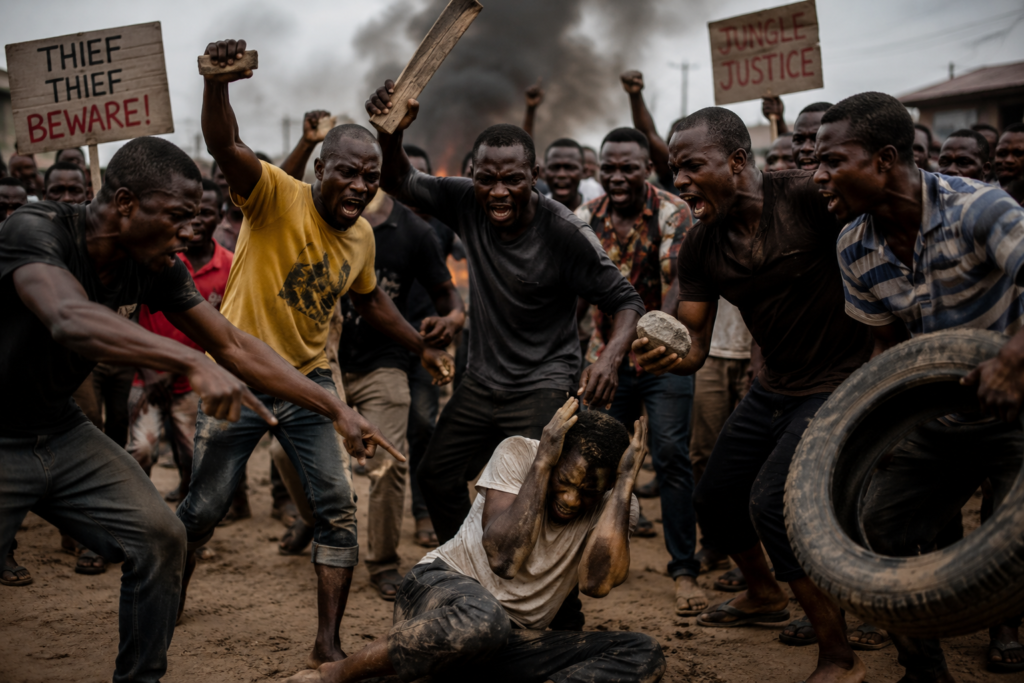
A person is accused of stealing a phone, committing fraud, kidnapping, blasphemy or engaging in some other crime. Before the police can investigate, before evidence can be examined and before a court can determine guilt, a crowd gathers. Anger takes over. Someone points a finger. Others follow. What began as an accusation can end with a life being taken in the name of justice.
It is not justice.
The recent warning by Inspector-General of Police Olatunji Disu that “jungle justice is murder” is important, but the problem is much bigger than a police directive. Mob justice has become a recurring feature of Nigeria’s security and justice landscape, and its persistence forces us to confront an uncomfortable question: why are so many people willing to abandon the legal system and become judge, jury and executioner?
Part of the answer lies in the public’s deep frustration with the justice system. Nigerians have seen cases drag on for years. They have witnessed suspects arrested and released, investigations that appear to go nowhere and victims who struggle to get justice. In communities where people believe the state is either unable or unwilling to protect them, taking matters into their own hands can begin to look like the only available option. But frustration cannot become a licence to kill. A justice system that is slow or imperfect must be fixed, not replaced by the violence of the crowd. When citizens decide that an accusation is enough to justify killing, they are not correcting the failures of the state. They are creating another, potentially more dangerous failure: a society where anyone can be condemned without evidence.
The danger becomes even greater in the age of social media. A photograph, video or WhatsApp message can circulate within minutes, often accompanied by an allegation presented as fact. Once a person’s identity has been attached to a crime, the online crowd can pass judgement long before the police establish what actually happened. By the time the truth emerges, it may be too late and the consequences of getting it wrong are irreversible.
The killing of 16 travellers in Uromi, Edo State, in March 2025 showed how deadly suspicion and collective fear can become. More recently, the death of 25-year-old University of Jos graduate Ibrahim Mbaya, who was reportedly attacked after being accused of stealing an iPhone, again drew attention to the devastating consequences of mob violence.
These cases should force Nigerians to ask a simple question: what if the accusation is wrong? What if the person being beaten is not the person who committed the crime? What if the photograph being shared is misleading? What if the stolen property is later found somewhere else? What if the person accused has done nothing at all?
There is no appeal after a mob killing.
This is why the argument that “the person must have done something” is so dangerous. It replaces evidence with assumption and due process with emotion. It also creates a frightening standard in which anyone can become a victim simply because enough people believe an allegation.
A Responsibility Beyond the Police
The responsibility does not belong to the police alone. Police officers must respond quickly when mob violence begins and must investigate and prosecute those responsible. Courts must deliver justice without unnecessary delays. Government must strengthen institutions so that citizens have confidence that reporting a crime will lead to meaningful action.
But citizens also have a responsibility, and Disu’s own directive makes that point more concretely than most previous warnings have. Beyond ordering commissioners in all 36 states and the FCT to investigate mob killings as homicide, Disu explicitly extended criminal liability to those who incite a crowd, film an attack, circulate the footage afterward, or physically obstruct police attempting to intervene. HE cited conspiracy-to-murder charges that carry up to 14 years in prison for people who never lay a hand on the victim. That distinction matters, because it names a form of participation Nigerians have grown used to treating as passive. Recording an attack and sharing the footage is not harmless. Mobilising a crowd against an accused person is not community service. Standing by while someone is beaten to death is not neutrality. And social media users must learn that forwarding an allegation is not the same thing as establishing a fact.
The law provides a process precisely because human beings are capable of making mistakes. Investigation exists because accusations can be false. Courts exist because evidence must be tested. Fair hearing exists because every person deserves an opportunity to answer allegations against them. Nigeria cannot build a culture of justice while simultaneously accepting the idea that some people are entitled to die because a crowd believes they are guilty.
A Warning That Must Outlast the Headlines
That is why Disu’s warning, while welcome, should not end with another public statement. His directive must translate into consistent investigations and prosecutions, not just of the person who threw the first blow, but of the people who filmed it, shared it, and cheered it on, exactly as his directive now claims the law allows. If people who participate in mob killings, in whatever form that participation takes, repeatedly escape accountability, another warning will do little to change the culture.
But punishment alone will not solve the problem either. Nigeria must address the distrust that makes people believe the mob can deliver justice faster than the state. That means improving police-community relations, strengthening investigations, reducing delays in the courts and making the justice system more accessible to ordinary citizens.
Most importantly, Nigerians must reject the dangerous idea that violence becomes acceptable simply because the person at the receiving end has been accused of wrongdoing. Justice cannot depend on how angry a crowd feels. It cannot be decided by the loudest voice, the most frightening rumour or the most widely shared video. And it certainly cannot be delivered with a beating, a petrol-soaked tyre or a crowd gathered around a helpless human being.
When suspicion becomes a death sentence, everyone is less safe. A country committed to the rule of law must insist on something simpler and harder: investigate first, establish the facts, and let justice — not the mob — decide.