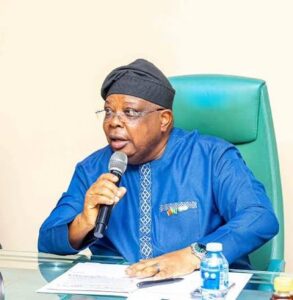


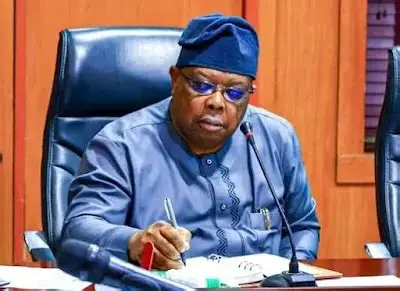
The Ministry of Power says it will penalise underperforming DisCos and GenCos and reform tariffs, after Minister Tegbe said Nigeria’s power sector “arithmetic does not add up.”
The Ministry of Power says it will penalise underperforming electricity distribution and generation companies (DisCos and GenCos) and pursue tariff reforms as part of efforts to support Nigeria’s industrialisation drive.
Minister of Power Joseph Olasunkanmi Tegbe disclosed this in a policy brief presented on his behalf by his special adviser, Martins Olajide, at the Nigerian Economic Summit Group’s (NESG) industrialisation and competitiveness forum on Wednesday.
The virtual forum, which convened policymakers, business leaders and economists, formed part of activities around NESG’s sixth annual MSME and Startup Economic Summit.
Performance Scorecards and Penalties
Tegbe said the ministry would introduce performance scorecards for power sector staff, DisCos and GenCos, with rewards for excellence and penalties for underperformance, to strengthen accountability across the electricity value chain. The move builds on remarks Tegbe made at a Q2 NESI stakeholders meeting in July, where he said the ministry was working toward publishing KPIs and performance scorecards for GenCos and DisCos to make both excellence and underperformance visible to the public, according to Lagos Post Online. “Trust in the market begins with trust in the numbers,” he said at that earlier event.
The push for tighter accountability echoes a position taken separately by NESG itself. In a paper published in its Economic and Policy Review Journal, authors Eyo O. Ekpo and Taiwo H. Odugbemi argued that unconditional federal government financial support has blunted the incentive for DisCos to improve, noting that by 2025, DisCos’ arrears to the Nigerian Bulk Electricity Trading Company (NBET) stood at an estimated N2.6 trillion, while government subsidy obligations exceeded N3.3 trillion, according to Arise News.
“The Power Arithmetic Does Not Add Up”
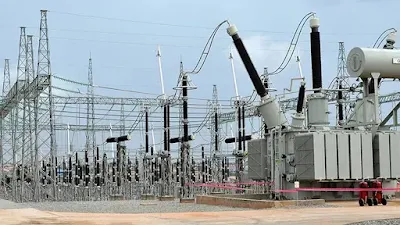
Tegbe said Nigeria has 13,625 megawatts (MW) of installed grid capacity, but average daily availability stands at only 4,854MW, meaning about 62 percent of installed capacity is idle despite realistic peak demand of roughly 20,000MW. “The power arithmetic does not add up,” he said.
The minister said the resulting gap between supply and demand has pushed households and businesses toward self-generation. Nigerians spent an estimated N16.5 trillion on self-generated electricity in 2023, he said, compared with about N1 trillion in revenue generated by the national grid. Citing World Bank estimates, Tegbe said inadequate electricity supply costs Nigeria about $25 billion annually, equivalent to 5 to 7 percent of GDP.
Tariff Reform and an Eight-Point Agenda
Tegbe proposed tariff reforms designed to protect vulnerable consumers while ensuring electricity supply obligations are met across the value chain. He said the scorecards and tariff measures form part of a broader eight-point agenda to stabilise the power value chain, restore market discipline and strengthen governance.
The agenda also includes plans to enhance the Lagos, Enugu-Port Harcourt, and Abuja-Kaduna-Kano transmission corridors, with Lagos serving as a proof of concept for a wider grid stabilisation programme, as well as measures to reduce commercial and technical losses, expand electricity metering, and optimise generation and transmission assets through targeted economic clusters and corridors to improve utilisation and attract investment.
Broader Context
The announcement is consistent with a wider posture Tegbe has taken since assuming office. At the July NESI meeting, he said Nigeria’s power crisis “was not built by one hand, and it will not be fixed by one hand,” calling on GenCos, DisCos, the Transmission Company of Nigeria (TCN), the Nigerian Independent System Operator (NISO), regulators and government to share responsibility for the sector’s problems and their solutions, according to multiple reports of that event. He also called at the time for power assets to be formally designated as Critical National Assets, describing vandalism, grid sabotage and energy theft as economic harm against ordinary households.
The prospect of penalties for underperforming operators is not new to Nigeria’s power sector. DisCo and GenCo operating licences, granted under the 2013 privatisation exercise, were designed with a 10-year performance review built in, and past administrations have periodically floated licence reviews over poor performance, though enforcement has historically been inconsistent.