

Kyiv says it sank a Russian corvette and hit a military-linked cargo ship near Benghazi, prompting calls for an investigation as Libya warns against becoming a battleground for foreign conflicts.
Ukraine has claimed responsibility for a drone attack that sank a Russian warship in eastern Libya, marking a significant geographical expansion of its war with Russia and raising concerns about the conflict’s growing reach beyond Europe.
Ukrainian President Volodymyr Zelenskyy confirmed on Monday, 23 November, that Ukrainian forces carried out the operation near the Libyan port city of Benghazi a day earlier.
He said seven Ukrainian-made naval drones were deployed to strike the Russian corvette Merkury and the cargo vessel MV Angara, which he alleged was being used to transport Russian weapons.
Zelenskyy described the operation as an “exemplary Ukrainian operation in response to Russia’s war”, adding that the targets had been successfully hit.
The Ukrainian president also said a Ka-27 helicopter aboard the warship was destroyed.
The Security Service of Ukraine (SBU) said the vessels were legitimate military targets because they supported Russia’s military capabilities and logistics.
What happened in Benghazi?
The attack occurred in the early hours of Sunday, 22 November, when an explosion and fire were reported aboard a Russian naval vessel docked at Benghazi’s naval base.
Libya’s eastern-based administration initially said a preliminary investigation suggested that the explosion was caused by a drone attack.
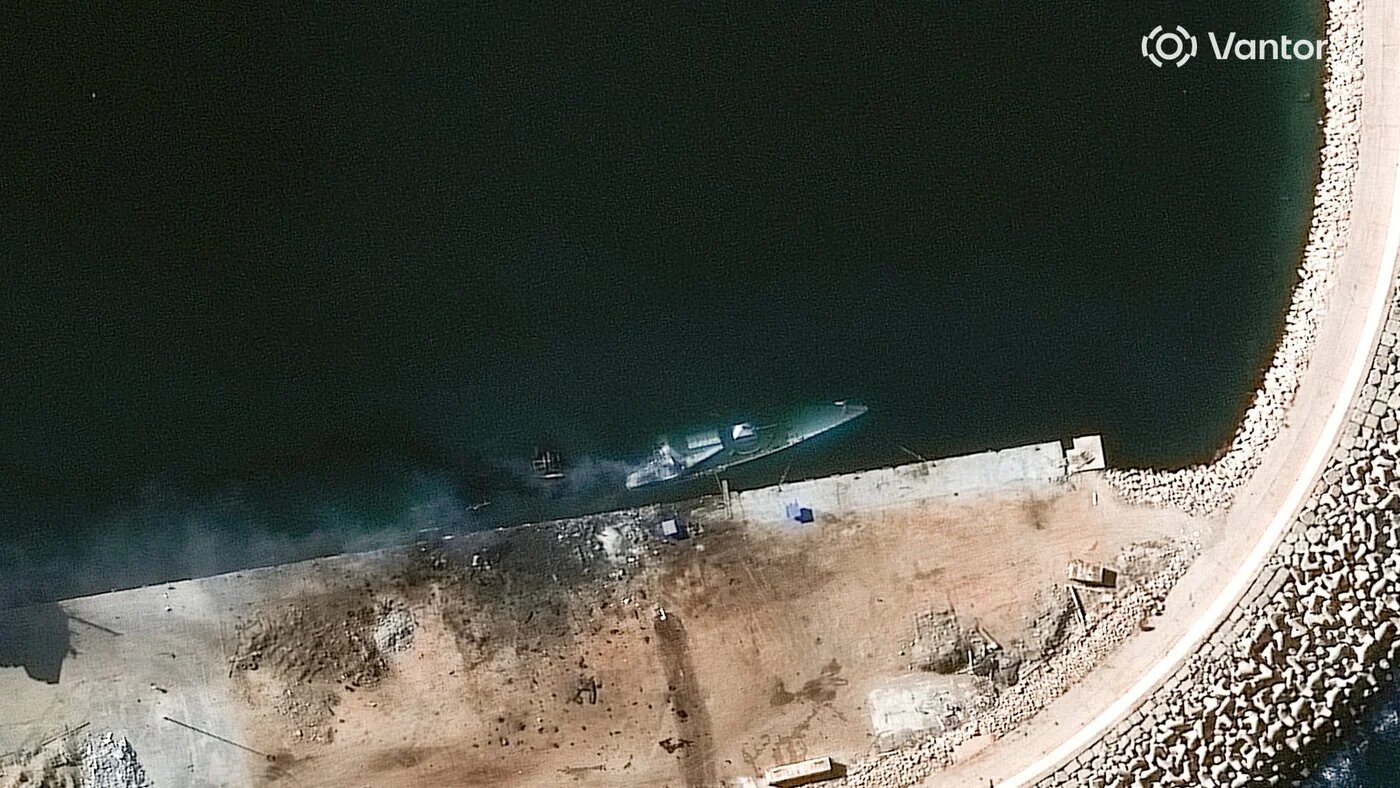
Satellite images later showed that the vessel, identified as the Merkury, had largely capsized and sunk, with smoke and debris visible around the port.
The Russian corvette was commissioned in 2023 and was reportedly in Benghazi to refuel and take on supplies while returning to Russia under a maritime cooperation arrangement with the eastern Libyan administration.
At least 10 people, including Russian and Libyan nationals, were injured in the incident, according to reports citing Libyan medical sources. No confirmed death toll has been established.
Ukraine’s SBU said the naval drones were transported to the area aboard a mother ship before being launched towards their targets.
The Ukrainian operation also reportedly struck the Russian cargo vessel MV Angara, which Kyiv accused of transporting military equipment.
A separate drone attack later targeted a Maltese-flagged commercial vessel off Benghazi. Its crew were rescued, with some members reported to have sustained minor injuries.
Why is Ukraine operating in Libya?
The attack highlights the growing strategic importance of Libya in Russia’s military and logistical activities in Africa and the Mediterranean.
Since the overthrow of longtime leader Muammar Gaddafi in 2011, Libya has remained politically divided between rival administrations.
The internationally recognised Government of National Unity operates from Tripoli in the west, while a rival eastern administration based around Benghazi is backed by military commander Khalifa Haftar.
Russia has developed close military and political ties with Haftar’s forces, using its relationship with the eastern administration to maintain influence in Libya and support its wider activities across Africa.
Russian vessels have also used Libyan ports as part of their logistical operations in the Mediterranean.
Meanwhile, reports have pointed to a growing Ukrainian security presence in western Libya, where Ukrainian military specialists are believed to have worked with forces aligned with the Tripoli administration.
The Associated Press reported that Ukrainian drone specialists had operated in western Libya for about a year under an arrangement involving the Tripoli-based government and Western backing. The eastern administration has since asked the United Nations to investigate allegations that the drones were launched from western Libya and that Ukrainian experts were involved.
The extent of Kyiv’s military presence and the precise nature of any agreement with authorities in Tripoli remain subjects of scrutiny.
Libya condemns attacks, demands investigation
The attack has drawn condemnation from officials in eastern Libya, who say the country’s territory and territorial waters must not become an extension of foreign conflicts.
Saddam Haftar, deputy commander of the eastern-based Libyan forces, rejected the use of Libyan territory as an arena for settling international disputes.
“We firmly reject the use of our territory or territorial waters as an arena for settling scores or as an extension of external conflicts,” he said.
The eastern administration also announced a joint investigation with Russia to establish the circumstances surrounding the attacks and identify those responsible.
Its Prime Minister, Osama Hamad, said the government had submitted a formal request to the United Nations General Assembly and Security Council for an international investigation.
The United Nations Support Mission in Libya (UNSMIL) also expressed serious concern, calling for an immediate, independent and transparent investigation.
“Libya cannot afford, and must not become a battleground for foreign conflicts,” the mission said.
UNSMIL urged all parties to exercise restraint and avoid circulating unverified information or politicising the incident while investigations are underway.
Russia and Ukraine war’s expanding reach
Russia has acknowledged Zelenskyy’s statement about the operation, but Kremlin spokesman Dmitry Peskov referred questions about the incident to the country’s Defence Ministry.
The strike is among the most significant Ukrainian operations against Russian military assets outside the immediate European theatre of the war.
Since Russia launched its full-scale invasion of Ukraine in February 2022, Kyiv has increasingly relied on long-range drones and naval weapons to target Russian military infrastructure, particularly in the Black Sea.
The attack in Benghazi demonstrates how Russia’s military and logistical relationships abroad could expose its assets to Ukrainian operations far from the frontline.
It also places Libya in a difficult position, given its internal political divisions and competing relationships with foreign powers.
For a country still struggling to reunify its institutions and stabilise its security environment, the possibility of becoming an active theatre in the Russia-Ukraine conflict presents another serious challenge.