

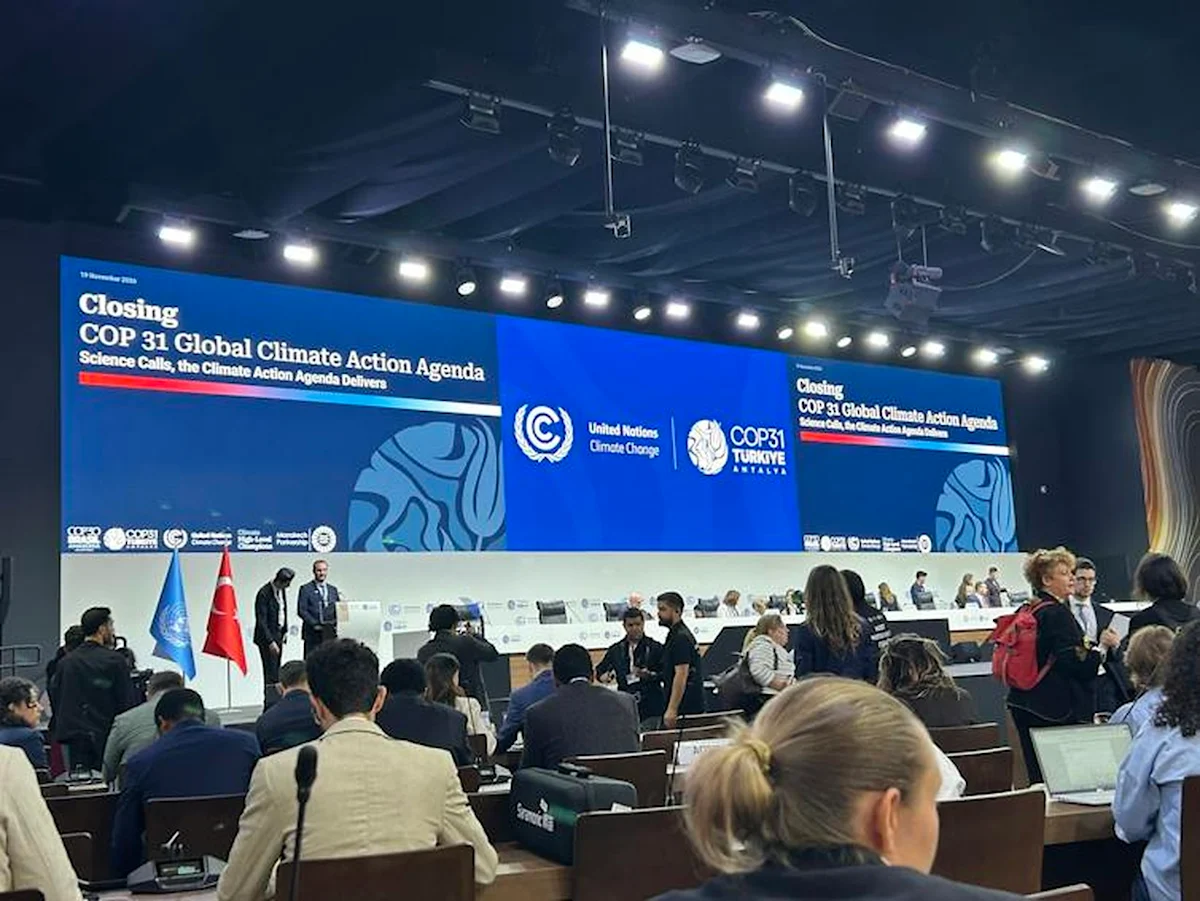
The Antalya summit closed without an overarching agreement after countries rejected the final draft, leaving disputes over fossil fuel transition and climate finance unresolved ahead of COP32 in Ethiopia.
The 31st United Nations Climate Change Conference (COP31) has ended without an overarching political agreement after countries failed to reach consensus on a proposed deal addressing fossil fuels, climate finance and the global response to climate change.
The summit, held in Antalya, Türkiye, from November 9, was scheduled to close on November 20 but continued for almost 49 hours beyond its deadline before negotiations collapsed on Sunday, November 22.
The extended negotiations made COP31 the longest UN climate conference on record, surpassing the previous record set by COP25 in Madrid in 2019.
COP31 President Murat Kurum confirmed at the closing plenary that the proposed final agreement, known as the Antalya Pact, would not be adopted after countries failed to bridge their differences over the text.
The breakdown followed objections from the European Union, the United Kingdom, Norway, Panama, the Marshall Islands and other countries, which said the final draft failed to address the urgency of the climate crisis because it made no direct reference to fossil fuels.
However, some progress was recorded on separate negotiating issues and voluntary climate initiatives. The failure to adopt the overarching agreement does not invalidate existing commitments under the Paris Agreement or previous COP decisions.
COP31 fossil fuel language sparks final disagreement
The disagreement over fossil fuels became the central obstacle to the proposed agreement.
The first draft of the presidency-led cover decision, released on November 16, included language calling for accelerated action to phase out fossil fuels, including a transition away from their use in energy systems.
However, subsequent drafts removed direct references to fossil fuels. The final proposal instead recalled the outcome of COP28 in Dubai in 2023, where countries agreed to transition away from fossil fuels in energy systems in a just, orderly and equitable manner.
The reference was insufficient for countries demanding a clearer commitment to implement the COP28 decision.
Ireland’s Environment Minister, Darragh O’Brien, speaking on behalf of the EU, said the bloc would not endorse an agreement that failed to mention fossil fuels, describing them as a key driver of climate change.
The disagreement reflected a wider divide between countries pushing for a clearer pathway away from coal, oil and gas and those resisting stronger language on fossil fuel production and consumption.
More than 130 countries had called for the final text to include a reference to transitioning away from fossil fuels. However, the Turkish and Australian presidencies did not retain the demand in the final draft.
The proposed agreement also faced criticism over its treatment of carbon capture and storage technologies. Critics argued that promoting carbon removal without stronger commitments to reduce fossil fuel use could allow continued dependence on oil and gas.
COP31 adaptation finance dispute deepens divisions
Climate finance was another major source of disagreement, particularly between developed countries and developing nations seeking more predictable funding to address the effects of climate change.
An earlier draft proposed that adaptation finance for developing countries should reach at least $120 billion annually, but the figure was removed from subsequent versions.
The later text retained a broader commitment to at least triple adaptation finance by 2035 but did not specify the $120 billion annual target or establish a clear baseline for measuring progress.
Developing countries have argued that increased adaptation funding is essential to help vulnerable communities respond to flooding, drought, rising temperatures and other climate-related threats.
The African Group of Negotiators (AGN), chaired by Ghana, expressed disappointment with aspects of the negotiations, particularly the treatment of long-term climate finance and climate education.
The group also questioned the process through which some decisions were presented, arguing that the presidency should facilitate consensus rather than impose outcomes on countries.
At the closing plenary, Ghana’s Environment Minister, Zanetor Agyeman-Rawlings, was interrupted while delivering the African group’s statement. The group’s chair, Nana Dr Antwi-Boasiako Amoah, challenged the interruption, arguing that Africa’s representatives deserved the same opportunity to express their positions as other delegations.
Kurum later apologised for the interruption.
The failure to agree on the overarching text means outstanding questions around adaptation finance and the transition away from fossil fuels will carry into further negotiations ahead of COP32 in Ethiopia.
Guterres, climate advocates react to COP31 outcome
United Nations Secretary-General António Guterres expressed disappointment that the conference ended without consensus, warning that the absence of agreement did not change the scientific evidence on climate change.
“There may be no consensus in the negotiating room. There is no ambiguity in the science,” he said.
Guterres said global temperatures continued to break records, climate extremes were intensifying and greenhouse gas emissions remained too high. He warned that the world was poised to exceed the 1.5-degree Celsius temperature limit set under the Paris Agreement.
He urged governments to do more to confront the climate crisis, accelerate the transition away from fossil fuels and increase support for vulnerable communities.
Christiana Figueres, former executive secretary of the UN Framework Convention on Climate Change (UNFCCC), also described the outcome as deeply disappointing.
However, she said more than 130 countries had refused to endorse a deal that did not reflect the scale of the climate crisis.
“Today nations stood up for what science and justice demand,” she said.
Mohamed Adow, director of Power Shift Africa, described COP31 as a “ghost COP”, arguing that wealthy countries had failed to provide the finance needed to accelerate climate action in developing countries.
He also criticised the failure to establish a just transition mechanism, which climate advocates had expected to advance following previous negotiations.
“COP31 was a ghost COP, and its lack of progress will haunt the climate vulnerable,” he said.
COP31 records progress outside formal negotiations
Despite the failure to adopt the overarching political agreement, some climate initiatives advanced outside the formal negotiations.
One of the major initiatives was the 35-by-35 Global Electrification Pledge, which seeks to increase electricity’s share of global final energy consumption to 35 per cent by 2035, from about 23 per cent currently.
Around 90 countries backed the voluntary initiative, which was promoted by the Turkish and Australian presidencies.
However, the pledge does not amount to a binding commitment to phase out fossil fuels. Its impact will also depend on how the additional electricity is generated, particularly whether countries expand renewable energy capacity alongside electrification.
Other negotiations also recorded progress, including work on just transition and adaptation, although some proposed decisions remained unresolved.
The next summit, COP32, is scheduled to take place in Addis Ababa, Ethiopia, in November 2027, placing climate finance, fossil fuel transition and the implementation of previous commitments among the major issues awaiting further negotiations.
The failure in Antalya has exposed the difficulty of securing agreement among nearly 200 countries with competing economic and energy interests. It has also renewed questions about whether the UN climate process can translate previous commitments into the action and funding needed to address the crisis.