

From food prices and electricity to healthcare, jobs, housing and security, the APC’s new manifesto sets out targets that could shape everyday life. Here is what the promises involve and what Nigerians should watch.
For many Nigerians, the most important question about any government manifesto is not how impressive the figures look on paper. It is whether life will become more affordable, whether businesses can operate without spending a fortune on generators, whether hospitals can treat patients without pushing families into debt, and whether people can move around without fear.
These are the everyday concerns President Bola Tinubu’s new 2027–2031 manifesto attempts to address.
It contains targets for food affordability, electricity, healthcare, employment, housing and public safety. Some are numerical, with specific deadlines. Others are broad policy commitments whose success will depend on how the government defines and measures progress.
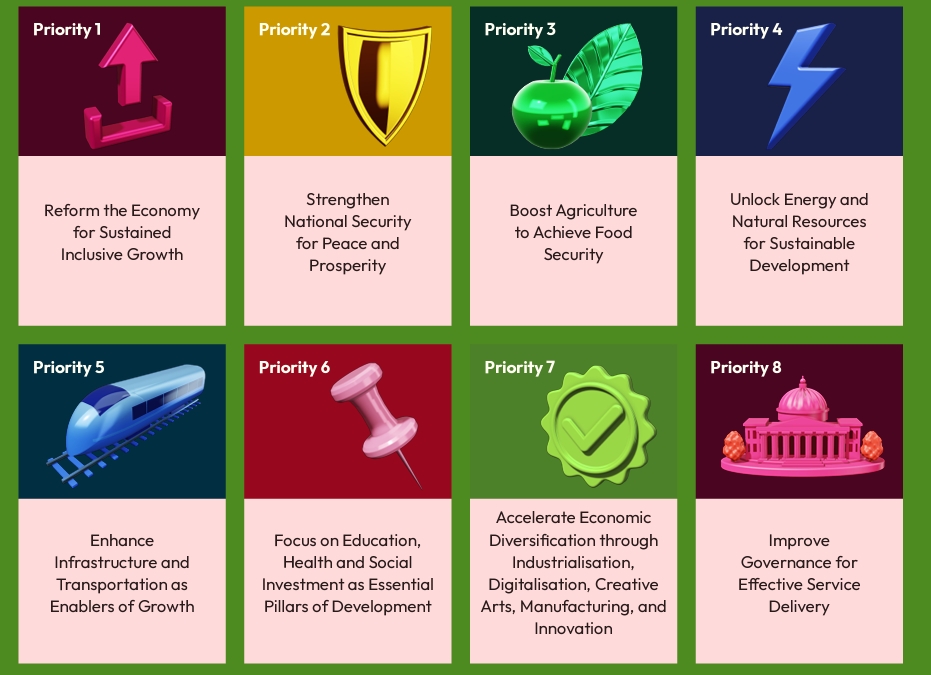
The proposals are for the 2027–2031 period and depend on Tinubu securing another term. They are promises, not evidence that the targets have been achieved.
Here are seven areas that could have the most direct impact on ordinary Nigerians:
1. Food prices: Will families be able to afford their next meal?
Food affordability is one of the manifesto’s central promises. The APC says it wants to stabilise staple-food prices through the Guaranteed Minimum Price scheme and strategic grain reserves.
It also promises to publish a monthly staple-food price tracker, showing Nigerians how prices are changing alongside headline inflation.
The plan goes beyond monitoring prices. It proposes expanding storage facilities, cold-chain infrastructure, farm-to-market roads and agro-processing to reduce the amount of food lost between harvest and the market.
The manifesto also links food affordability to cheaper transportation, including road, rail and compressed natural gas (CNG) initiatives. It proposes expanding school feeding and nutrition support for children and mothers.
For households, the intended result is straightforward: fewer sudden increases in the cost of basic food, better availability of produce and lower transportation costs passed on to consumers.
But there is an important distinction. The manifesto does not promise a specific percentage reduction in the price of rice, beans, garri or other staples. Its commitment is to steadier prices, better supply chains and more transparent monitoring.
The test will be whether the monthly tracker is published consistently, whether strategic grain reserves are disclosed and whether improvements in storage and transportation translate into lower market prices.
2. Electricity: More power for homes and businesses
The manifesto targets at least 7,500 megawatts of sustained average electricity generation and 10,000MW at peak by 2031.
It also promises seven million additional electricity meters, with at least two million installations annually, while reducing aggregate technical, commercial and collection losses in the distribution system to no more than 16 per cent.
The document gives a Q2 2026 baseline of 4,022MW average generation and 5,800MW peak generation.
For ordinary Nigerians, the promise is about more than the amount of electricity generated. It is about how much power actually reaches homes, shops, factories and offices, and how reliably it is supplied.
More meters could reduce estimated billing and give customers better control over electricity consumption. Lower distribution losses could improve the financial health of the electricity market, while dedicated power for industrial clusters could reduce dependence on generators.
However, generation figures alone will not tell the full story. Nigerians will need information on average delivered electricity, hours of supply, voltage quality, outages and the performance of distribution companies.
The manifesto itself proposes quarterly public reporting on some of these indicators. Whether that information becomes available and reflects consumers’ actual experiences will matter.
3. Healthcare: Less money spent before treatment
Healthcare is another major area of the manifesto, particularly the financial burden placed on families when someone falls ill.
The APC wants to increase active health insurance coverage from more than 23 million enrollees to 40 per cent of Nigerians by 2031.
It also promises to reduce out-of-pocket health expenditure from 71 per cent of total health spending to below 50 per cent.
The plan includes increasing the proportion of functional primary healthcare centres from 53 per cent to 90 per cent, extending direct quarterly financing under the Basic Health Care Provision Fund to all 17,600 primary healthcare centres and expanding emergency maternal care to all 774 local government areas.
The government also intends to provide steady electricity to 30 per cent of health facilities by the end of 2027 through solar installations, improve healthcare workers’ conditions and increase local production of essential medicines to 50 per cent by 2031.
For patients, these commitments could mean more accessible clinics, fewer journeys to distant hospitals, better-equipped facilities and greater financial protection when medical attention is needed.
But insurance enrolment figures must be treated carefully. The important measure is active coverage and whether people can actually access services when they need them. A health insurance card that does not translate into affordable treatment offers limited protection.
4. Jobs and skills: Training must lead somewhere
The manifesto sets an ambitious target of halving youth unemployment by 2031.
It also promises skills training for two million young Nigerians and digital literacy programmes targeting 30 million people.
Other commitments include expanding access to credit through initiatives such as NEXTGEN Bank, the Nigeria Youth Investment Fund and YouthCred, as well as pursuing a proposed Youth Bank law that would make financing available without traditional collateral requirements.
The document also targets one million export-linked jobs for young Nigerians through talent and services exports by 2030. It proposes at least one major industrial cluster in each geopolitical zone to support manufacturing, investment and employment.
For young Nigerians, these promises could create more routes into employment, entrepreneurship and the digital economy.
However, the number of people trained is not the same as the number of people employed. The manifesto acknowledges this by promising to track job placements, business survival and job creation.
The real test will be whether training programmes lead to paid work, whether businesses can access affordable capital and whether new industrial investments translate into jobs that last.
5. Housing: A target of 200,000 homes
Housing is one of the manifesto’s most detailed commitments.
The Tinubu Mass Social Housing Scheme is expected to operate across all 774 local government areas, with a target of 200 units in each council area. That amounts to 154,800 homes.
The broader ambition is to work towards 200,000 homes through the social housing scheme, mortgage financing and partnerships with licensed private developers.
The plan also includes capitalising the Ministry of Finance Incorporated Real Estate Investment Fund (MREIF) towards ₦1 trillion, increasing the Federal Mortgage Bank of Nigeria’s loan ceiling from ₦50 million to ₦85 million and growing National Housing Fund contributors from six million to 10 million by 2028.
There are also proposals for affordable rental housing, incremental housing, digital land titles and stronger regulation of property developers.
For ordinary Nigerians, the intention is to make home ownership and secure accommodation more accessible, particularly for working households that cannot afford to buy property outright.
But the figures need careful monitoring. The 154,800 units under the local government scheme are not the same as the wider 200,000-home target.
More importantly, Nigerians should be able to see how many homes have been completed, handed over, occupied and mortgaged, rather than simply announced or started.
6. Security: More officers and stronger community policing
The security commitments include recruiting and deploying 50,000 newly recruited police officers, with the goal of moving towards a police-to-citizen ratio of one officer to 400 people.
The government also plans to recruit 28,000 additional military personnel, complete four new Army divisions in Makurdi, Ilorin, Jalingo and Benin City, and strengthen border surveillance.
Other proposals include body cameras, digital police records, emergency dispatch systems, forensic infrastructure and a legal framework for accountable state and community policing.
For Nigerians, the expected impact is safer communities, better emergency response and improved protection for farmers, traders, commuters and schoolchildren.
Yet recruitment numbers cannot, on their own, demonstrate improved security. Deployment, equipment, training, response times and accountability will be equally important.
The manifesto promises public reporting on the deployment of additional military personnel. Nigerians should also expect transparent information about where new police officers are posted and how their presence affects security at community level.
7. Education and social protection: Protecting families beyond income
The seventh commitment brings together education, minimum wage protections and support for vulnerable households.
The manifesto targets a 50 per cent reduction in the number of out-of-school children by 2031 and the recruitment and training of 20,000 additional teachers.
It also promises to verify at least 20 million people on the National Social Register by 2030, expand direct cash transfers and take the national school feeding programme to full coverage.
On employment protections, the APC says it will enforce the ₦70,000 minimum wage nationwide and expand training to 100,000 unemployed citizens annually by 2030.
The document also proposes stronger support for older people, children, persons with disabilities and vulnerable families.
For households, these commitments could mean more children in school, better access to social assistance and stronger protection for workers.
But the number of people listed in a social register is not the same as the number receiving support. The government will need to demonstrate that beneficiaries are properly identified, payments reach them and the assistance makes a measurable difference.
The bigger question: Who will be held responsible?
Beyond these seven areas, the manifesto makes a commitment that could determine whether any of the promises are taken seriously: public accountability.
It says every commitment should have a baseline, a target, a cost, a named owner and a reporting date, all published through a public delivery tracker. It also promises independent verification and public progress reports.
The first 100 days are expected to include publication of baselines and named owners, a quarterly cost-of-living basket, an independent audit of unfinished and under-used public assets, and the launch of a Citizen Service Guarantee.
These are important starting points. Without clear budgets, responsible institutions and regular evidence of delivery, even the most detailed targets can become difficult to monitor.
The manifesto offers Nigerians a long list of things to expect by 2031. The challenge will be determining how much of that list moves from paper to reality.
For a family buying food, a trader paying for electricity, a patient seeking treatment or a young person looking for work, the measure of success will not be the number of promises made.
It will be what has actually changed in their lives.