

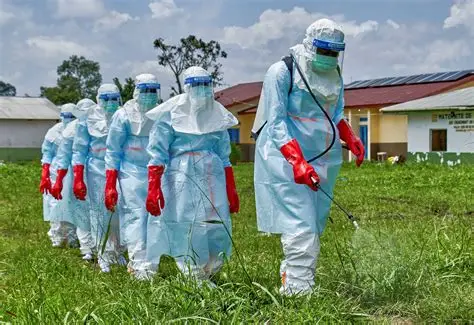
Jean Kaseya says more than 10,200 cases have been confirmed across affected countries as African health ministers intensify efforts to contain the Bundibugyo virus outbreak.
The Director-General of the Africa Centres for Disease Control and Prevention (Africa CDC), Jean Kaseya, has warned that the Ebola outbreak spreading across parts of Africa is not yet under control, despite ongoing containment efforts.
Kaseya gave the assessment on Friday during an interview on Morning Brief, a Channels Television programme, following a virtual meeting of African health ministers convened by the agency on October 28.
He said the meeting brought together more than 42 ministers and over 600 participants, including representatives of international organisations and development partners, to review the outbreak’s trajectory and discuss a coordinated response.
“We analysed the data and we saw that the outbreak is not yet under control,” Kaseya said.
He said the outbreak had resulted in more than 10,200 confirmed cases across the continent and over 5,000 deaths.
“We have achieved what is a number of 10,000 people confirmed cases in DRC and also, if we put together, it’s more than 10,200 confirmed cases across the continent,” he said.
“We also saw that we have more than 5,000 people already passed on due to this outbreak.”
However, the latest available figures from the European Centre for Disease Prevention and Control (ECDC) put confirmed cases in the Democratic Republic of the Congo (DRC) at 10,193, with 4,960 related deaths as of October 28. The US Centers for Disease Control and Prevention (CDC), using figures from affected countries as of October 27, reported a combined 10,224 confirmed cases and 4,964 deaths.
DRC remains epicentre of Ebola outbreak

Kaseya said the geographical spread of the outbreak was changing, with the epicentre shifting as health authorities continued monitoring transmission patterns.
The outbreak is caused by the Bundibugyo virus, a strain of Ebola that has spread from the DRC to other countries, including Kenya and Nigeria. Uganda also recorded cases earlier in the outbreak, although it subsequently declared the outbreak over.
The DRC remains the worst-affected country, with community transmission continuing across eight provinces, including Ituri, North Kivu, South Kivu and Haut-Uele.
According to the ECDC, 52 new confirmed cases and 32 deaths were reported in the DRC between October 26 and 27, highlighting the continuing spread of the disease.
Kenya has reported nine confirmed cases, including two deaths, linked to an imported infection from the DRC. The last reported case in the country was identified on October 20.
Nigeria monitors 62 contacts after imported case
Nigeria confirmed its first Ebola case in more than a decade on October 20, after a 42-year-old Swiss woman tested positive for the Bundibugyo virus in Abuja.
The woman had travelled from Uganda to Nigeria and developed symptoms four days after arriving in the country. She sought medical attention in Abuja on October 11 before testing positive nine days later.
She was initially isolated and treated by Nigerian health authorities before being medically evacuated to Switzerland on October 26. Her husband, who was identified as a close contact, was also evacuated for monitoring and care.
Following the evacuation, Mohamed Janabi, WHO regional director for Africa, said Nigeria had no confirmed Ebola cases. However, the World Health Organisation clarified that the evacuation did not mean the country had been declared Ebola-free.
The organisation said contact tracing and monitoring must continue, with Nigeria required to complete the 42-day monitoring period after the last possible exposure before an official declaration can be made.
In its October 29 situation report, the Nigeria Centre for Disease Control and Prevention (NCDC) said 62 contacts linked to the index case had been identified and were being monitored.
The agency reported no new contacts or symptomatic contacts in the preceding 24 hours. It also said a suspected case reported in Enugu had tested negative.
African health ministers agree to strengthen cross-border response
The October 28 meeting was convened by Africa CDC as the outbreak spread across Central, Eastern and Western Africa.
The agency had earlier warned that the geographical spread of the Bundibugyo virus required stronger coordination, surveillance and political commitment across the continent.
Following the meeting, Kaseya said African countries had agreed to prepare for possible cases, coordinate their responses across borders and keep borders open while strengthening monitoring.
“We agreed to prepare every country, coordinate across our borders and keep those borders open while watching them closely,” he said.
The agency has also called for stronger disease surveillance, cross-border cooperation, community engagement and protection for frontline health workers.
The outbreak has raised concerns about the capacity of African health systems to detect and contain infectious diseases, particularly as people move across national borders for trade, work and travel.
With community transmission continuing in the DRC and imported cases reported elsewhere, health authorities face the challenge of preventing further spread while sustaining contact tracing, early detection and treatment efforts.