


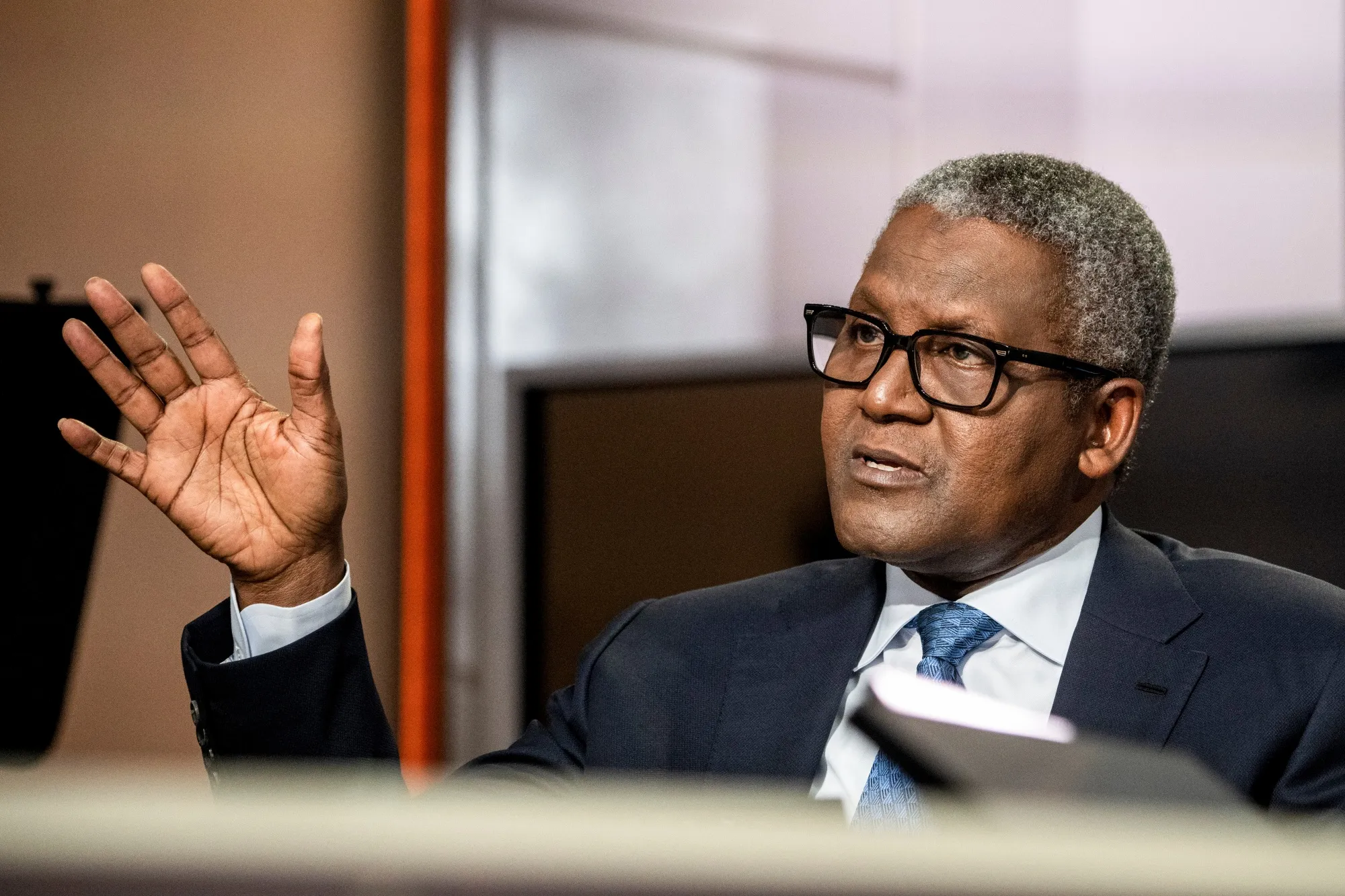
The billionaire says his three daughters are capable of taking the Dangote Group forward, but insists succession must prioritise professional management and strong governance.
Aliko Dangote, Chairman of Dangote Group, has said having a male heir to inherit his business empire is not a priority, expressing confidence that his three daughters could eventually take leadership of the conglomerate.
Dangote made the remarks during an interview with ARISE News on Tuesday, amid questions about succession and the traditional expectation in parts of northern Nigeria that family businesses should have a male heir.
Asked whether he could see one of his daughters eventually leading the group, Dangote said he had been closely observing all three and believed they had the capacity to take charge.
“I think, yes, I can see one of them. I’ve been watching all of them, so I can definitely see one of the three that can actually lead,” he said.
ARISE separately reported Dangote as saying he could see one or two of his daughters eventually leading the conglomerate, while he described all three as capable.
Dangote backs daughters for succession
Dangote’s daughters, Halima, Fatima and Mariya, already hold senior positions within the family business, with their responsibilities expanding as the group develops its succession structure.
According to Dangote, their involvement in the business has been driven by personal interest rather than parental pressure.
“They are very, very interested in the business. I’m not forcing them to come and be part of this business, no. They are very interested, and they enjoy it,” he said.
The businessman also said he believed his daughters could surpass what he had achieved and take the company to a higher level.
He said their education and exposure could make them more creative in running the conglomerate and, when asked whether he considered all three capable, replied, “All of them.”
The comments come as the Dangote Group continues to expand its industrial footprint, with the billionaire increasingly discussing how the conglomerate should be managed beyond his own tenure.
‘A son is not my priority’
Dangote was also asked whether he still hoped to have a son, particularly given traditional expectations surrounding male heirs in Kano.
He dismissed the idea that having a son was necessary to preserve his family’s name or business legacy.
“Sometimes you can pray for God to give you a son, but that son might be the one to bring down the name of the family,” he said.
“Sometimes when God doesn’t give you something, don’t push. I don’t think a son would have done something better than these three daughters that I have. That one, I think, you know, it’s not my priority.”
Dangote said having a male child was not automatically a guarantee that a family’s legacy would survive.
He added that, even if he had a son, he did not believe the child would necessarily perform better than his daughters.
Professional management comes first
Beyond the question of who might eventually take charge, Dangote said his succession plans were centred on ensuring the company remained professionally managed.
“I want this company to be run professionally. I want to have the highest level of governance,” he said.
He pointed to companies such as Microsoft and Apple as examples of businesses that had continued beyond their founders.
“We want to make sure that we make it very difficult for any family member to come and destroy anything,” Dangote said.
His comments suggest that succession, in his view, is not simply about choosing a family member to inherit control but about building governance structures strong enough to protect the business regardless of who eventually occupies the top position.
The remarks come as Dangote Group enters another major phase, following the launch of the public offering of shares in Dangote Petroleum Refinery and Petrochemicals. Reuters reported that the offering is seeking to raise up to $2.1 billion to fund the refinery’s expansion.
For Dangote, however, the larger ambition appears to extend beyond preserving a family business.
“What I want to leave as a legacy is to industrialise Africa,” he said.
“I cannot do it alone, but I’m 100% sure that in the next two or three years, other Africans will join.”