

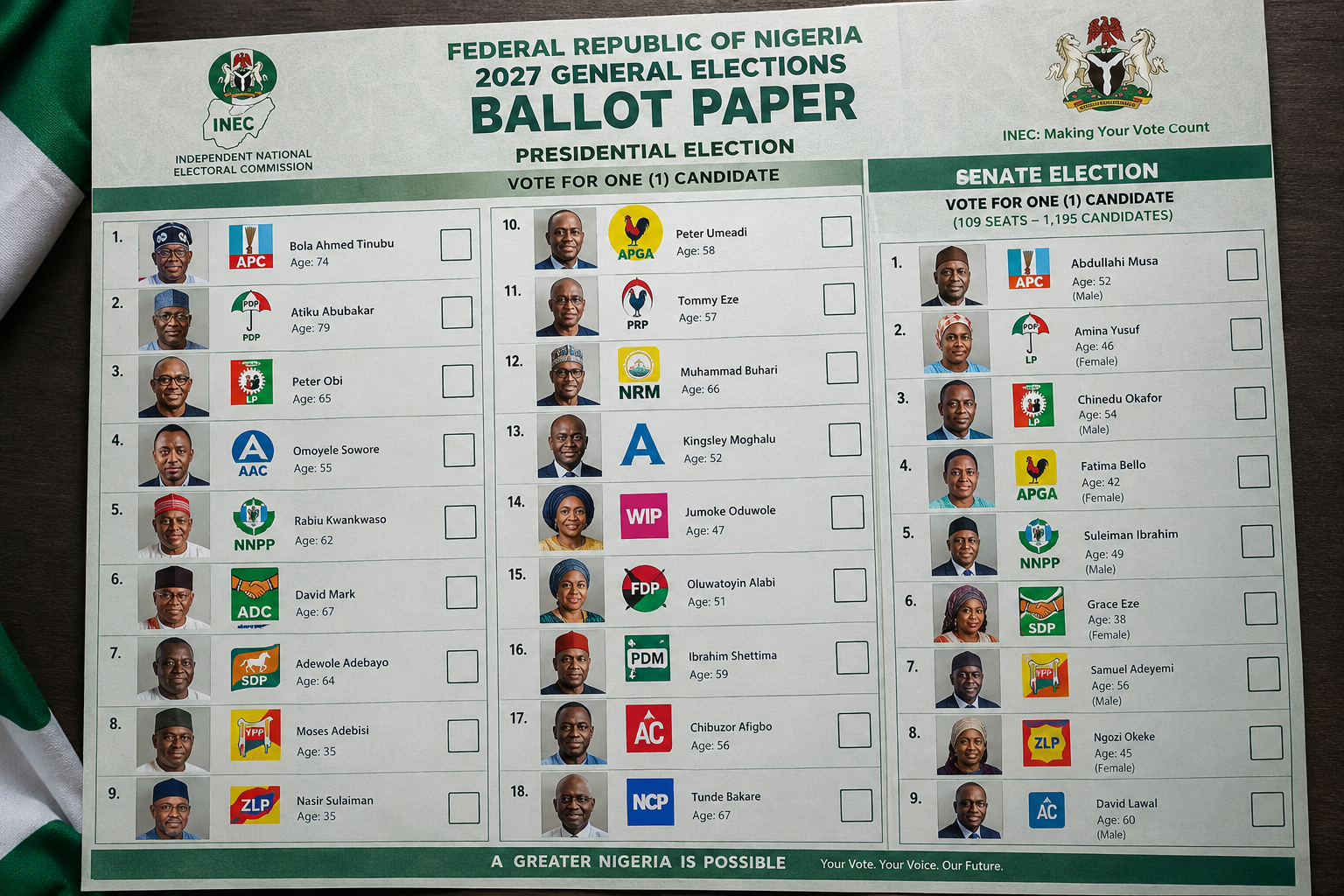
Eighteen presidential tickets, 1,195 Senate hopefuls, and somewhere in all that data, the country’s median age of 18 barely shows up at all.
Nigeria is heading into another election season with a ballot that is technically broad, politically crowded and, when viewed against the country’s demographics, surprisingly unrepresentative.
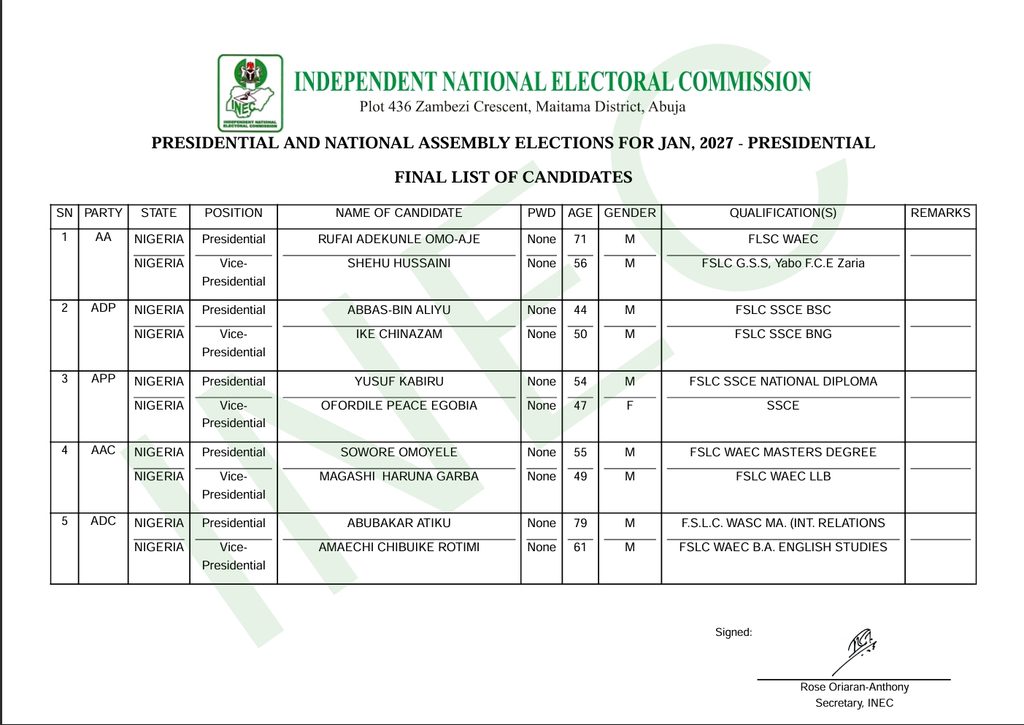
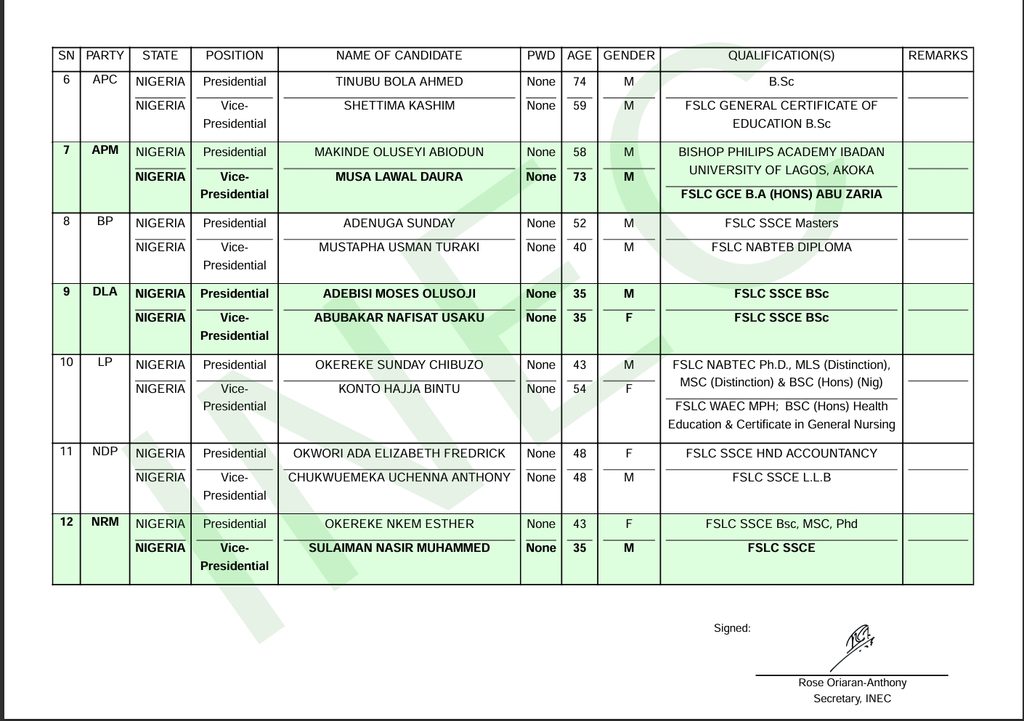
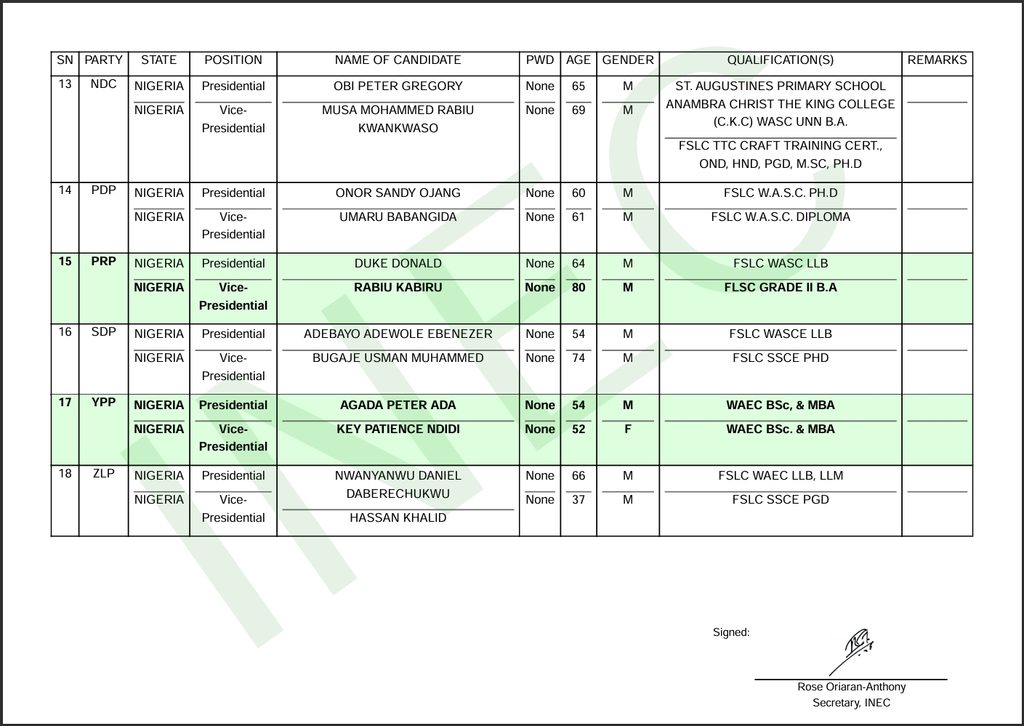
The final list of presidential candidates published by the Independent National Electoral Commission has 18 names. The Senate race has 1,195 candidates competing for 109 seats.
On paper, that looks like a healthy democratic field. Look closer, however, and another picture emerges.
The people seeking power do not look much like the population they want to govern.
Take a look at the list:
Age is the first giveaway
Nigeria is one of the youngest countries in the world. With a population of 238M people, Nigeria has a median age of 19.2 years.
Look at the presidential ballot, however, and that youthfulness disappears.
The three men who currently dominate serious discussion of the presidential race are 74, 79 and 65. Tinubu is 74. Peter Obi, at 65, is the “young” option among the leading contenders, and he’s not a token entry either. After his surprisingly strong 2023 run, Obi is widely treated as a genuine third force with a real path, not simply a protest vote. Even so, none of the three leading contenders is under 65.
Then there’s Omoyele Sowore, Sowore built his 2019 and 2023 campaigns around generational change, the argument that Nigeria’s gerontocracy needed to be broken by someone who wasn’t part of the old guard. He was 47 when he first ran. He’s 55 now, on his third attempt, still running as the outsider, except the outsider has aged eight years without the guard actually changing. That’s not a knock on Sowore personally; people are allowed to keep running. But it’s a quietly revealing detail about how long “generational renewal” can be promised in Nigerian politics before it has to reckon with its own candidate’s birth certificate.
This is not an argument that older politicians should be disqualified from public office. Experience matters, and age alone tells us very little about a person’s ability to govern.
But representation is another question.
If the median Nigerian is 19, there is something worth examining about a political system in which the people with the strongest realistic pathways to the presidency are separated from that median by several decades.
Atiku, if elected, would become the oldest person to assume Nigeria’s presidency, surpassing the record set by Muhammadu Buhari, who was 72 when he took office in 2015.
Meanwhile, the youngest presidential candidates, Moses Adebisi and Nasir Sulaiman, are both 35. They are on the ballot, but neither is considered a serious contender for Aso Rock.
That distinction matters. A ballot can include young people without giving young people a meaningful shot at power. And that is where the question moves beyond age.
Then there is the question of women
Nigeria is not only young. It is also roughly half female. Yet women remain strikingly scarce among those seeking national political power.
The final INEC list has 18 presidential candidates. Only two are women, while four women are running as vice-presidential candidates.
No woman has ever been elected president or vice-president of Nigeria. And in 2027, none of the major parties has placed a woman at the top of its presidential ticket.
The numbers are even more revealing in the Senate race.
Of the 1,195 candidates cleared to contest the 109 Senate seats, 1,080 are men and just 115 are women. That means women account for roughly 9.6 per cent of the candidates seeking seats in the chamber.
So, again, this is not about whether women are legally allowed to contest. They are.
It is about what happens between being legally eligible and becoming politically competitive.
Nigeria has been here before. Women have appeared on presidential and vice-presidential tickets in previous elections, but that has rarely translated into sustained access to the highest levels of political power.
The National Assembly has also never come close to reflecting the gender balance of the country it represents. Female representation has remained low across successive assemblies, despite repeated calls for reform.
The result is a political system in which women constitute a huge part of the electorate but a much smaller part of the political class competing to represent them.
The National Assembly knows there is a problem
Interestingly, the institution at the centre of this problem is also increasingly acknowledging it.
During its 2026 Open Week, held under the theme “Advancing Transparency, Inclusion and Reform”, the National Assembly hosted a dedicated dialogue on reserved seats for women and persons with disabilities.
It also held a Youth Town Hall focused on young people’s participation in governance, alongside wider discussions involving civil society groups, development partners, women and youth organisations.
The Federal Ministry of Women Affairs used the platform to renew its advocacy for the Women’s Special Seats Bill, which seeks reserved seats for women in the National Assembly and state Houses of Assembly.
That creates an uncomfortable contrast.
The institution is opening its doors to discuss how Nigeria can make political representation more inclusive, even as the electoral pipeline feeding that same institution continues to produce a candidate pool that is overwhelmingly male and, at the presidential level, dominated by older politicians.
The conversation about inclusion is happening.
The harder question is whether inclusion is making it onto the ballot.
What does the ballot actually represent?
None of this means the 2027 election is illegitimate. It does not mean older candidates should make way simply because Nigeria is young, or that women should be handed political offices regardless of merit.
Elections are competitions. Candidates still have to win voters, build organisations, raise money and navigate the machinery of political parties.
But that is precisely why the candidate list deserves scrutiny. Before Nigerians vote, the political system has already made a series of choices about who gets to compete seriously.
Those choices are shaped by party structures, name recognition, political networks, money, incumbency and years of accumulated influence.
That does not make the eventual winner illegitimate. But it does raise a more uncomfortable question: how representative is the competition before voters even enter the equation?
A country can have universal adult suffrage and still have a political class that looks very different from its population. Nigeria’s 2027 ballot appears to demonstrate exactly that.
Its population is exceptionally young, but its most viable presidential contenders are decades older. Its population is roughly half female, yet women make up fewer than one in 10 Senate candidates.
And while the National Assembly is discussing reserved seats, youth participation and broader inclusion, the candidates most likely to fill those seats still come disproportionately from groups that have historically dominated Nigerian politics.
A ballot can be valid and still tell an incomplete story
There is a temptation to treat an election as representative simply because everyone has, at least theoretically, the right to vote. But representation begins much earlier than the polling booth.
It begins with who can afford to run. Who can secure a party ticket. Who can build the machinery required to compete. Who has enough name recognition to be taken seriously.
And, ultimately, who gets to appear on the ballot with a realistic chance of winning.
That is why the 2027 candidate lists are worth examining beyond the usual horse-race question of who will win. They reveal something about the Nigerian political system itself. The ballot is a mirror, but it is a curious one. It reflects Nigeria’s political structure more accurately than it reflects Nigeria’s population.
Nigerians will vote in January regardless, and whatever the result, it will be entirely legitimate under every rule that governs the process. But legitimacy and representation are not the same thing.
A country can run a flawless election and still walk away with a ballot that tells it surprisingly little about who it actually is.