

NDC says INEC published 10 unauthorised names as its Anambra State Assembly candidates for 2027; INEC says it lacks legal power to nominate or substitute candidates and will verify the claims against its records.
The Independent National Electoral Commission (INEC) has denied altering the House of Assembly candidates submitted by the Nigeria Democratic Congress (NDC), after the party accused the commission of removing its nominated candidates for the 2027 state assembly elections and replacing them with “impostors.”
In a statement on Sunday, NDC National Chairman Senator Moses Cleopas Zuwoghe said the list of Anambra candidates for the state assembly elections, published by INEC on Sunday, August 30, contained names not authorised, approved or submitted by the party.
Zuwoghe named the affected constituencies as Onitsha South 1, Onitsha South 2, Orumba North, Anaocha 1, Idemili North, Njikoka 1, Nnewi South 1, Nnewi South 2, Ayamelum and Dunukofia, and separately identified the individuals published in place of the party’s candidates, including Umennaajiego Jude Ezenwa, Akpotue Obinna Chibuike and Nwankwo Chiemerie, among others.
A Serious Allegation
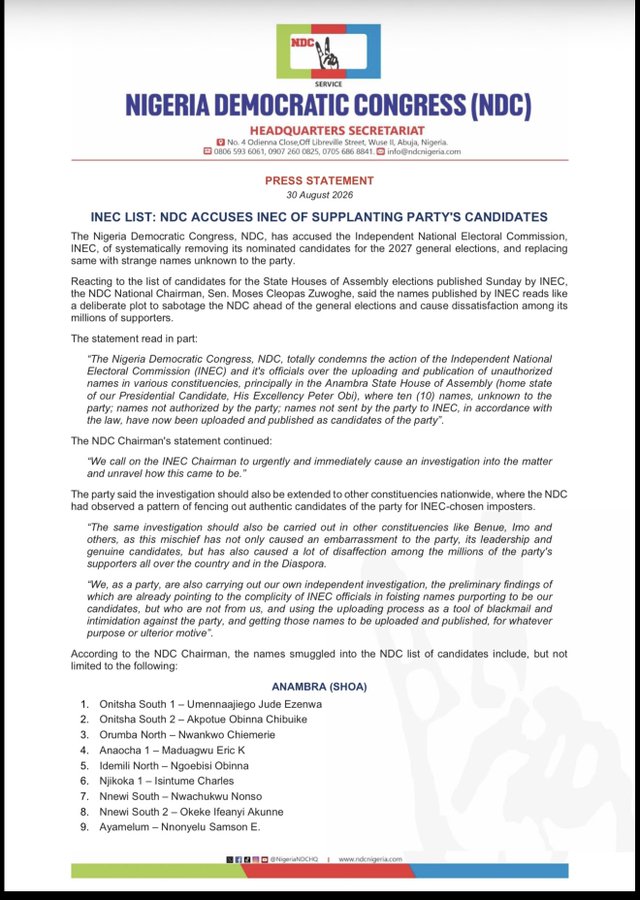
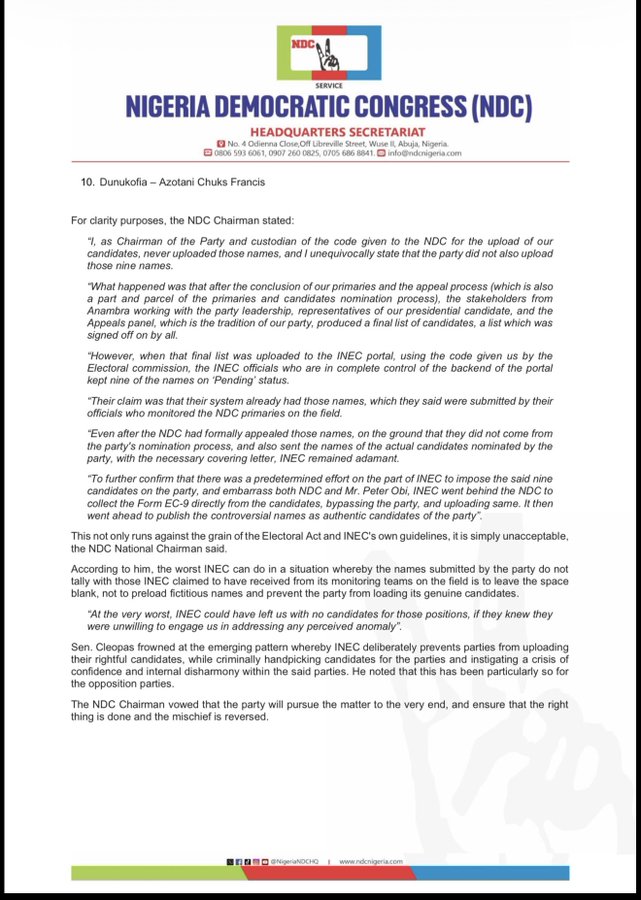
Zuwoghe said the disputed list emerged despite the party having completed its primaries and appeal process, with a final candidate list signed off by Anambra stakeholders, party leadership, representatives of presidential candidate Peter Obi, and members of the party’s appeals panel.
He alleged that INEC officials had gone around the party to obtain Form EC9 nomination documents directly from individual aspirants and uploaded their particulars onto the commission’s portal without the party’s authorisation, and said the party’s preliminary internal investigation pointed to possible complicity by some INEC officials. He described the situation as “a deliberate attempt to sabotage the NDC” and generate disaffection among its supporters, and said the issue was especially troubling given that Anambra is the home state of the party’s presidential candidate.
Zuwoghe also alleged that a similar pattern had emerged in other states, including Benue and Imo, and said the party would pursue legal redress if necessary to have its authentic candidates restored, arguing that if INEC had concerns about the NDC’s submitted names, it should have left the affected positions vacant rather than publish unauthorised substitutes.
INEC’s Response

Reacting in a statement on Monday, INEC Chief Press Secretary Adedayo Oketola described the allegations as “serious” but said the commission does not nominate candidates for political parties.
“The Commission does not possess the legal authority to select a candidate for a political party or substitute its own preferred candidate for a person validly nominated by a political party in accordance with the law,” he said, adding that candidate nomination is the responsibility of political parties, subject to the Constitution, the Electoral Act 2026, and other applicable regulations.
Oketola said political parties submit candidate particulars through INEC’s candidate nomination portal using access credentials issued for that purpose, and that all portal activity is electronically recorded and can be verified through the commission’s audit trail, which can establish the history and source of any entry. Rather than address the claims through speculation, he said, “the Commission will examine the relevant records relating to the constituencies identified by the NDC” to establish the facts.
Oketola also clarified that INEC’s role in monitoring party primaries is separate from a party’s responsibility to nominate and submit its own candidates, and that monitoring a primary does not amount to INEC choosing a candidate on a party’s behalf.
“INEC cannot assume the role of a political party in choosing its candidates, nor can it disregard applicable statutory requirements governing the nomination and submission of candidates,” he said, adding that any credible allegation of misconduct by a commission official would be investigated through established procedures.
He said INEC has no institutional interest in which candidates political parties choose, and that parties themselves bear responsibility for ensuring their nomination processes, internal appeals, and use of the nomination portal comply with the law and prescribed timelines. “The Commission will neither nominate candidates for political parties nor lend itself to the imposition of candidates on any political party,” Oketola said, adding that legitimate concerns raised about the nomination process would be addressed based on the commission’s records and applicable law.
As of the latest reporting, INEC had not issued a specific finding on the Anambra constituencies named by the NDC, and the dispute remains unresolved.
Background
The NDC is a relatively new political vehicle, and its rise is tied closely to a string of defections by presidential candidate Peter Obi. Obi ran for president under the Labour Party (LP) in 2023, finishing third with over 6 million votes in a result that established him as a major opposition figure. Following prolonged internal crisis within the LP, he defected to the African Democratic Congress (ADC) in December 2025, before defecting again, this time to the NDC, in May 2026, alongside former Kano State Governor Rabiu Kwankwaso, citing the ADC’s own internal disputes. That move triggered a wave of further defections into the NDC from the APC, PRP and NNPP.
The NDC itself was only officially registered by INEC in February 2026, following a legal dispute dating back to 2017 that required a Federal High Court order compelling the commission to grant registration, meaning NDC and INEC have a prior history of contentious dealings predating this candidate dispute. Anambra is also Obi’s home state and considered central to the NDC’s political base, which is part of why Zuwoghe repeatedly emphasised the state’s significance in his statement.