


Every week, we throw 10 questions at someone whose mind we find fascinating — the thinkers, founders, innovators, policymakers, builders, and culture-shapers quietly changing how we see the world and inspiring us to do things not just differently, but better-differently. First thoughts only.
This week, we caught up with Adeoluwa Boluwajaiye, professionally known as MIN.ADEOLUWA, a UK-based Gospel recording artist, songwriter, worship leader, writer, editor and filmmaker. He once wanted to be a lawyer, studied Philosophy instead, survived a life-threatening experience that permanently changed his relationship with God, and eventually found himself parked on the side of a road, saying two words to his wife that became a number one song.
His Scripture Singing Project takes Bible passages word for word and sets them to music, not inspired by Scripture, but Scripture itself, so that a generation that has drifted from the Bible can carry it without even realising.
What does it take to build a creative life where every part of it points to the same thing?
Read as MIN.ADEOLUWA shares his thoughts on faith, music, ministry and the art of leaving something meaningful behind:
Who Adeoluwa Boluwajaiye was before music
1. Before the music, the films and the chart positions, who was Adeoluwa Boluwajaiye growing up, and what did you think your life was going to look like?
Growing up, I wanted to be a lawyer. I have always been the kind of person who enjoys a good argument, not just for the sake of it, but because I love presenting my side with facts, examples and reasons to support it.
Music was always a part of me, even while I was chasing that dream. In my head, the plan was quite straightforward: study Law, come out with good grades, go into politics, have my family and gradually build a career in the political space.
When I did not get Law, I went into Philosophy, but even that was intentional. Those who knew me on campus can attest to it. The plan was to study Philosophy, build my political career, maintain good grades and eventually transition into Law. A lot of those things happened, but Law never did, and that was one of the things that changed the direction of my journey.
2. Growing up in a pastor’s home means church was never really optional. Was there a moment where faith shifted from something you inherited to something you chose for yourself?
Yes, growing up, church really was not an option. As a pastor’s son, you had to be in church before almost everyone else. But there came a point when my faith moved from simply doing what my parents expected of me to becoming my own personal conviction.
I went through a life-threatening experience where it genuinely looked like it was over. The drugs and everything being done were not working, but God intervened and took the poison out of my system. That experience completely changed my perception of God, church and faith.
Then I got into university to study Philosophy, and there was this general idea that studying Philosophy would make you question God or even become an atheist. For me, it did the opposite. Philosophy helped me develop logical reasons for what I believe.
So yes, the faith I inherited from my parents gave me the foundation, but today, my faith is personal. I have walked my own journey with God and developed my own convictions.
How music went from family heritage to a serious calling
3. When did music first become a serious thing for you, and was there a specific moment or experience that made you realise it was more than a hobby?
I do not think I have ever seen music as a hobby because I grew up in it. Before becoming a pastor, my dad was a musician and had his own choral group. My mum sings, everyone in my family is musical, and I started playing instruments from about five years old. I was also singing duets at major church concerts as a child. So for me, music is almost a family heritage.
I always knew I would eventually do something serious with music, even if it was not as a singer. I imagined owning a label, producing or becoming a major figure within the music scene.
What changed was when I suddenly started receiving songs. I could be doing something completely unrelated and find myself singing a song I had never heard before. Sometimes I would not record it, and moments later it was gone. Having been around music all my life, I knew this was different.
Then during a Bible study at my church in the UK, one of the pastors, Pastor Emmanuel, spoke about turning Bible verses into songs. He called my name and said, “This is what you are meant to be doing.” For me, that was confirmation of something that was already happening, and that was when it really became serious.
The Scripture Singing Project: carrying the Bible in a song
4. The Scripture Singing Project did not start as a grand vision. It started with a practical thought. Walk us through exactly what triggered it and what the first attempt looked like.
It started with a concern. Growing up, Scripture was deeply woven into our lives through Bible recitations, quizzes, church competitions and even Children’s Day services where we preached and led different parts of the service. So seeing that culture gradually fading, especially among younger people, really bothered me.
From that concern came the vision. I started thinking about music as a tool because music goes everywhere, and some Bible verses I still remember today stayed with me because veteran Gospel artists had put them into songs.
That was how the Scripture Singing Project was birthed: taking a verse, several verses or even a chapter and singing it word for word, then pushing it across different platforms so people can hear Scripture in a form they naturally engage with.
The first song I released from the project was Mary’s Praise, taken word for word from Luke 1:46 to 49. Someone later told me they opened their Bible to confirm the passage and that it was the first time in years they had done that. For me, that was a major confirmation that what had been planted in my heart was worth pursuing.
And when I say Scripture Singing, I mean word for word. Most Gospel songs are scriptural, but with this project, when you are listening to the song, you are literally listening to the Bible passage as it is written.
5. You moved to the UK at some point in your journey. How did that transition shape you as an artist and as a person, and what did you have to unlearn or relearn about yourself in a new environment?
Moving to the UK was very instrumental in helping this part of me as an artist develop. I had been doing music all my life, but mostly as ministry. Growing up as a pastor’s son, being in the choir, playing instruments and singing were things I saw mainly as gifts to serve the church.
It was after moving to the UK that I started receiving songs more intentionally, around 2022, and the environment gave me space to develop gradually. In Nigeria, there are many things I could probably get done much faster because of the access and relationships I already had, but being here forced me to take things step by step and really grow through the process.
One major thing I had to relearn was my understanding of music genres. I used to think Gospel music had to sound a certain way, mainly worship or praise, and I even had reservations about genres like rap. Being in the UK exposed me to Afrogospel, R&B, drill, rap and other expressions, and I realised that a genre itself is not spiritual or unspiritual. It is simply a vehicle.
I also had to learn how to present my music to a different audience and understand that what works in one environment may not necessarily work in another. Personally, the move made me more intentional, more independent and more willing to build from the ground up.
That has really helped my Scripture Singing journey because now I can carry Scripture through different sounds and potentially reach people outside the traditional church space. So the UK did not introduce me to music, but it definitely expanded how I see, build and express it.
Ministry, media, filmmaking and finding a through line
6. Ministry, music, media and filmmaking are four very different worlds. Was there ever a period where you felt pulled in too many directions, and how did you find your footing?
They may look like different worlds, but for me they all communicate one thing: creativity. I have been involved in media since around 2013, going back to the days of Nairaland. Filmmaking is more recent in terms of actually producing movies, although I featured in a film as far back as 2010.
So when you look at the things I am doing now, many of them are not completely new. They are different expressions of parts of me that have been there for years and are now becoming more visible.
There are definitely moments when balancing everything can feel like a lot, but I have learnt not to see them as competing with one another. Ministry gives me purpose, music gives me a voice, media allows me to communicate, and film gives me another way to tell stories. Once I understood that connection, it became easier to find my footing.
THIS GOD, a visa refusal and a number one chart position

7. THIS GOD hitting number one on the UK Christian and Gospel Singles Chart is a significant milestone. But what was happening in your life in the season you wrote that song?
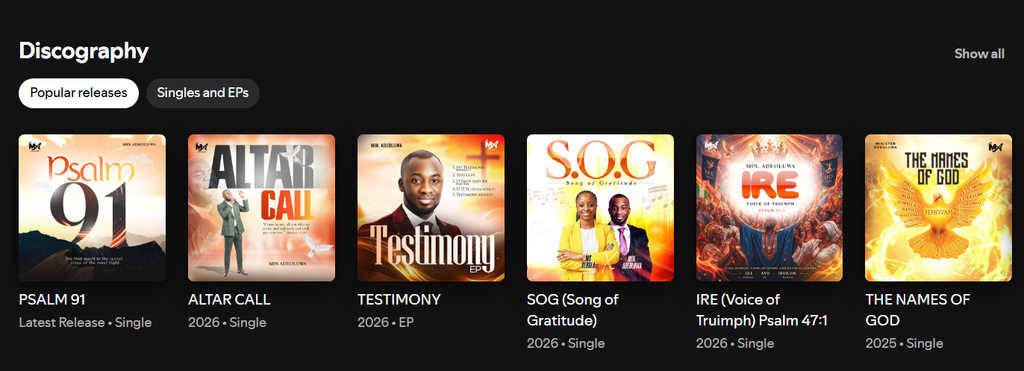
THIS GOD is one of the songs from my EP, Testimony, and it came from a very intense season of my life. My son was born on 6 March 2025, and on that same day I received a refusal for a visa I had applied for. From there, it became a roller coaster. The visa issue was really just a fraction of a much bigger picture of what I was going through at the time.
So THIS GOD was really my response to God in the middle of everything. I remember receiving some good news one day while I was driving. I parked and started chatting with my wife. I said, “This God…” and she replied, “He answers prayer.” Immediately, the song started playing in my head.
That is why the song is very personal to me. It came from experiencing God’s goodness in the middle of a difficult season, so seeing that same song eventually reach number one made the journey even more meaningful.
8. Your father is a minister. Has he ever heard your music and said something that stopped you in your tracks, good or bad?
He is actually my number one fan. Whenever he hears my music, he is always happy. He will say, “Keep the flag flying. The family was built for this.” Sometimes he will call me saying, “I cannot find this song, where can I get it?” or tell me he asked one of my brothers to play a particular song for him. He is very supportive.
The only time he really questioned something in my music was about a chant in one of my songs. The chant itself was harmless, but my dad comes from a generation that believes music should communicate words clearly. His view is that chants or tongues may edify the individual, but when you are ministering to the wider body, people should also be able to understand what is being communicated.
He told me, “Do not focus too much on chants. Let people hear words. The path you have been on, continue with it. Do not let the noise of the world make you change what you have.”
That stayed with me. I may not approach everything exactly the way his generation does, but I understand the wisdom behind what he was saying: never allow trends or sounds to take the place of the message.
Filmmaking, stories and the cost of building something new

9. You have produced two films. What story were you trying to tell with each one, and which one cost you the most to make, emotionally or otherwise?
The first film was my way of telling the story of redemption in a more relatable way. The second focused more on family, particularly the hidden pain and struggles that can exist within families even when everything looks fine from the outside.
I would say the first one cost me more, especially financially. Being new to filmmaking, I made some expenses that, looking back now, were not really necessary. They were not completely unimportant, but I could have achieved the same result differently. It was part of the learning process, and that experience definitely shaped how I approached the second film.
What MIN.ADEOLUWA wants to leave behind
10. You talk about leaving something meaningful behind. If everything stopped tomorrow, what would you want people to say about what you built?
I would want people to say that I used everything God gave me to communicate something meaningful. Whether through music, ministry, media or film, I want the common thread to be that there was always a message and a purpose behind it.
I grew up with Scripture deeply rooted in me, and now I am trying to pass that on in a way that speaks to this generation. If someone remembers a Bible verse because of one of my songs, returns to Scripture because they heard my music, sees redemption differently because of a film I made, or is simply inspired to use their own gift with purpose, then I believe I have built something worthwhile.
Ultimately, I do not just want to leave songs, films or achievements behind. I want to leave impact. Something that continues speaking even when I am no longer there to explain it.
Connect with MIN.ADEOLUWA on Instagram: min.adeoluwa, TikTok: MIN.ADEOLUWA, X: MinAdeoluwa and Facebook: Min Adeoluwa Isreal, listen to his music on Spotify: MIN.ADEOLUWA and watch his films on YouTube: MIN.ADEOLUWA TV.