

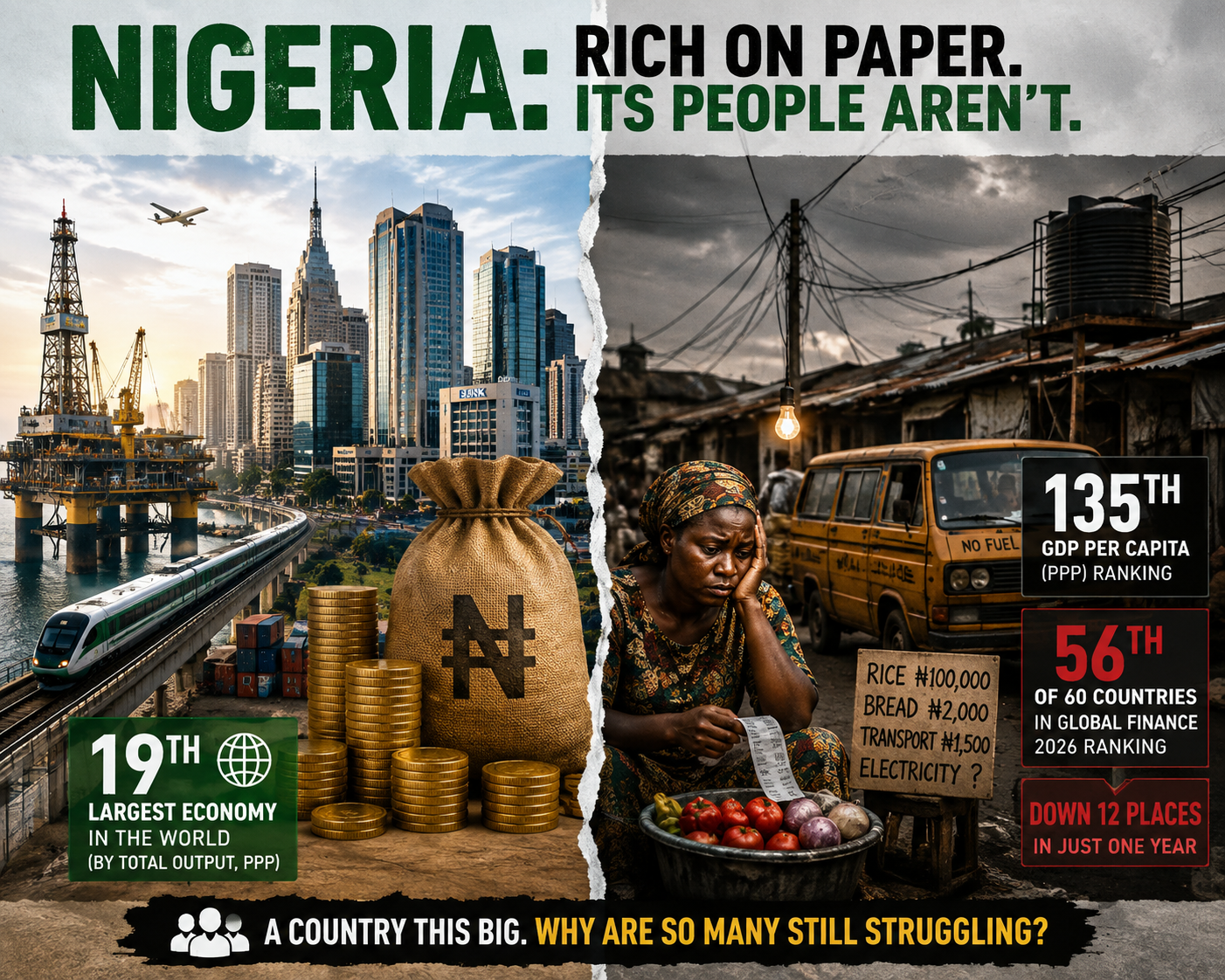
Nigeria’s economy is large enough to rank 19th in the world. Its people rank 135th and that ranking just fell 12 places in a single year. The real story isn’t the size of the economy. It’s who it’s actually working for.
Nigeria has spent years celebrating the size of its economy. It is Africa’s largest, blessed with oil, gas, agriculture, a huge consumer market and a population of more than 200 million people. Yet for many Nigerians, the size of the economy is an abstract statistic that does little to describe the reality of daily life.
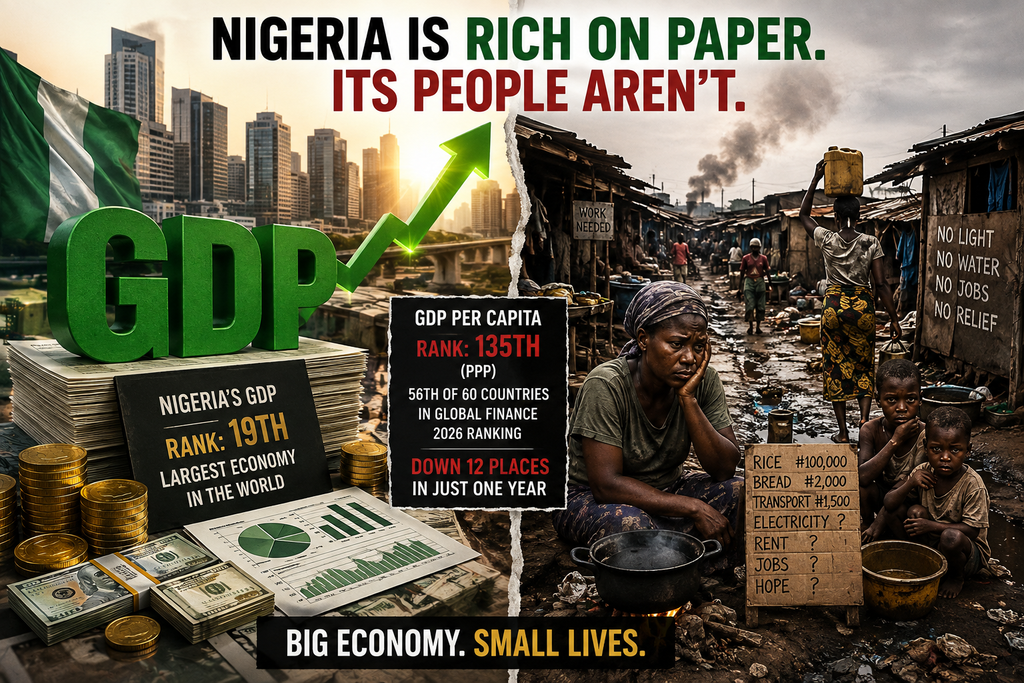
A new ranking by Global Finance offers an uncomfortable reminder of that disconnect. Based on GDP per capita at purchasing power parity, Nigeria ranked 56th among the 60 countries assessed in 2026, with a GDP per capita of $9,532.92, down from 44th position in the 2025 ranking. A 12-place drop in a single year, using the same methodology both times, is not easily explained away as statistical noise. Widen the lens and the picture gets starker still: by IMF-based estimates, Nigeria’s total economy, adjusted for purchasing power, ranks as the world’s 19th-largest, ahead of countries such as the Netherlands and Switzerland. Its GDP per capita, by the same measure, ranks closer to 135th. A country wealthy enough to sit among the world’s 20 biggest economies is, per person, near the bottom third of nations, and losing ground even on its own recent standing. That gap is not a rounding error. It is the entire story.
It’s Not Just the Population Math
The easy explanation is Nigeria’s population. A country can generate substantial economic output and still show low output per person when that output is divided among more than 200 million people. That’s real, but it’s an incomplete answer Indonesia and Pakistan carry comparably large populations against smaller economies and still post meaningfully higher per-capita figures. Population size sets the denominator. It doesn’t, on its own, explain why the numerator has grown so slowly for so many.
The deeper problem is productivity.
By some estimates, more than half of Nigeria’s economic activity happens in the informal sector work that generates income but rarely builds the kind of durable wealth, tax base, or productivity gains that show up in rising wages. Millions of Nigerians work every day. Too many of them work in low-productivity activity that provides survival without security. Economic growth that does not generate sufficient productive, formal employment cannot adequately improve living standards, no matter how large the headline GDP figure becomes.
This is where the conversation about Nigeria’s economy often becomes disconnected from the lives of Nigerians. Government and economic commentators can point to GDP growth, rising foreign reserves, or improvements in particular indicators, and lately, genuinely, some of those numbers have moved in the right direction. But the average citizen experiences the economy through the price of food, transport, rent, electricity, healthcare and education, and through whether their income can keep pace with all of it. On that measure, more than 60 percent of Nigerians are estimated to live below $3.65 a day. A country cannot measure economic success only from the top.
Resources Without Conversion
Nigeria’s natural resources have created enormous expectations. For decades, oil has been the backbone of government revenue and foreign exchange earnings. Yet the country has struggled to convert that resource wealth into broad-based prosperity. The question is no longer simply whether Nigeria has resources. It is whether those resources are being converted into productive infrastructure, human capital, industries and opportunities that let more Nigerians create and retain wealth, rather than exporting a raw commodity and reimporting nearly everything made from it.
Electricity remains a fundamental part of that equation. Businesses that must generate their own power face higher operating costs before they’ve made a single sale. Manufacturers struggle with infrastructure constraints that no amount of entrepreneurial energy can offset. Small businesses spend money solving problems that should have been addressed by public infrastructure decades ago. Those costs ultimately show up in productivity, prices, wages, and the ability of Nigerian companies to compete regionally, let alone globally.
Insecurity adds another burden, one that is easy to treat as a separate headline but functions as a direct economic tax. Farmers cannot maximise agricultural production when communities are unsafe. Businesses are less likely to invest where assets and workers are vulnerable. Roads, transport networks and markets cannot function efficiently where insecurity restricts movement. These are not isolated security problems sitting next to the economy. They are economic problems wearing a different label.
The same applies to education and healthcare. A country cannot build a highly productive workforce when millions of people struggle to access quality education or affordable care. Human capital is not a luxury to be addressed after the economy becomes wealthy, it is one of the foundations wealth is built on in the first place. Nigeria’s Human Development Index ranking, near the bottom third of countries assessed globally, reflects exactly this gap between resource wealth and human outcomes.
Beyond the Size Debate
This is why Nigeria’s economic debate needs to move past the size of GDP. Being Africa’s largest economy is significant. But size without productivity, inclusion and opportunity can become little more than a headline, a fact repeated at conferences and in investor decks that quietly stops describing the country most Nigerians actually live in.
The real measure of economic progress should be whether Nigerians can find productive work, build businesses, afford basic necessities, access quality services, and plan their lives without being constantly pushed backwards by inflation, insecurity or inadequate infrastructure.
There is also a danger in treating this as a problem government alone can solve. The private sector has its own overdue work: businesses that build for scale rather than survival, financial institutions that price credit for the SMEs currently locked out of it rather than only for blue-chip borrowers, and state governments that compete on ease of doing business rather than simply waiting on federal transfers. But government carries a unique responsibility, because many of the barriers to productivity are structural in a way no individual business can fix alone. It is difficult for a farmer to become more productive without reliable roads and security. It is difficult for a manufacturer to compete globally without dependable electricity. It is difficult for a young person to build a career without quality education and skills. It is difficult for any family to accumulate wealth when most of its income disappears into basic necessities before the month is halfway through.
The Real Question
This is why the latest ranking should not trigger only another round of arguments over whether Nigeria is “poor.” The more important question is why a country large enough to rank 19th in the world by total output continues to produce such limited prosperity for so many of the people who generate that output.
Nigeria does not necessarily need to become a dramatically bigger economy before Nigerians become better off. It needs an economy that produces more per person, creates more productive jobs, supports businesses, invests in people, and converts natural and human resources into wealth that stays broadly distributed rather than pooling at the top.
The country has spent decades talking about its potential. The more urgent conversation now is: how do we turn Nigeria’s population into productive human capital, its resources into industries, its economic activity into decent jobs, and its growth into a better standard of living, measurable in something more concrete than a GDP league table?
Because being Africa’s biggest economy is an achievement. But if millions of Nigerians still struggle to afford the basics, the bigger question was never how large the economy is. It is who the economy is actually working for.