


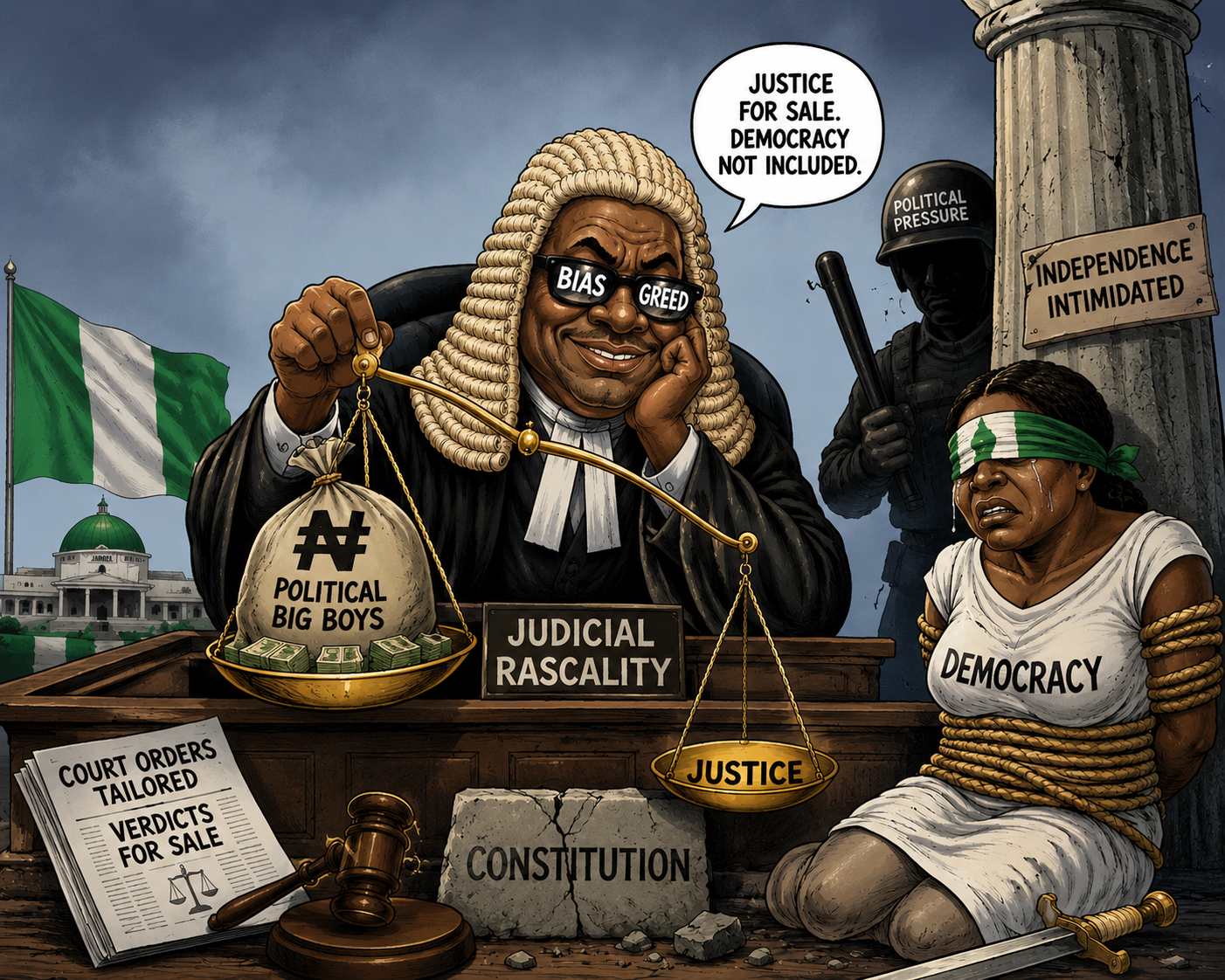
Judicial rascality exposed as court eliminates opposition parties weeks before elections.
There’s something deeply troubling about what unfolded at the Federal High Court recently. Justice Peter Lifu handed down a judgment that wasn’t just controversial. It was an affront to the democratic process itself.
The order to deregister five opposition political parties, the African Democratic Congress, Accord Party, Action Alliance, Action Peoples Party and Zenith Labour Party, came so close to the 2027 general elections that you’d have to be deliberately naive to miss what was happening. It wasn’t about upholding the Constitution. It was about shrinking the political space, cutting down opponents before the game really began.
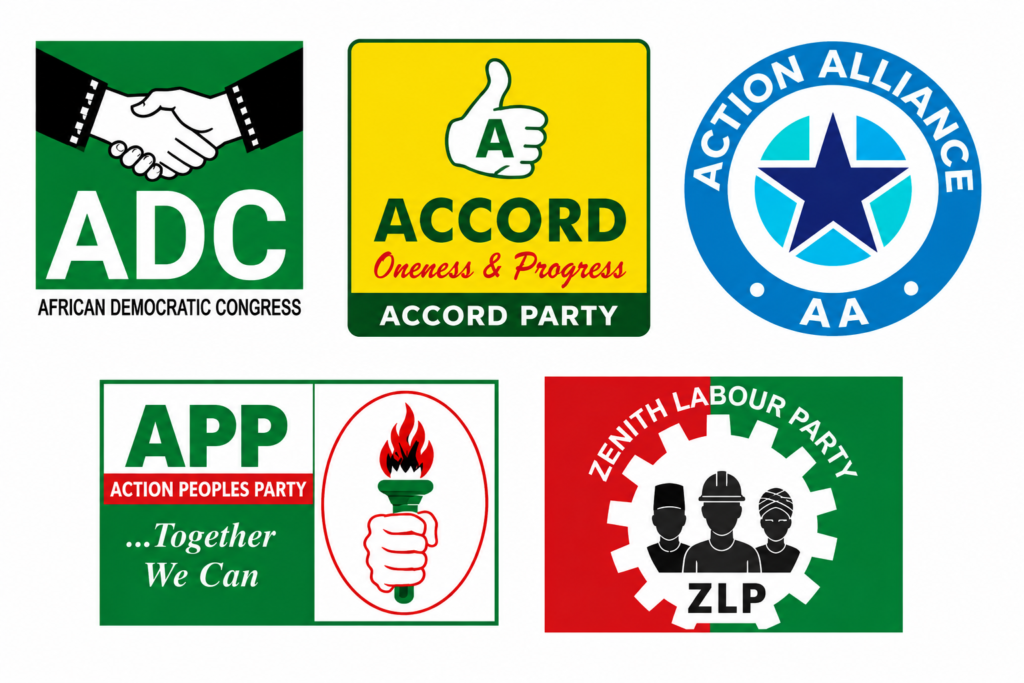
Let’s be honest: the timing was no accident. Here we have a sitting government, represented by the Attorney-General Lateef Fagbemi, backing a suit filed by an obscure group called the National Forum of Former Legislators. This group nobody had heard of suddenly decides the Constitution was being violated and Nigerian courts need to step in. Meanwhile, Atiku Abubakar, the ADC’s presidential candidate, and Governor Ademola Adeleke of Accord were preparing for elections. Coincidence? Hardly.
Judicial gymnastics that passed for justice
What made this judgment especially egregious was how Justice Lifu proceeded. There was already a Court of Appeal order staying further proceedings in the case. The appeal was scheduled for October 20. INEC itself had filed the notice. Yet Lifu went ahead anyway, rendering judgment in direct violation of the higher court’s authority. It wasn’t just bad judgment. It was contempt wrapped in a judicial robe.
The Court of Appeal later called it what it was: “judicial rascality.” In a rebuke that should have embarrassed anyone with a sense of professional ethics, the appellate court noted that Lifu’s actions constituted “a brazen violation of the hierarchy of courts and the provisions of the Constitution.” The same Constitution he claimed to be defending.
This is precisely the kind of judicial misconduct that corrodes public confidence in the bench. When a judge can ignore the orders of a superior court, when he can proceed with a case explicitly stayed by appellate authority, what does that say about the rule of law? It says the rule of law is dead. It says judges can do as they please.
The constitutional argument that doesn’t hold water
Now, about Section 225(A) of the Constitution, the section cited to justify all this. Yes, it does give INEC authority to deregister parties that fail to meet certain thresholds in elections. But here’s the problem: these thresholds are supposed to be applied based on actual electoral performance, not on speculation about what might happen in future elections.
The parties in question had already conducted their primaries. Some had members in state houses of assembly and local government councils. Accord itself had councillors. ADC had members in the House of Representatives, including the Deputy Minority Leader. Were these irrelevant to the calculation? Apparently so, according to Lifu’s logic.
It gets worse. The plaintiff, this shadowy National Forum of Former Legislators, didn’t even have clear standing to bring the case. Who are they? What’s their locus standi? Why does a group of undefined “former legislators” get to determine the fate of registered political parties? These questions weren’t adequately answered before the judgment, and they still hang in the air unanswered.
Some have questioned whether the group even has members among these political parties. If not, how do they benefit from the deregistration? What gives them standing to sue? The court never seemed to care about these fundamental questions.
The bigger picture: democracy on life support

What we’re witnessing is a gradual strangulation of multiparty democracy. And it’s happening in plain sight, defended by legalistic arguments that crumble under scrutiny. The late Gani Fawehinmi fought these battles in the 1990s, challenging INEC’s restrictive policies on party registration. He won, expanding the democratic space for all Nigerians. Now, decades later, we’re watching that space get narrower again.
There’s a pattern here that should concern anyone who believes in democratic competition. You restrict the space for opposition parties through constitutional amendments. You give INEC sweeping powers to deregister based on vague performance criteria. Then, when it suits the ruling faction, you use the courts to eliminate inconvenient opponents mere months before elections. It’s textbook authoritarianism dressed up in constitutional language.
The message being sent is clear: if you pose a political threat, expect the machinery of state to come after you through the courts. Not through the ballot box, not through better ideas or superior organisation. Through judicial manipulation.
The real scandal
The real scandal isn’t that these five parties exist. It’s that government officials feel comfortable using the judiciary as a tool to manipulate electoral outcomes. The Attorney-General of the Federation didn’t have to join this case. He chose to. Femi Gbajabiamila, the Chief of Staff, didn’t have to convene the National Forum of Former Legislators in January and secure their endorsement for Tinubu. He chose to. These choices reveal who’s really pulling the strings.
And where was INEC in all this? The electoral commission insisted from the beginning that these parties met constitutional requirements. INEC knows its mandate. Yet the court essentially overruled the organisation responsible for elections, creating chaos months before the polls.
This is not how democratic institutions are supposed to function. Each arm of government should operate within its sphere. Courts shouldn’t be substituting their judgment for INEC’s on technical electoral matters. Yet that’s precisely what happened here.
What needs to happen
The Appeal Court’s stay of execution is a band-aid on a much larger wound. What Nigeria needs is for Justice Lifu’s conduct to be referred to the National Judicial Council for disciplinary action. Not just a reprimand. Real consequences. Because if judges can violate superior court orders with impunity, if they can render political judgments dressed as legal ones, then the rule of law becomes meaningless.
More importantly, Nigerians, especially those leading the country, need to ask themselves a hard question: do we actually believe in democracy, or are we just pretending? Because genuine democracy means accepting electoral competition from parties you don’t like. It means letting voters choose, even if they might choose your opponent. It means trusting democratic processes instead of trying to rig them through the courts.
The 2027 elections are coming. They should be about choosing leaders based on ideas and records, not about which party gets eliminated before voting even starts. Right now, the signals we’re sending suggest we’ve learned nothing from our past mistakes about using state power to eliminate opponents.
That’s not democracy. It’s just corruption with a different name.