

At the 59th anniversary memorial, the Asagba of Asaba said forgiveness would not erase the community’s demand for official acknowledgement and accountability.
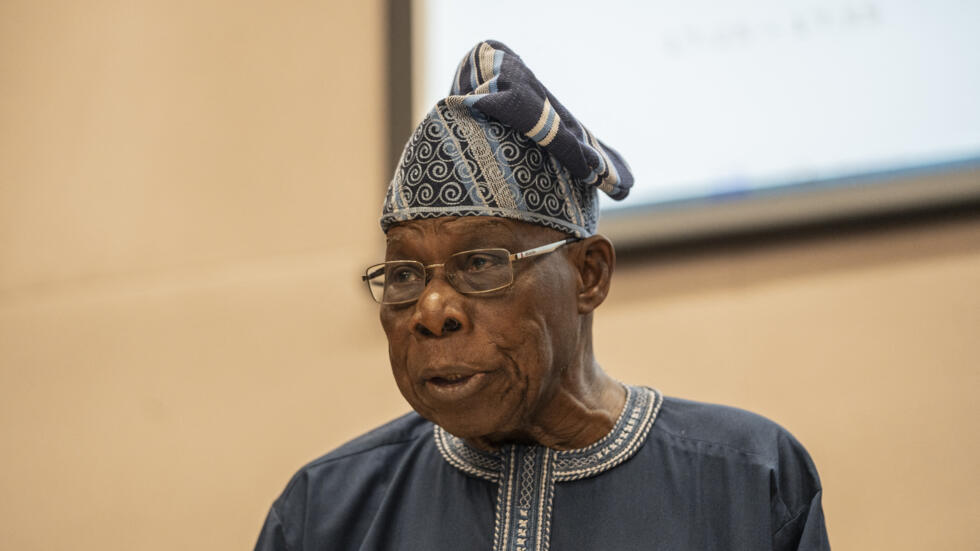
Former President Olusegun Obasanjo has described the 1967 Asaba massacre as one of the most painful episodes of the Nigerian Civil War, urging survivors and victims’ families to embrace forgiveness and reconciliation.
Obasanjo spoke virtually on Wednesday as chairman of the occasion at the 59th anniversary memorial of the massacre in Asaba, Delta State.
He said the Civil War itself was an unfortunate event that should never have happened, but singled out the Asaba killings as one of its most terrible episodes.
“This marks the remembrance of one very sad aspect of the Nigerian Civil War. Of course, the war in its entirety was an unfortunate event which should never happen,” Obasanjo said.
“But the Asaba Massacre, as it is called, was one of the most painful, one of the most terrible aspects of that war.”
The former military head of state also said he wept after receiving documents about the massacre from Chief Chuks Nduka-Eze, convener of the Asaba Massacre Memorial.
Obasanjo said he was deeply saddened that such an event occurred in Nigeria during his lifetime.
“To all of you assembled: let us keep one thing in mind: forgiveness, forgiveness, and forgiveness again,” he said.
He also called for the tragedy to remain part of Nigeria’s historical memory to ensure that similar atrocities are not repeated.
Asaba massacre survivors seek more than forgiveness
While acknowledging the importance of forgiveness, the Asagba of Asaba, Prof Epiphany Azinge, said forgiveness should not be confused with forgetting or closing the matter.
Azinge said the community could forgive while continuing to demand official recognition and accountability.
“We may not forget, but certainly, we have to forgive,” he said.
The monarch, however, said there could be no closure or healing for the community until a sitting Nigerian president publicly apologised for the killings.
“There will be no closure, there will be no healing until a sitting President, not an ex-President, but a sitting President, publicly apologises to us,” Azinge said.
He noted that former military head of state Yakubu Gowon had apologised while out of office, but said the community wanted an acknowledgement from a serving president.
Azinge also challenged Obasanjo’s appeal for Nigerians to ensure that such tragedies never happen again, recalling the 1999 Odi killings that occurred during Obasanjo’s presidency.
“Coming from him, I was a bit taken aback. How long do we say ‘never again’? But it happened at Odi,” he said.
The reference was to the November 1999 military operation in Odi, Bayelsa State, during which residents were killed and much of the community destroyed. The exact number of people killed in Odi has remained disputed.
Taiwo family receives Asaba’s forgiveness
Despite his demand for a presidential apology, Azinge announced that the Asaba community had forgiven the family of Colonel Ibrahim Taiwo, an officer associated with the military operation during the massacre.
He said the community had accepted an apology from retired Major-General Ahmed Ibrahim Taiwo, Colonel Taiwo’s son.
“On behalf of the Asaba community, and as the prescribed authority, the Asagba of Asaba, I hereby publicly proclaim that we have forgiven the Taiwo family,” the monarch said.
Ahmed Taiwo had expressed regret and apologised on behalf of his father and family for any act, omission or commission associated with the tragedy.
“I know it will not right the wrong, but I believe and pray it is a start towards reconciliation,” he said.
The development highlights the distinction the community is drawing between personal forgiveness and institutional accountability. While the Taiwo family has received the community’s forgiveness, Azinge maintained that official closure requires a public apology from a sitting president.
Asaba massacre death toll remains disputed
The Asaba massacre took place in October 1967, during the Nigerian Civil War, after federal troops entered the town in pursuit of retreating Biafran forces.
Civilians were rounded up during the military occupation. On October 7, men and older boys were separated from women and younger children during a gathering where residents had come out in ceremonial white attire. Historical research documents mass killings of civilians in the town.
The precise death toll remains disputed.
A 2014 study by historians S. Elizabeth Bird and Fraser Ottanelli noted that no precise casualty count had been established. A list compiled by the Asaba Development Council in 1981 recorded 373 deaths but acknowledged that it was incomplete, while other contemporary and eyewitness estimates ranged from about 500 to more than 1,000.
Academic research has estimated that between 700 and 800 people were killed, while the Delta State Government said researchers and community historians had estimated that more than 1,000 people died.
For that reason, the higher figure should be attributed rather than presented as an undisputed death toll.
Delta State Governor Sheriff Oborevwori, represented at the memorial by Secretary to the State Government Kingsley Emu, said the killing of unarmed civilians could never be justified.
He pledged continued support for national recognition of the massacre and the establishment of a permanent memorial.
FG plans reconciliation declaration ahead of 60th anniversary
The memorial came as the Federal Government is expected to make a formal reconciliation declaration over the massacre, according to Oborevwori.
The governor said an official acknowledgement was important to the reconciliation process and expressed hope that the Federal Government would make a formal declaration.
The development comes ahead of the 60th anniversary of the massacre in 2027.
Nduka-Eze said preparations were already underway for the anniversary, including efforts to establish a permanent memorial centre dedicated to remembrance, documentation and education.
He said the central message of the memorial campaign was that “Nigerian lives matter”.
The proposed centre is expected to preserve records, testimonies and the history of the victims for future generations.