

Commission cites an AI division, a rapid-response team and platform partnerships, as experts and fact-checkers urge faster verification of official election results.
The Independent National Electoral Commission (INEC) says it has an AI division, a rapid-response team and a media monitoring unit to detect and counter fabricated election content ahead of the 2027 general elections.
Wilfred Ifogah, Deputy Director, Voter Education and Publicity at INEC, told LEADERSHIP Weekend that the commission is closely monitoring AI-generated fake results, videos, audio and documents. He urged Nigerians to rely only on results released through INEC’s verified channels.
The warning comes as election experts caution that synthetic content, including cloned voices and manipulated images, could confuse voters and weaken confidence in the polls.
What INEC says it has in place
Ifogah said INEC will keep attaching disclaimers to fake content once its monitoring systems pick it up. A dedicated rapid-response team and a media monitoring unit handle the follow-up.
“We respond as soon as the content is flagged,” he said.
He added that the commission is working with Meta, X, TikTok, Google and WhatsApp to tackle election-related misinformation and disinformation.
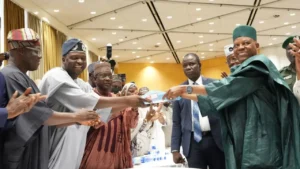
INEC’s concern is not new. At a workshop for Public Affairs Officers in Abuja last month, National Commissioner Mohammed Kudu Haruna said AI could produce highly targeted messages that present conflicting narratives to different groups of voters.
Lessons INEC must draw from 2023
False claims and manipulated material circulated widely during the 2023 elections. The Nigerian Fact-Checkers’ Coalition set up situation rooms in Abuja, Lagos and the United Kingdom to track content capable of inciting violence, fuelling voter apathy and eroding trust.
FactCheckHub’s review found 127 claims were fact-checked across the presidential, National Assembly, governorship and State Assembly elections. Videos made up a significant share, alongside fabricated graphics and old footage passed off as current.
Opeyemi Kehinde, coalition coordinator and editor at FactCheckHub, said at the time that members would monitor and debunk false information from election day until INEC announced the final results.
Fact-checker Kamaru Danlami said 2023 showed how fast misinformation travels during voting, result collation and the announcement of results.
What experts want INEC to do differently
Abuja-based cybersecurity and AI expert Salami Daniel said AI has lowered the barrier to producing convincing fakes. A fabricated video or audio clip “can be produced within minutes,” he said, and circulated before the affected person or institution can respond.
Daniel urged INEC to move beyond debunking fakes after they go viral. He called for systems that quickly authenticate official results, statements and videos, backed by continuous social media monitoring.
Kehinde urged journalists to verify unusual audio, video, screenshots and documents with the original source and the relevant authority before publishing. He cautioned that no single detection tool is completely reliable. The best approach, he said, combines “technical detection, human verification, source authentication and rapid communication” from trusted institutions.
Danlami said the danger goes beyond fake results to false claims about voting procedures, polling units, candidates and incidents at polling stations.
“Artificial Intelligence now gives those producing false information more sophisticated tools,” he said.
He urged voters to question the source of sensational election content, and called for stronger coordination among INEC, political parties, the media, technology platforms and fact-checking organisations.
What this means for INEC
Detection alone will not be enough. The real test is whether verified information reaches voters faster than a fake can settle into belief.
With the 2027 general elections approaching, how quickly INEC, platforms, factcheckers and the media can authenticate and communicate results will shape public confidence. The commission has urged Nigerians to verify election information through its official channels.