

Nigeria’s independence from British colonial rule was the result of decades of political organising, protests, constitutional negotiations, journalism and popular mobilisation. Although famous names such as Nnamdi Azikiwe, Obafemi Awolowo, Ahmadu Bello, Tafawa Balewa, and Herbert Macaulay dominate many accounts of the independence struggle, several other Nigerian independence activists played important roles in building the political movements that eventually led to self-government in 1960.
Among them were Aminu Kano, Sa’adu Zungur, Gambo Sawaba, K. O. Mbadiwe and Bode Thomas. Their approaches were different: some challenged colonial rule directly, while others fought for political representation, social reform, education, women’s rights and greater participation in government.
Together, their stories show that Nigeria’s road to independence was shaped by competing political ideas and activists from different parts of the country.
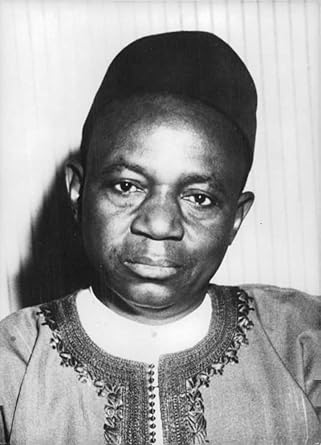
Mallam Aminu Kano (1920–1983) was one of the most important political figures to emerge from Northern Nigeria during the struggle against colonial rule. A teacher, writer, trade unionist and politician, Kano became particularly influential because he challenged both British colonialism and the concentration of political power within the traditional emirate system.
Kano was born in Kano and received both Islamic and Western education. He later attended the University of London, where his political ideas developed further. On returning to Nigeria, he became increasingly involved in political activism and the campaign for greater political participation in Northern Nigeria. Oxford University describes his political career as being strongly shaped by his opposition to colonialism, social inequality and the political domination of the emirate system.
One of Kano’s most significant contributions to the Nigerian independence movement was his role in the Northern Elements Progressive Union (NEPU). Established in 1950, NEPU became an important opposition movement in Northern Nigeria. It represented a more radical political alternative to the conservative Northern People’s Congress and sought to mobilise ordinary people, particularly the talakawa, or common people.
This was significant because the independence struggle was not simply a confrontation between Nigerians and the British. It was also a struggle over what kind of Nigeria would emerge after colonial rule. Kano argued that political independence should be accompanied by greater social and political equality.
NEPU’s politics challenged the privileges associated with the colonial administration and traditional political structures. Kano also supported women’s liberation, democratisation and greater political participation in Northern Nigeria. His political programme therefore connected the struggle for national independence with demands for social reform.
Kano was also an effective political organiser. Rather than limiting politics to educated elites, he helped bring political ideas to ordinary people. His activism demonstrated that nationalist politics could become a mass movement rather than remain confined to lawyers, journalists and educated professionals.
His opposition to the conservative establishment sometimes brought him into conflict with powerful political and traditional authorities. Nevertheless, he remained an influential voice in Northern politics throughout the period leading to independence.
Kano’s contribution to Nigeria’s independence struggle was therefore not limited to demanding the removal of British colonial rule. He helped expand the meaning of political freedom by asking who would have power in an independent Nigeria and whether ordinary Nigerians would have a meaningful voice.
By the time Nigeria became independent on 1 October 1960, political movements such as NEPU had helped establish a tradition of opposition politics in the North. Kano’s legacy continued long after independence, particularly through his emphasis on political participation, social equality and the rights of ordinary Nigerians.
In the history of Nigerian independence activists, Aminu Kano stands out for connecting the demand for national freedom with the demand for political and social reform.
By the time constitutional conferences were held in London in 1957 and 1958, Nigerian politicians from different parties and regions were participating directly in negotiations over the structure of an independent Nigeria. The National Library of Nigeria describes these conferences as important stages in preparing the federal constitution for an independent Nigeria.
Nigeria finally achieved independence on 1 October 1960.
The independence story was therefore not the achievement of one party, one region or one political ideology. It was the product of years of organising, political education, constitutional negotiations, popular mobilisation and pressure for self-government.
For that reason, remembering figures such as Aminu Kano, Sa’adu Zungur, Gambo Sawaba, K. O. Mbadiwe and Bode Thomas provides a broader understanding of how Nigerians challenged colonial rule and built the political movements that eventually made independence possible.