

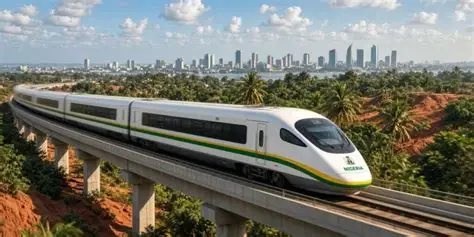
The Federal Government has unveiled plans for a 360km/h high-speed rail line linking Lagos to Maiduguri, part of a wider rail expansion announced at the 19th National Council on Transportation.
The Federal Government says it plans to develop a high-speed rail line linking Lagos to Maiduguri, with trains expected to run at speeds of up to 360 kilometres per hour.
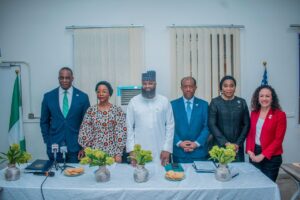
Olufunso Adebiyi, Permanent Secretary at the Ministry of Transportation, disclosed the plan on Monday at the opening of the 19th National Council on Transportation in Abuja, a four-day event themed “Developing an Effective Transport System for Nigeria: The Role of Integrated Transportation.”
The estimated cost of the project has been put at around £12 billion, though this figure has not been independently corroborated and should be treated as provisional.
The line is expected to begin from Lekki in Lagos State, with the corridor potentially built on elevated structures to allow trains to sustain high speeds. Adebiyi separately suggested the wider rail investment could eventually enable travel between Abuja and Lagos in about three hours, though it was not clear whether that specific claim relates to the Lagos-Maiduguri line itself or the broader rail network under development.
Part of a Wider Rail “Rebirth”

Adebiyi said the proposed line is part of the government’s broader effort to reduce Nigeria’s reliance on roads by developing rail, maritime and air transportation, giving citizens a genuine choice between transport modes rather than near-total dependence on road travel. “Light rail projects have also been approved for Lagos and Kano, with plans to extend similar systems to other state capitals,” he said.
He described the railway sector as undergoing a “rebirth,” listing the Port Harcourt-Aba, Warri-Itakpe, Lagos-Ibadan and Abuja-Kaduna corridors among routes already completed and operational. On routes still under construction, he said: “The Kaduna–Zaria–Kano line is nearing completion and should open by December. The Kaduna–Daura–Katsina line is progressing, the Katsina–Jibia–Maradi link is targeted for next year, and work continues on Kano–Dutse.”
Adebiyi said the government is also promoting rail freight to reduce the number of heavy-duty vehicles on Nigerian roads, and that expanding dry ports would help move containers closer to their final destinations, reducing road congestion, accidents and damage to highways. He said rail investment to date has supported an estimated 9,000 jobs, citing about 4,000 workers on one rail project and more than 5,000 on another, and pointed to the Federal University of Transportation as part of the government’s efforts to build a skilled workforce for the sector.
A National Transport Database
Adebiyi disclosed that the Federal Executive Council (FEC) had approved a smart national transport data bank, to be developed under a design-build-finance-operate-and-transfer model. He said the platform would create a central database for drivers, vehicles, number plates and transport operators nationwide, and would introduce standardised manifests at motor parks to record vehicle, driver, passenger and destination details. “This means that anytime a vehicle has an accident anywhere, you can pick the manifest and know who is inside and for what purpose, and computerised plate numbers will also make it easier to track traffic violations,” he said.
Standardised Bus Terminals
Adebiyi said the government had also approved six standardised bus terminals as a pilot project, which would feature waiting areas, passenger information systems, police posts, vehicle inspection bays, mechanic workshops, restaurants and restrooms. He said operators using the terminals would be required to meet safety and regulatory requirements, with sanctions for violations.
On the maritime sector, Adebiyi said reconstruction and automation work at Nigeria’s ports is ongoing, aimed at improving cargo handling, reducing congestion and cutting costs.
A Broader Policy Rollout
Also speaking at the event, the Head of the Civil Service of the Federation, Abel Enitan, cautioned that infrastructure investment alone would not be enough to build an effective transport system, stressing the need for strong institutions, effective regulation, reliable data, innovation and a skilled workforce to complement the physical investments. He described transportation as “the lifeblood of the economy” and urged stronger collaboration between the Federal Government, state governments and other stakeholders.
Adebiyi also disclosed that Nigeria’s National Land Transport Policy, approved at the previous National Council on Transportation meeting, would be formally unveiled later in the week, on Thursday, with the aim of improving the efficiency, safety, affordability and coordination of land transportation nationwide.