

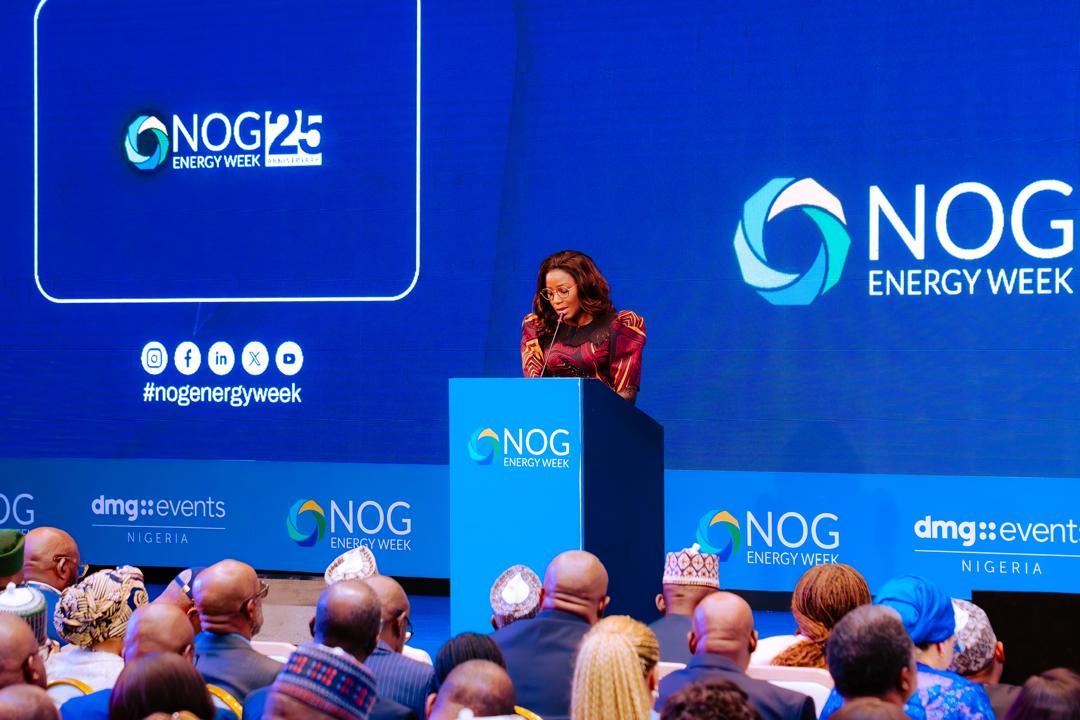
Nigeria now has more than $50 billion worth of upstream oil and gas projects in its visible pipeline, Special Adviser to the President on Oil and Gas, Olu Arowolo Verheijen, said on Tuesday, crediting the surge to reforms introduced under President Bola Ahmed Tinubu.
Speaking at the 25th NOG Energy Week Conference in Abuja, Verheijen noted that investor confidence has returned, as the country targets three million barrels of crude oil per day and ten billion standard cubic feet of gas per day by 2030.
“In the last three years, more than 10 billion dollars of long-awaited final investment decisions have come through,” she said.
She added that crude oil and condensate production has risen by about 400,000 barrels per day since 2023, with onshore production at its strongest level in twenty years. Nigeria’s share of Africa’s upstream final investment decisions, she added, has “risen dramatically — from the margins to leadership,” while external reserves have crossed $50 billion.
“These are not talking points,” Verheijen said. “They are signals. When the rules improve, capital moves.”
Highlighting the wider continental picture, Verheijen cited the 650,000 barrel-per-day Dangote Refinery as proof that “African industrial scale is not aspirational; it is operational.”
Nigeria, she disclosed, has made a deliberate choice “to become an engine of African industrialisation. We have chosen not merely to produce molecules, but to convert molecules into megawatts, fertiliser, petrochemicals, mobility, manufacturing, jobs and exports.”
Another proof of the success of President Tinubu’s reforms, she said, is the surging indigenous participation in gas, up from 69 to 83 percent, with Nigerian companies such as Seplat, Oando and Renaissance now operating as “continental energy actors” rather than merely local players. “This is ownership. This is capability. This is the future taking institutional form,” she emphasized.
However, she cautioned that rising indigenous ownership has to be matched with discipline. “Local content must create value, not inflation. Regulation must accelerate, not obstruct. Policy must invite capital, not frighten it away,” she said, warning that delays and unclear approvals carry real costs. “Every unnecessary delay is an export subsidy to another country. Every unclear approval is a tax on national ambition. Every project we fail to deliver becomes somebody else’s refinery, somebody else’s power plant, somebody else’s jobs.”