

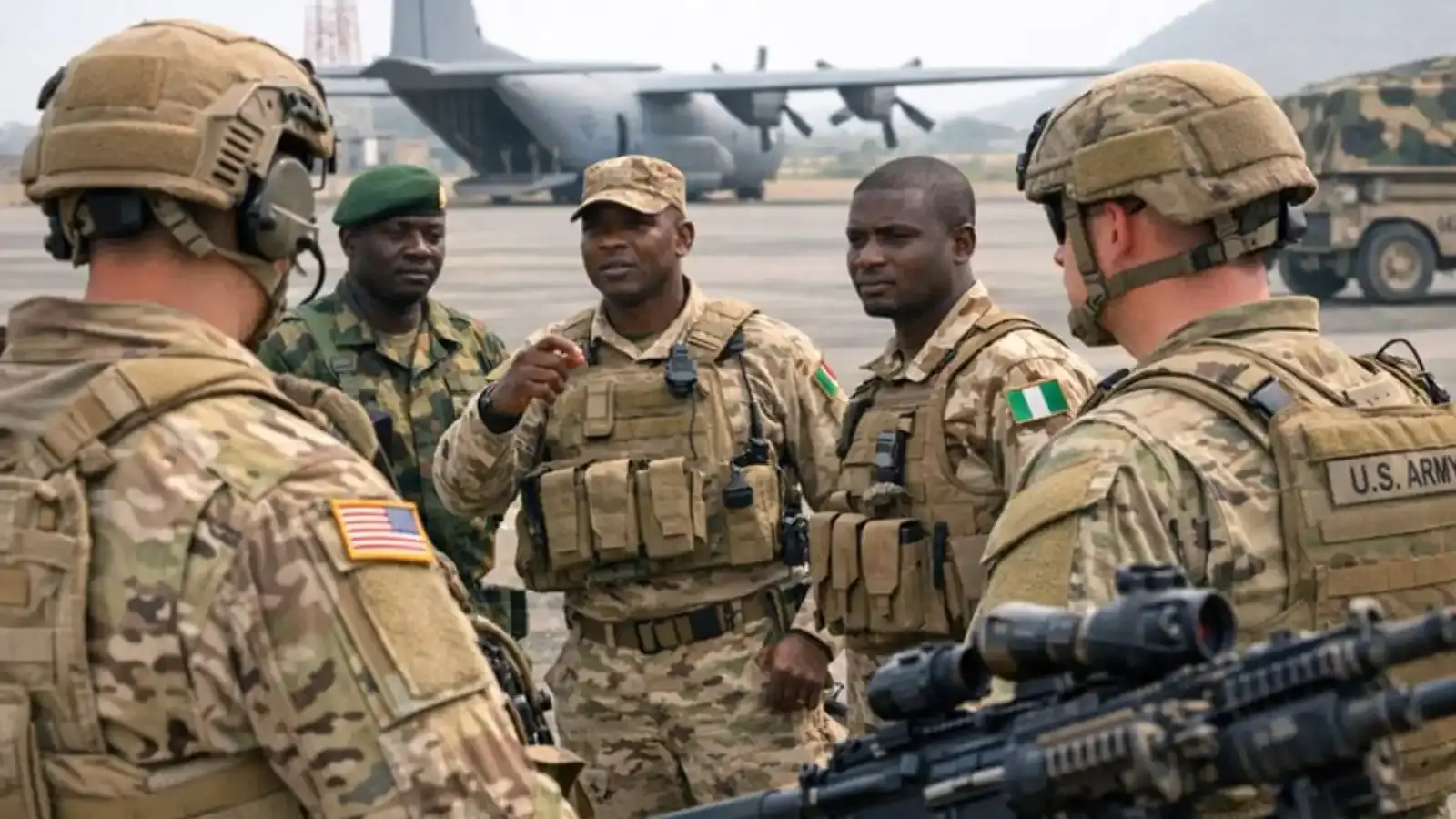
US withdraws troops from Nigeria after a May operation killed ISIS second-in-command Abu-Bilal al-Minuki in the Lake Chad Basin, but retains intelligence partnership.
The United States has pulled back the majority of its troops from Nigeria following the May 2026 operation that killed Abu-Bilal al-Minuki, the second-in-command of ISIS, in the Lake Chad Basin.
Dagvin Anderson, commander of US Africa Command (AFRICOM), announced the development on Thursday at a press briefing in Luanda, Angola, after the conclusion of the 2026 African Chiefs of Defence Conference. He confirmed that the US would retain its intelligence partnership with Nigeria despite the troop withdrawal.
The operation that triggered the drawdown
Anderson cited the al-Minuki operation as a model of partnership without external interference, pointing to Nigeria’s own military capabilities as central to the mission’s success.
“One quick example of not having external interference is I think the partnership that we’ve shown recently with Nigeria, where Nigeria’s a very capable and large country — it’s got a strong economy; it’s got a large, educated population; it’s got a very capable military,” Anderson said.
He explained how US-Nigeria intelligence sharing made the operation possible.
“But there are things that we have learned in the counterterrorist fight over several years that we were able to assist and integrate with them to help them with their intelligence and help with the intelligence sharing that eventually led to a cooperative effort to where we were able to bring some unique capabilities that the US brings and be able to prosecute together the number two leader within the ISIS or Daesh organisation who is responsible for much of their global operations, their global media, and their recruiting,” he said.
Anderson underscored the operation’s significance beyond the immediate region.
“And so that operation in the Lake Chad Basin of Nigeria not only helped the countries in that immediate region; it also helps countries globally as that disrupts the ISIS network,” he said.
What comes next
Anderson confirmed the nature of the continuing US presence in Nigeria following the withdrawal.
“And so, we have withdrawn much of our forces that were just there for that operation but are continuing the partnership that Nigeria has asked for to help continue with the intelligence sharing and the understanding that’s necessary to be able to prosecute these difficult tasks,” he said.
The AFRICOM commander added that the operation significantly degraded ISIS leadership both in Nigeria and globally, and that Nigeria has been “very active” since May, working to eliminate terrorists’ self-sufficiency.
The killing of al-Minuki, described as the ISIS figure responsible for the organisation’s global operations, media and recruitment, marks one of the most significant counterterrorism strikes in the Lake Chad Basin in recent years. The region, which borders Nigeria, Niger, Chad and Cameroon, has been a persistent theatre for ISIS-linked operations, with Borno State in northeast Nigeria bearing the brunt of attacks.
The US troop withdrawal signals a shift from a direct operational posture to a behind-the-scenes intelligence support role consistent with AFRICOM’s broader stated approach of building partner capacity rather than sustaining large forward deployments on the continent.