


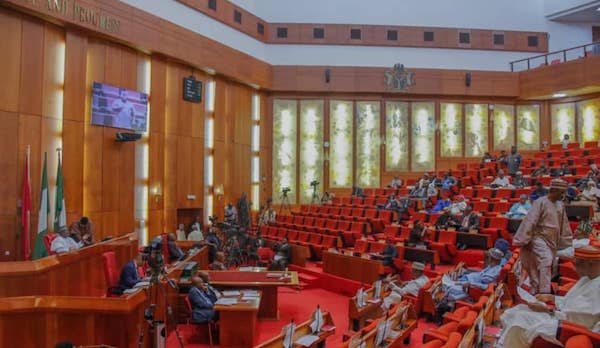
Senate Leader Bamidele pushes decentralised policing as critical security reform while constitutional concerns raised over amendment procedures
The Senate has passed a constitutional amendment bill seeking to establish state police and transfer policing powers to subnational governments as a significant progress towards a security reform described as one of the most consequential since Nigeria’s return to democratic rule in 1999.
The bill successfully scaled the second reading on Thursday and has been referred to the Senate Ad-hoc Committee on the Review of the 1999 Constitution for further scrutiny.
The legislation, sponsored by Senate Leader Opeyemi Bamidele, enjoys broad bipartisan support across the Red Chamber. It seeks to establish both Federal and State Police structures with clearly defined responsibilities and create oversight mechanisms to prevent potential abuse by state governors.
“This constitutional amendment is one of the most significant security reforms contemplated since the return of democratic governance in 1999,” Bamidele stated during the debate. He described the proposal as essential to addressing the limitations of Nigeria’s centralised policing structure in responding effectively to diverse and localised security threats.
Bamidele outlined the security challenges confronting the nation, listing terrorism and violent extremism, banditry, mass abductions, farmer-herder conflicts, cultism and gang violence, armed robbery, pipeline vandalism and economic sabotage, communal clashes, and emerging cyber-enabled crimes as justification for the reform.
State police decentralisation aims to strengthen security

The Senate Leader explained that the bill seeks to move policing from the Exclusive Legislative List to the Concurrent Legislative List, thereby enabling both federal and state governments to legislate on policing matters within their respective jurisdictions.
“The establishment of state police will improve intelligence gathering. Local police officers are better equipped to obtain actionable intelligence from communities because they understand local languages, customs and social structures. Modern policing relies heavily on intelligence rather than force. State police will significantly strengthen Nigeria’s intelligence architecture,” Bamidele said.
He stressed that state police would facilitate rapid response to security threats, strengthen community policing and reduce the burden on the Nigeria Police Force (NPF), which has been overwhelmed by the breadth and complexity of security challenges across the nation.
Bamidele acknowledged widespread concerns that state governors could abuse state police structures for political purposes but argued that the bill contains sufficient safeguards to prevent such outcomes. These safeguards include the establishment of State Police Service Commissions, federal oversight through the Federal Police Service Commission, uniform national policing standards, legislative confirmation of senior police appointments, and constitutional procedures for the removal of state commissioners of police.
“These safeguards ensure that state police operate professionally, responsibly and in accordance with the rule of law,” Bamidele stated. He emphasised that the proposal strengthens federalism rather than weakening national unity.
“The proposed amendment does not weaken national unity. Rather, it strengthens the Federation by enabling each level of government to effectively discharge its constitutional responsibilities,” he declared.
State police proposal cites international examples
Bamidele cited international examples to support the state police proposal, referencing the United States, Canada, Australia and Germany as federal systems where subnational policing structures operate effectively alongside federal law enforcement agencies.
Several senators contributed to the debate in support of the bill. Senate Chief Whip Tahir Monguno, representing Borno North, said the proposal would provide a legal framework for the operation of state police and help address the proliferation of vigilante groups across the country.
Constitutional concerns halt immediate passage
However, the bill’s passage was complicated by constitutional objections raised by Senator Adamu Aliero, representing Kebbi Central. Aliero cited Section 9 of the 1999 Constitution, which requires constitutional alteration bills to secure the support of not less than two-thirds of all members of each chamber and approval by at least two-thirds of state houses of assembly.
“We have collated all the bills, and they are currently discussing them. So, discussing this bill now proposed by the leader will amount to putting the cart before the horse,” Aliero said, referring to a constitutional amendment committee chaired by Deputy Senate President Barau Jibrin.
Aliero stressed that whilst he supports the concept of state policing, the Senate must comply with constitutional procedures.
“I support the idea of state policing, but we must comply with the provisions of the constitution. Otherwise, if we go ahead with this debate, whatever we decide, whatever we do, will be a nullity,” he warned.
Following Aliero’s intervention, the Senate proceeded into a closed-door executive session. When lawmakers resumed, the state police bill was no longer listed for consideration as the chamber proceeded to debate budget-related matters.
House of Representatives approves bill
The House of Representatives, however, passed the state police bill during its plenary session on the same Thursday. This development suggests broader parliamentary support for the reform across both chambers of the National Assembly.
The bill now advances to the Senate constitutional review committee for detailed examination before returning to the full Senate for possible third reading and passage, with the understanding that the constitutional procedures outlined by Aliero must be followed for the amendment to be valid.
Aggregated from TheCable