


Four persons have been sentenced to death over Owo church massacre in landmark ruling reinforcing Nigeria’s terrorism laws.
Four men have been sentenced to death by hanging by a Federal High Court in Abuja for their involvement in the 5 June 2022 attack on St. Francis Catholic Church in Owo, Ondo State, which left more than 40 worshippers dead and over 100 others injured.
The four convicted persons are Idris Omeiza, Al Qasim Idris, Jamiu Abdulmalik and Abdulhaleem Idris. Justice Emeka Nwite held on Wednesday that the prosecution had proven its case beyond reasonable doubt on all nine counts of terrorism charges brought against them by the federal government.

A fifth defendant, Momoh Otuho Abubakar, was discharged and acquitted after the court found insufficient evidence linking him to the attack.
According to court documents and prosecution arguments, the defendants were members of a terrorist cell allegedly linked to Al-Shabaab and operating from Kogi State. The court heard that they held planning meetings in Kogi and Ondo States in 2022 before executing the attack using improvised explosive devices and AK-47 rifles.
The federal government told the court that the assault was carried out to advance extremist religious ideology, offences punishable under the Terrorism (Prevention and Prohibition) Act, 2022.
The Case
During the trial, the prosecution called 11 witnesses and submitted 23 exhibits, including confessional statements and a digital forensic report. A mobile phone presented in evidence was said to contain communications between the defendants before and after the attack.
One Catholic priest who presided over the Pentecost Sunday Mass told the court that worshippers were preparing to leave when gunshots and explosions began, triggering chaos inside the church. He described the scene as chaotic and said many parishioners were killed or injured.
Another witness identified two of the convicted men as participants in the attack, while a survivor testified that she sustained severe injuries that required multiple surgeries. She also told the court that her two-year-old cousin was killed during the incident.
A further witness said she lost both legs above the knee and her left eye as a result of the attack.
Justice Nwite ruled that the evidence established active participation in terrorist activities and involvement in the planning and execution of the assault.
What this means
The judgment reinforces the Nigerian judiciary’s position on terrorism-related offences under the Terrorism (Prevention and Prohibition) Act. It signals continued state emphasis on prosecution and deterrence in high-profile terror cases. The ruling may also shape how future terrorism trials are prosecuted, particularly in relation to digital forensic evidence and confessional statements.
Background
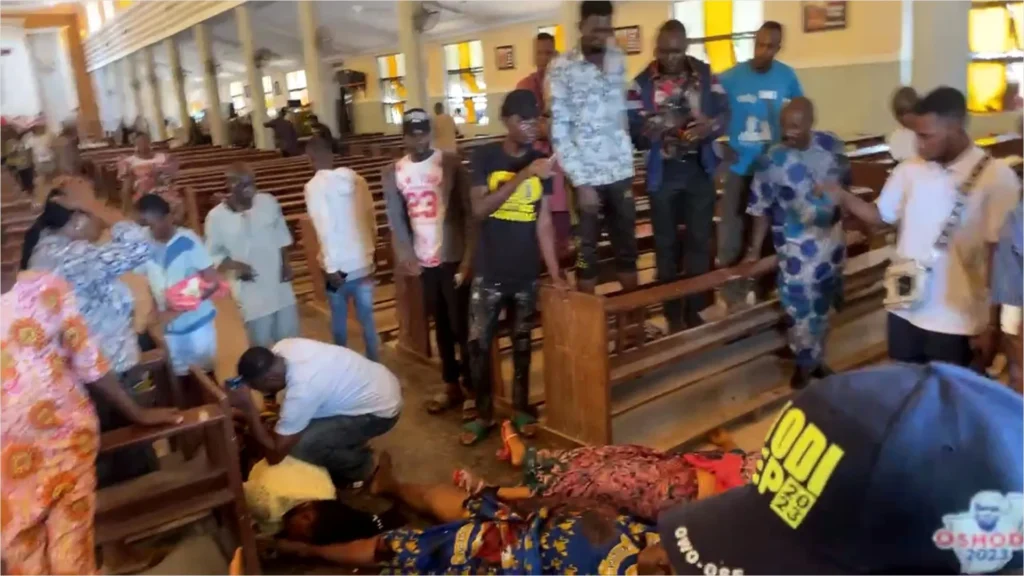
The attack on St Francis Catholic Church in Owo, Ondo State, on 5 June 2022, remains one of the deadliest assaults on civilians in recent years in Nigeria’s south-west. The incident occurred during the Pentecost Sunday service when gunmen stormed the church with explosives and firearms, killing more than 40 worshippers and injuring over 100 others. The attack shocked the country and prompted widespread condemnation, with authorities later linking the incident to a terrorist cell allegedly operating across parts of Kogi and Ondo states and affiliated with extremist networks.
The tragedy triggered national and international outrage, with President Muhammadu Buhari at the time condemning the attack as “heinous” and ordering security agencies to track down those responsible. In the aftermath, security operatives launched investigations that later linked the assault to a suspected terrorist cell operating across parts of Kogi and Ondo States, with alleged connections to extremist networks.
The case became one of Nigeria’s most closely followed terrorism prosecutions, involving forensic analysis, confessional statements, and witness testimonies, as authorities sought to establish how the attackers planned and executed the coordinated assault on a place of worship.