

The former president called debt “worse than leprosy” as Tinubu seeks approval for $20.5bn and €1.05bn in fresh external loans.
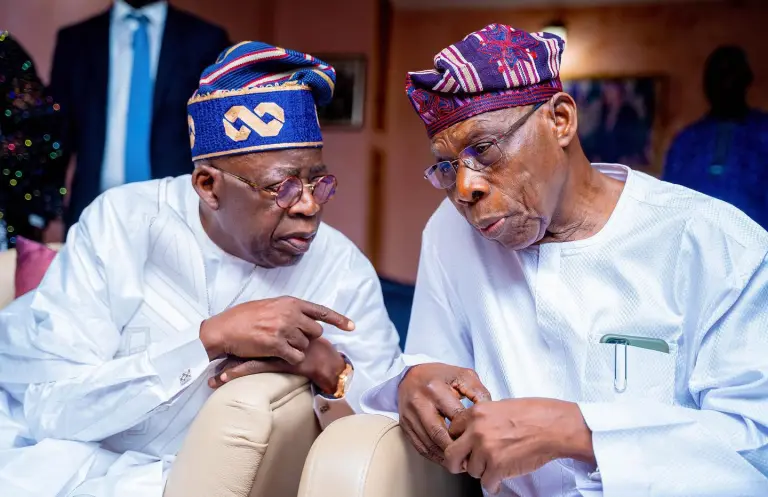
Former President Olusegun Obasanjo has criticised President Bola Tinubu’s borrowing policy, warning that excessive government debt could place an unfair burden on generations of Nigerians yet unborn.
Obasanjo described debt as more damaging than leprosy while questioning the Federal Government’s continued reliance on domestic and external loans to finance its budget and infrastructure projects.
He spoke on Friday, October 30, at the third Ajibosin Annual Symposium in Abeokuta, Ogun State. The event, held at the Olusegun Obasanjo Presidential Library, was themed “Leveraging Artificial Intelligence to Solve Grassroots Problems and Accelerate National Development”.
Reacting to Tinubu’s earlier defence of government borrowing, the former president dismissed the suggestion that debt was not inherently harmful.
“And for anybody to say debt is no leprosy, is absolute nonsense. Debt is worse than leprosy. Because leprosy destroys only one person. Debt destroys generations,” Obasanjo said.
His remarks came days after Tinubu requested National Assembly approval for a supplementary external borrowing plan totalling $20.52 billion and €1.045 billion for the 2026–2027 fiscal period.
The proposed facilities are intended to finance projects and programmes across infrastructure, agriculture, healthcare, education, water supply, security and employment generation. The request is awaiting legislative consideration and does not represent funds already secured or disbursed.
Obasanjo challenges Tinubu’s borrowing argument
Tinubu has repeatedly defended borrowing as a necessary tool for financing infrastructure and other development priorities, arguing that the focus should be on the value generated from the funds rather than the amount borrowed.
In April, the President said his administration would continue to borrow whenever necessary, provided the country worked to repay its obligations.
“If we have to borrow, we borrow. Borrowing is not leprosy, we just have to work hard to be able to pay for it,” Tinubu said during a meeting with Plateau State leaders at the Presidential Villa in Abuja.
On Thursday, October 29, he again defended the government’s borrowing plans in an essay titled From Reforms to Delivery: Our Infrastructure Investment and Growth Strategy.
“The real question is not how much we borrow, but what we build, what value we create and what future we leave behind,” the President said.
He identified the Lagos-Calabar Coastal Highway, Sokoto-Badagry Superhighway, Trans-Sahara Superhighway, electricity grid upgrades and improvements to major commercial ports as projects expected to strengthen the economy and create opportunities.
Tinubu maintained that borrowing should support productive investments capable of generating economic returns and improving living standards.
Nigeria’s debt rises as Tinubu seeks fresh loans
The latest borrowing request comes amid an increase in Nigeria’s public debt.
Figures published by the Debt Management Office showed that the country’s total public debt rose to ₦166.79 trillion as of June 30, 2026, up from ₦159.35 trillion at the end of March.
The June figure comprised ₦91.59 trillion in domestic debt and ₦75.2 trillion in external debt.
The International Monetary Fund’s 2026 Article IV assessment estimated Nigeria’s public gross debt at 35.4 per cent of gross domestic product in 2026. However, it projected that interest payments would account for 53.7 per cent of Federal Government revenue that year, highlighting the pressure debt obligations place on public finances.
The IMF’s figures also point to an important distinction: a country’s debt-to-GDP ratio may appear moderate while the cost of servicing that debt remains high relative to the revenue available to government.
In March, the National Assembly approved a $6 billion external borrowing plan, including a proposed $5 billion facility from First Abu Dhabi Bank to support the national budget and a $1 billion export finance facility arranged by Citibank for the rehabilitation of Tin Can Island Port and the Lagos Port Complex.
The legislature also approved a $516.3 million loan from Deutsche Bank AG for the construction of the Sokoto-Badagry Superhighway, with a nine-year repayment period, including a grace period of up to three years.
Obasanjo questions Nigeria’s economic direction
Beyond the borrowing debate, Obasanjo questioned Nigeria’s economic performance, particularly the depreciation of the naira against the US dollar.
Recalling when he established his farm 47 years ago, he said the exchange rate was approximately ₦1 to $1.85 at the time.
“When I started my farm, 47 years ago, naira to the dollar was one naira to $1.85. Forty-seven years ago. What has Nigeria done in 47 years that we now have 1,500 naira to the dollar? What have we done?” he asked.
The former president also questioned the capacity of political leaders to make decisions that would improve the living conditions of Nigerians.
“What do our leaders know? And what do they not know? And from what they know, what can they do for us?” he said.
He further criticised Nigeria’s reliance on economic prescriptions from international institutions, particularly the World Bank and IMF, arguing that their recommendations might not adequately reflect the country’s circumstances.
“World Bank and IMF were not designed for us. They were not built by us. They were built before we became independent. And that’s the people who would determine what we do,” Obasanjo said.
He cautioned against adopting economic recommendations from foreign-trained experts without considering Nigeria’s local realities.
The former president’s intervention adds to the debate over the country’s borrowing strategy, with the Tinubu administration maintaining that external financing is necessary to close infrastructure gaps, while critics question the long-term cost and the government’s capacity to repay.