

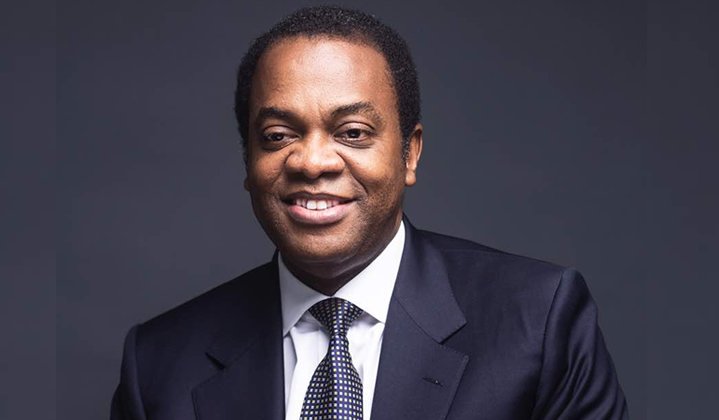
The PRP presidential candidate says domestic fuel should be priced around production costs, not international market prices.
Peoples Redemption Party presidential candidate Donald Duke has promised to work towards reducing petrol to about ₦300 per litre if elected president in the 2027 election.
Duke, a former Cross River State governor, made the pledge during an interview on Channels Television’s Morning Brief, where he criticised President Bola Tinubu’s economic policies and outlined his alternative approach to petrol pricing.
He said petroleum products meant for domestic consumption should be priced according to production costs rather than international market prices.
“I will try and bring it to about ₦300. It sounds so outlandish, but I have given you the arithmetic,” Duke said.
He proposed allocating part of Nigeria’s crude production for domestic consumption while selling the remainder internationally.
“If you allocate 600,000 barrels, if that is what is consumed daily, allocate that to yourself; the other 1,000,000 you can sell it,” he said.
Duke’s proposal comes more than three years after Tinubu announced the removal of petrol subsidy in May 2023, a policy that led to a sharp increase in pump prices and successive adjustments in the downstream market.
Duke’s ₦300 petrol proposal
Duke argued that Nigeria should use its crude oil resources to reduce the cost of petroleum products for domestic consumers.
He said the production and refining cost was around $45 per barrel, while international market pricing was substantially higher.
“The subsidy regime thing, this whole scam… I’m going to price petroleum products for local consumption at production cost, not at the international market,” he said.
Duke also linked the price of petrol to the wider cost of living, arguing that high fuel costs place a disproportionate burden on low-income Nigerians.
“The basic minimum wage is ₦70,000; will your salary go in just filling a tank of fuel or some fuel? So, we have got to look at it,” he said.
His proposal comes as Nigeria’s oil production has increased but remains below the two million barrels per day level often targeted by the government.
The Nigerian Upstream Petroleum Regulatory Commission said Nigeria produced an average of 1.68 million barrels of crude oil and condensate per day in August 2026. Crude oil alone accounted for about 1.5 million barrels per day.
However, the availability of crude for domestic refining is not simply a question of national production. NUPRC reported earlier in 2026 that while 61.9 million barrels were allocated to domestic refineries in the first quarter, actual supply was 28.5 million barrels. It attributed the shortfall partly to pricing differences between producers and domestic refiners.
The commission has since been working on measures to improve domestic crude supply, including consultations on a crude oil and gas swap arrangement. It reported that 53.7 million barrels of crude were supplied to local refiners between April and June, representing 97.4 per cent of the relevant allocation for the quarter.
These figures provide context to Duke’s proposal but do not independently establish whether his proposed ₦300 pump price would be financially or operationally achievable.
Duke rejects Tinubu’s policies
Duke also said he would not continue Tinubu’s economic policies if elected, arguing that his administration would place greater emphasis on productivity.
“I won’t inherit his policies,” he said.
“For me, productivity is everything… within a safe and orderly environment.”
He particularly criticised the current approach to petrol pricing, arguing that domestic consumers should not bear international-market costs for locally produced resources.
Duke said the government should instead structure the petroleum sector in a way that allows Nigerians to benefit directly from the country’s crude production.
His comments come amid continuing debate over the consequences of petrol subsidy removal, including its impact on transport costs, household incomes and the cost of doing business.
Duke links insecurity to economic pressure
The PRP candidate also attributed Nigeria’s worsening insecurity to economic hardship and what he described as a collapsed economy.
He argued that population growth had not been matched by a corresponding expansion in the real value of government spending.
“If you look at it, the population has tripled. Forty-six years after, our population is about 230 million, they say,” he said.
“Our budget is still in the 20s; forget the trillion they mention, so the real value has come down.”
Duke said the resulting economic pressure had contributed to crimes such as kidnapping and banditry, arguing that people increasingly resort to criminal activity because of economic hardship.
His explanation is a political and economic interpretation rather than an independently established explanation for Nigeria’s insecurity, which has multiple documented drivers across different regions.
Duke calls for presidential debate
The former governor also called for a debate involving the presidential candidates ahead of the 2027 election.
He said candidates should be required to explain their ideas and allow Nigerians to compare their positions on the country’s major challenges.
“My desire is to get the conversation driven to where, in particular, it is instrumental to our thinking. I will like us to have a debate, for instance, a very robust debate, and I’m going to be calling for this where all the candidates speak,” he said.
Duke is among the candidates campaigning for the 2027 presidential election, which is scheduled for January 16, 2027.