

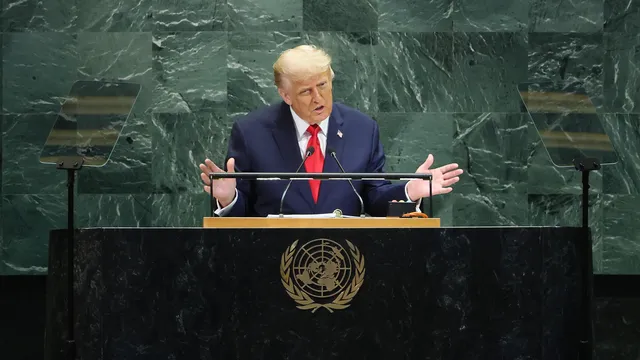
US President Donald Trump returned to the United Nations General Assembly with a familiar message: America is stronger, US power is back and his administration is willing to use it.
But his 37-minute address on Tuesday was also packed with claims and remarks that immediately drew scrutiny, from his threat to “annihilate” Iran to his assertion that he had settled eight wars.
Trump also renewed his attacks on the United Nations, the International Criminal Court and migration, while defending US actions in Venezuela and Cuba.
Some of the themes echoed his appearance at the 80th General Assembly a year ago, although the conflicts and claims at the centre of his latest speech have changed.
Here are some of the major controversial points:
Iran threat puts military power at centre of speech
The sharpest moment of Trump’s address came when he presented Iran with what he described as a choice between a negotiated settlement and destruction.
“I have a big decision to make,” Trump told world leaders. “Will a deal be made with Iran… or do I annihilate the Islamic Republic and do it quickly?”
He also said he could “drive them into hell” if no agreement was reached.
Trump defended the US military campaign against Iran, saying his administration’s objective was to prevent Tehran from acquiring a nuclear weapon. He accused Iran of supporting terrorism and said other countries should join the US in economically isolating Tehran.
The remarks were notable because Trump simultaneously suggested that diplomacy remained possible. He predicted that a deal could be reached after the US midterm elections and later told reporters that he believed a settlement was in sight.
The Iranian delegation was not in the General Assembly hall when Trump began speaking. AP reported that Iranian officials and their delegates had left the chamber about 10 minutes into the address.
The threat also came against a backdrop of scrutiny of the US military campaign. Reuters reported that a UN fact-finding mission had said it had reasonable grounds to believe US forces committed war crimes in two strikes on Iran, including an attack on a primary school in Minab.
Eight wars, one sweeping claim
Trump again presented himself as a president who has succeeded where previous administrations failed. This time, he said he had settled eight wars.
The conflicts he referenced included disputes involving Cambodia and Thailand, Kosovo and Serbia, Rwanda and the Democratic Republic of Congo, India and Pakistan, Armenia and Azerbaijan, Gaza, Israel and Iran, and Egypt and Ethiopia.
That was an expansion of a claim Trump made at UNGA 80 in September 2025, when he said he had ended seven “unendable wars” in seven months.
That earlier claim was challenged by the Associated Press, which found that Trump’s role varied across the conflicts and that some of the situations he described as wars were better characterised as disputes or tensions. In some cases, fighting had also not been permanently resolved.
A year later, Trump has expanded the number from seven to eight. His broader argument, however, remained largely unchanged: that American military and economic power had produced diplomatic results that previous leaders could not achieve.
“We’ve settled eight wars,” Trump said, presenting the record as evidence of his administration’s approach to international affairs.
Gaza: ‘We ended the war’
Gaza provided another major point of contrast between Trump’s two UN appearances. At UNGA 80 in September 2025, the war was still ongoing. Trump called for an immediate end to the conflict and pushed for the release of Israeli hostages, while rejecting international moves towards Palestinian statehood. He argued that recognising a Palestinian state would reward Hamas.
This year, Trump presented Gaza as a completed diplomatic success.
“One year ago, when I addressed the great leaders in this hall, the war in Gaza was still raging brutally,” he said.
“A few weeks later, we ended the war in Gaza.”
He also said his administration had secured the return of all remaining hostages and praised the US-backed peace plan and Board of Peace. There is, however, an important distinction between a ceasefire and the complete end of the conflict.
The UN has described the Gaza ceasefire as “far from perfect”, with ongoing Israeli attacks and no tangible recovery initially visible in the territory.
As recently as September 18, the UN Office for the Coordination of Humanitarian Affairs reported ongoing strikes, widespread destruction, restrictions on essential supplies and continuing humanitarian risks nearly a year after the October 2025 ceasefire.
The ceasefire therefore represents a major change from the full-scale fighting of 2025, but Trump’s description of the war as simply “ended” leaves out the continuing violence and unresolved political and humanitarian issues.
Trump takes another swipe at the UN
Trump’s relationship with the UN was another recurring theme. In 2025, he complained about the organisation after an escalator malfunction and teleprompter problems interrupted his visit. He joked that the two things he received from the UN were “a bad escalator and a bad teleprompter”.
This year, the criticism was more substantive. Trump said the UN had “great, great potential” but accused it of imposing what he called a “far-left agenda” driven by “globalist bureaucrats who nobody ever elected”.
He also celebrated what he described as sweeping reforms, including a 15 per cent cut in the UN budget in 2026 and the elimination of more than 4,000 positions. The remarks came as the UN undergoes the UN80 reform process, which is intended to make the organisation more efficient and financially sustainable.
Trump also criticised UNESCO and linked the UN’s approach to migration with what he described as the erosion of national cultures.
“There is no human right to illegal immigration,” he said, arguing instead for the right of countries to protect their sovereignty.
From climate ‘con job’ to ‘superintelligence’
Trump’s 2025 and 2026 speeches also show how quickly the subject of his most provocative technological claims can change.
At UNGA 80, he dismissed climate change as a “con job” and attacked what he called Europe’s “suicidal energy ideas”, arguing that countries should rely more heavily on fossil fuels. Scientists, however, have established that human activities are driving climate change.
This year, artificial intelligence took centre stage.
Trump proposed that the US should use the term “superintelligence” instead of artificial intelligence because, in his view, the word “artificial” makes intelligence sound fake.
He also dismissed warnings about the dangers of AI and argued that the technology could become more significant than the Industrial Revolution.
“Whoever wins SI, whoever wins Superintelligence wins,” he said, referring to the competition for technological leadership.
The remarks came as governments and technology companies continue to debate how quickly AI should develop and what safeguards should accompany it.
ICC remains a target
Trump also used the UN platform to renew his opposition to the International Criminal Court. He described the ICC as an “out of control institution” and an “evil group of people” and urged member states to withdraw.
The US is not a party to the Rome Statute, which established the ICC. Trump has previously taken punitive measures against the court and its officials.
His latest attack was framed around protecting US military personnel from what he called “show trials” by an “anti-American tribunal with no jurisdiction over us”.
The criticism also comes against the backdrop of the ICC’s arrest warrant for Israeli Prime Minister Benjamin Netanyahu over alleged crimes linked to the Gaza conflict.
Venezuela, Cuba and the limits of ‘America First’
Trump’s vision for the Western Hemisphere was another prominent feature of the address. He defended the US military operation in Venezuela that led to the capture of Nicolás Maduro, presenting it as evidence that Washington would no longer allow threats to establish themselves in the Americas.
“Our actions in Venezuela are proof that the United States will no longer permit threats to America to gain a foothold anywhere in the Western Hemisphere,” he said.
He also described Mexico as the “epicenter” of cartel violence and accused Cuba of being a “failed state”.
“Communism will never be coming to America, but freedom will be coming to Cuba,” Trump said.
Members of the Cuban delegation walked out during his remarks, according to Reuters.
The comments is a broader feature of Trump’s foreign policy: the emphasis on American power and national interests, even when dealing with issues traditionally addressed through multilateral diplomacy.
A year later, the tone has changed, but the formula remains
Trump’s UNGA 81 speech was different in subject matter from his appearance a year earlier, but the underlying approach was recognisable.
At UNGA 81, Iran, AI, Venezuela and his claimed diplomatic successes took centre stage.
Yet the central message remained consistent: American strength, rather than international institutions alone, should determine how major global problems are confronted.
The difference is that Trump returned this year not simply to criticise the existing international order, but to present his administration’s actions as proof that his alternative is already working.
That claim now sits alongside an expanding list of controversies over the scale of his military threats, the accuracy of his diplomatic scorecard and the gap between declaring conflicts settled and resolving the problems that produced them.