


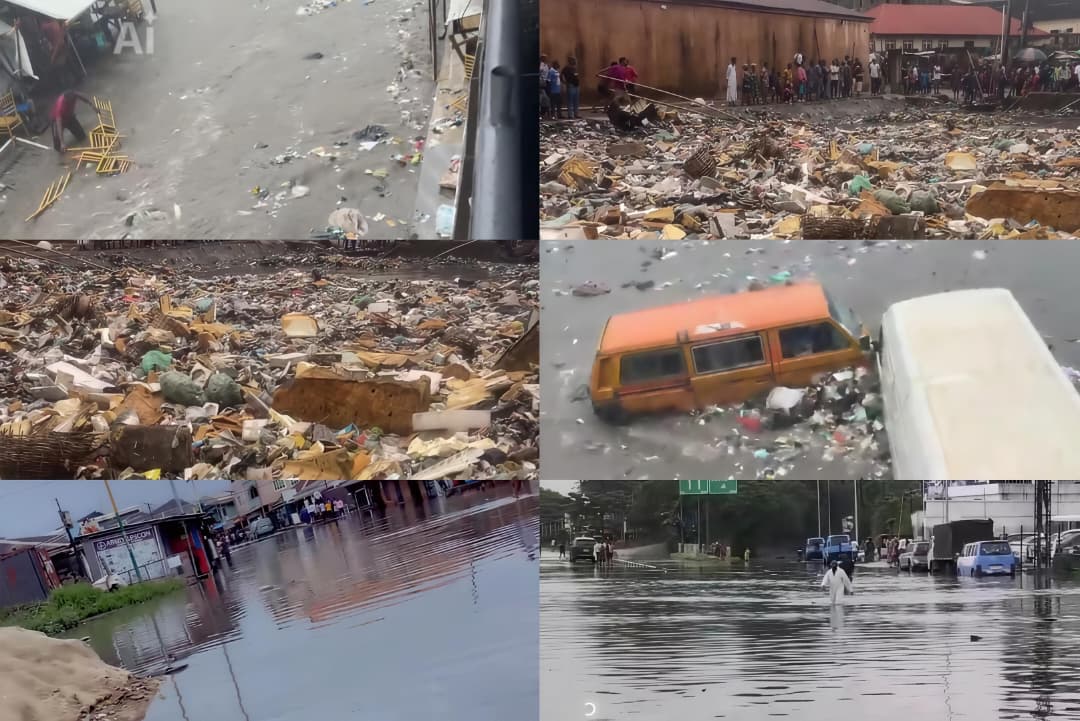
Annual Flood Outlook reveals unprecedented scale of danger; identifies flooding seasons, causes, and why responses have failed in previous years
The Nigeria Hydrological Services Agency has released its 2026 Annual Flood Outlook, painting a catastrophic picture of a nation where nearly 31,000 communities face flooding threat.
The comprehensive assessment identifies 30,707 communities across 33 states and the Federal Capital Territory as vulnerable to flooding at varying severity levels. This represents not merely a seasonal inconvenience but an existential emergency shaped by climate change, infrastructure collapse, and decades of inadequate governance response.
The scale of the threat demands clarity. Of the 30,707 communities identified as at-risk, 14,118 face high flood risk, 15,597 face moderate risk, and 923 face low risk. This three-tier categorisation matters because it determines urgency. High-risk communities face near-certain flooding with devastating consequences. Moderate-risk communities will likely experience significant flooding. Even low-risk communities cannot be dismissed as safe.
The scope represents an unprecedented mapping effort. The AFO does not merely warn of general flooding but identifies specific communities, maps vulnerable infrastructure, and provides month-by-month breakdowns of when and where flooding will intensify. Yet despite this clarity, Nigeria’s historical pattern suggests that many warnings will go unheeded until waters rise and devastation spreads.
Table of Contents
The vulnerable landscape: Understanding community risk tiers
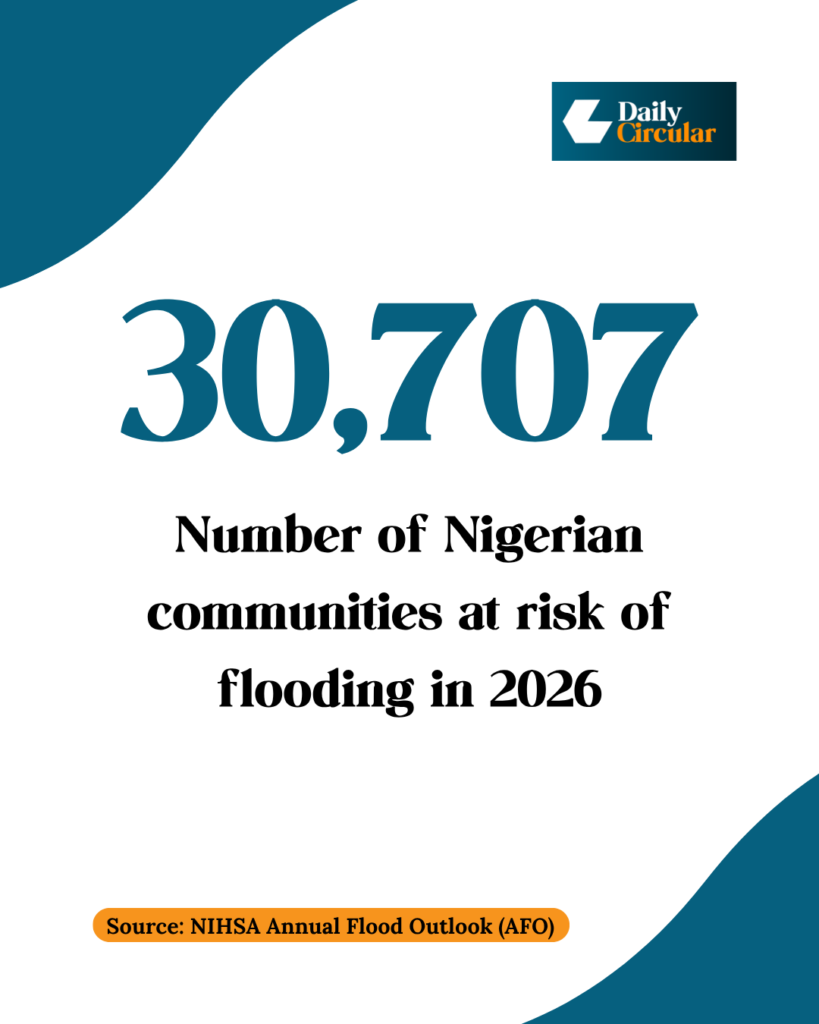
The breakdown of 30,707 at-risk communities into three risk categories reveals the graduated nature of Nigeria’s flooding crisis. Understanding these categories is essential because response resources must target high-risk areas first.
The 14,118 communities classified as high flood risk face near-certain inundation during the 2026 flood season. These communities sit in floodplain zones, along major river corridors, or in areas where urban drainage systems have completely failed. When flooding occurs in high-risk zones, displacement is massive. In the 2022 floods, high-risk communities accounted for the majority of the 1.4 million people displaced nationally. Many of these communities have experienced repeated flooding in previous years, yet lack the resources or political support to relocate.
The 15,597 communities at moderate flood risk represent a second tier of vulnerability. These communities may experience flooding depending on rainfall intensity and duration. In years with above-average rainfall, moderate-risk communities face inundation. In years with average rainfall, some escape flooding. The unpredictability makes planning difficult. Communities cannot definitively prepare because they cannot know with certainty whether they will flood.
The 923 communities at low flood risk represent the safest tier, though “safe” remains relative in Nigeria’s context. Even these communities face some flooding risk, and in extreme weather years, low-risk designations may shift.
Across all three categories, the total remains staggering: nearly 31,000 communities, representing millions of people.
When the waters come: Understanding Nigeria’s flooding seasons
The 2026 AFO identifies a clear seasonal pattern that defines Nigeria’s flood calendar. The flooding season extends from April through October, aligned with Nigeria’s rainy season. However, the forecast breaks this period into three critical phases with distinct characteristics.
The first phase, from April to June, brings early rains and the onset of moderate flooding across vulnerable areas. This period tests drainage systems and signals the beginning of the emergency management calendar. In April, scattered rainfall across Nigeria’s hydrological areas begins to raise water levels. By June, the rains intensify and early flooding occurs in areas with saturated soil and blocked drainage systems.
The second phase, from July to September, represents the critical period. During these three months, the forecast predicts peak flooding conditions. Water levels in major rivers including the Niger and Benue rise significantly. Dam releases intensify, particularly from the Lagdo Dam in Cameroon, which discharges water into Nigeria’s system between August and September. The combination of sustained rainfall, swollen river channels, and dam releases creates conditions for the most severe flooding. This period accounts for the majority of flooding disasters, displacement and deaths each year.
The final phase, from October to November, marks the tail end of the rainy season. Though flooding diminishes as rainfall decreases, water levels remain elevated. Late-season rains can trigger secondary flooding in already saturated areas. Communities that have not fully recovered from peak-season flooding face new inundation.
The 2026 forecast predicts that at least 13 states will experience rainy seasons longer than normal. These states are Lagos, Benue, Enugu, Ebonyi, Ogun, Oyo, Nasarawa, Anambra, Kwara, Kebbi, Kaduna, Gombe and Taraba. For these states, the flooding season will extend beyond normal timelines, compounding overall impact and extending the period during which communities remain at risk.
Why Nigeria floods: The interlocking causes
The AFO identifies multiple drivers of flooding, and understanding them reveals why warnings alone are insufficient without structural action. Nigeria’s flooding crisis emerges from three primary sources: natural forces, human failure and systemic collapse.
River flooding, technically called fluvial flooding, occurs when rainfall across vast catchment areas drains into major river systems. The Niger and Benue rivers serve as the primary drainage routes for enormous catchments covering multiple states. As water volumes exceed channel capacity, rivers overflow their banks, inundating communities across the Niger-Benue corridor. The 2026 AFO specifically flags this region as an area of extreme concern, with communities across Kogi, Benue, Niger and Nasarawa states facing high risk. Historical records show that communities along these rivers experience flooding with predictable regularity.
A critical component of river flooding involves dam releases. The Lagdo Dam in Cameroon discharges water into Nigeria’s hydrological system, with releases expected between August and September 2026. These releases are predictable and avoidable through advance warning and evacuation planning. Communities downstream have received advance notice of expected water levels for years. Yet year after year, communities flooded by anticipated dam releases express shock and demand compensation, suggesting that warnings never translated into evacuation action.
Flash and urban flooding represents the second major category. This occurs when heavy rainfall overwhelms urban drainage systems. Data from the National Emergency Management Agency shows that 70 per cent of flash floods in Lagos and Ibadan are directly caused by blocked drains and gutters. A gutter clogged with plastic waste, leaves and silt becomes a weapon against the city’s inhabitants. What should drain within minutes instead pools dangerously, flooding homes, shops and streets within hours. This category of flooding is almost entirely preventable through basic maintenance.
The third category, coastal and tidal flooding, affects southern coastal states including Bayelsa, Delta, Lagos and Ondo. Rising sea levels, land subsidence, and the intrusion of saltwater into freshwater aquifers all contribute. Lagos, sitting on low-lying coastal terrain, faces particular vulnerability. The AFO identifies coastal flooding as one of the most destructive categories precisely because it combines water from multiple sources: rainfall, tidal surge and ocean wave action.
Beyond these natural triggers lies a human dimension that transforms weather events into disasters. Poor urban planning has created cities where development sprawls across floodplains with minimal drainage provision. Blocked gutters, encroached waterways and buildings constructed in high-risk zones amplify impact. When rain falls on these poorly planned cities, flooding becomes inevitable.
Learning from devastation: Impact in previous years
Nigeria has experienced catastrophic floods repeatedly in the recent past, providing clear evidence of what is at stake in 2026.
The 2022 floods represent the recent benchmark for devastation. That year, Nigeria experienced what NEMA described as the worst floods in more than a decade. Over 600 people died. The floods displaced 1.4 million persons from their homes. Agricultural land covering 440,000 hectares was destroyed, threatening food security across affected regions. Healthcare facilities, schools and roads were damaged extensively. The economic impact extended beyond immediate losses to include long-term impacts on health, education and livelihoods as communities struggled to recover.
In 2024, despite improved early warning systems and supposedly better coordination, Nigeria still recorded 241 deaths from flooding. Half a million people were affected. States such as Bayelsa, Delta, Rivers, Benue, Kogi and Lagos experienced significant damage. The progress from 2022 to 2024 was real: fewer states affected, fewer deaths. Yet the bar for success has become depressingly low. When nations can celebrate that only 241 people died in a predictable natural disaster, something has fundamentally failed in governance and preparedness.
What these statistics obscure is the pattern of response failure. Year after year, warnings are issued months in advance. Year after year, responses are delayed until water rises. State governments have not pre-positioned emergency supplies. Communities have not evacuated despite warnings. Drainage systems remain blocked. Floodplain encroachment continues unchecked. By the time water levels rise, the response is reactive rather than preventive.
Minister of Water Resources Prof Joseph Utsev acknowledged this pattern, stating that “preparedness must be proactive, not reactive.” Yet the gap between this aspiration and actual practice remains vast. NEMA Director-General Zubaida Umar has shown genuine commitment to coordination, but the agency cannot function alone. It depends on state governments that often lack functional disaster management protocols, adequate funding, and the political will to enforce building codes or clear drainage systems before flooding season arrives.
How the forecast is made: Understanding AFO’s data methodology
The AFO is not guesswork. It represents the synthesis of comprehensive hydrological data collected across Nigeria’s eight distinct hydrological areas using advanced monitoring systems and artificial intelligence modelling.
Nigeria is divided into eight hydrological areas based on natural drainage patterns. These eight areas are distinct hydrological ecosystems with their own rainfall patterns, river systems and flooding characteristics. NiHSA maintains over 250 monitoring stations distributed across these eight areas. These stations continuously measure water levels, discharge rates and rainfall patterns. The data flows into centralised systems for analysis.
In 2026, NiHSA upgraded its methodology from traditional modelling to hybrid artificial intelligence integrated modelling systems, designed to improve accuracy and response times. The upgrade represents a significant technological advancement in Nigeria’s capacity to forecast flooding. The agency collaborates with the Nigerian Meteorological Agency to integrate weather predictions with hydrological data. It analyses soil conditions, land cover changes and historical rainfall patterns. It measures river discharge on the Niger, Benue and their tributaries. All this data feeds into predictive models that forecast where, when and with what severity flooding will occur.
The 2026 AFO incorporated improved forecasting methods and enhanced hydrological monitoring systems. Yet gaps remain. Data coverage in some regions remains incomplete. Some communities in remote areas lack monitoring infrastructure. The forecast provides general scenarios but struggles to downscale to specific urban hotspots requiring hyper-local predictions.
The agricultural catastrophe: 4.2 million hectares at risk
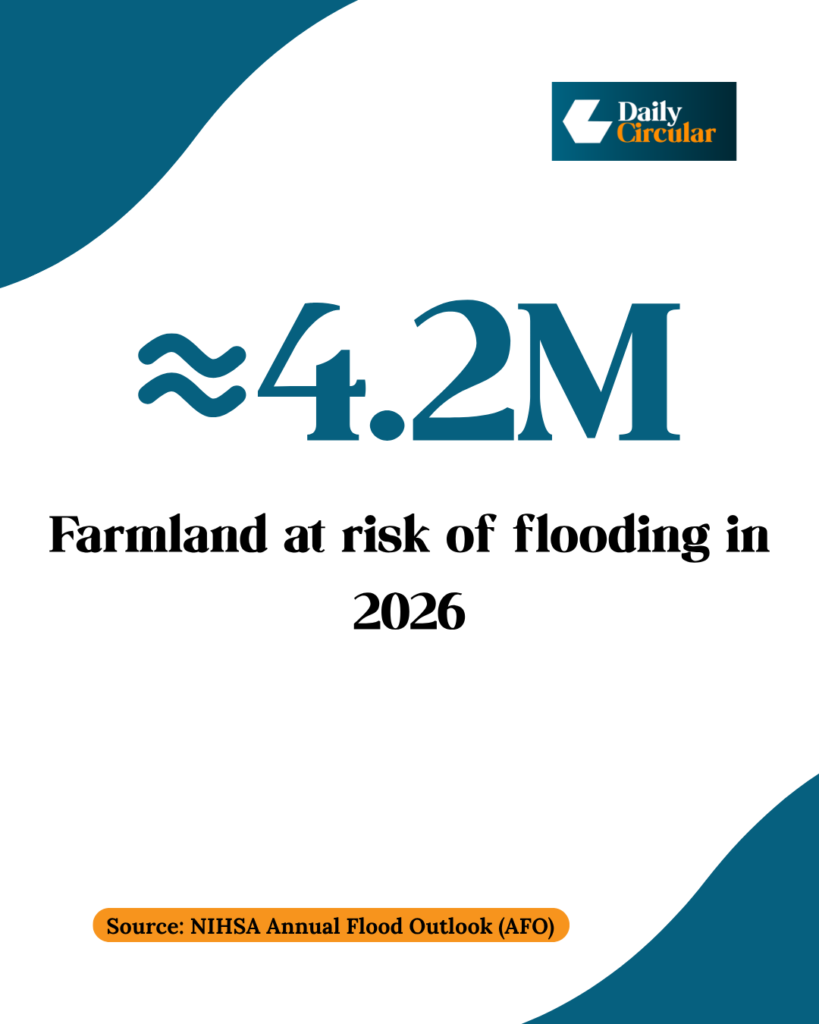
Perhaps no sector faces a more immediate and devastating threat from the 2026 floods than agriculture. Nigeria’s farming community depends on seasonal rainfall but is devastated by flooding that destroys crops, kills livestock and contaminates soil.
The AFO identifies approximately 4.2 million hectares of farmland as facing flood risk. This represents an enormous proportion of Nigeria’s cultivable land. When these areas flood, the impact ripples across the entire food system. Crop losses translate directly into food scarcity. Livestock drownings reduce protein availability. Seed stocks are destroyed, compromising next season’s planting. Rural income collapses, forcing farmers into debt and desperation.
The 2022 floods destroyed 440,000 hectares of farmland. If similar proportions are affected in 2026, Nigeria could lose millions of tonnes of agricultural output. This occurs within the context of an already fragile food security situation where millions of Nigerians face hunger despite having adequate land. Flooding does not create food insecurity; it compounds and intensifies existing vulnerability.
The Benue and Niger valleys, breadbaskets for much of Nigeria, face particular vulnerability. Communities in these regions have historically experienced devastating floods. Yet year after year, farming communities return to the same floodplain lands because these are their ancestral territories and the most fertile ground available. They have adapted through generations, developing coping mechanisms. But 2026 may test these mechanisms beyond their limits.
Critical infrastructure under threat
Beyond farmland, the AFO identifies critical infrastructure across Nigeria as vulnerable to flooding. The assessment reveals the scale of systemic risk.
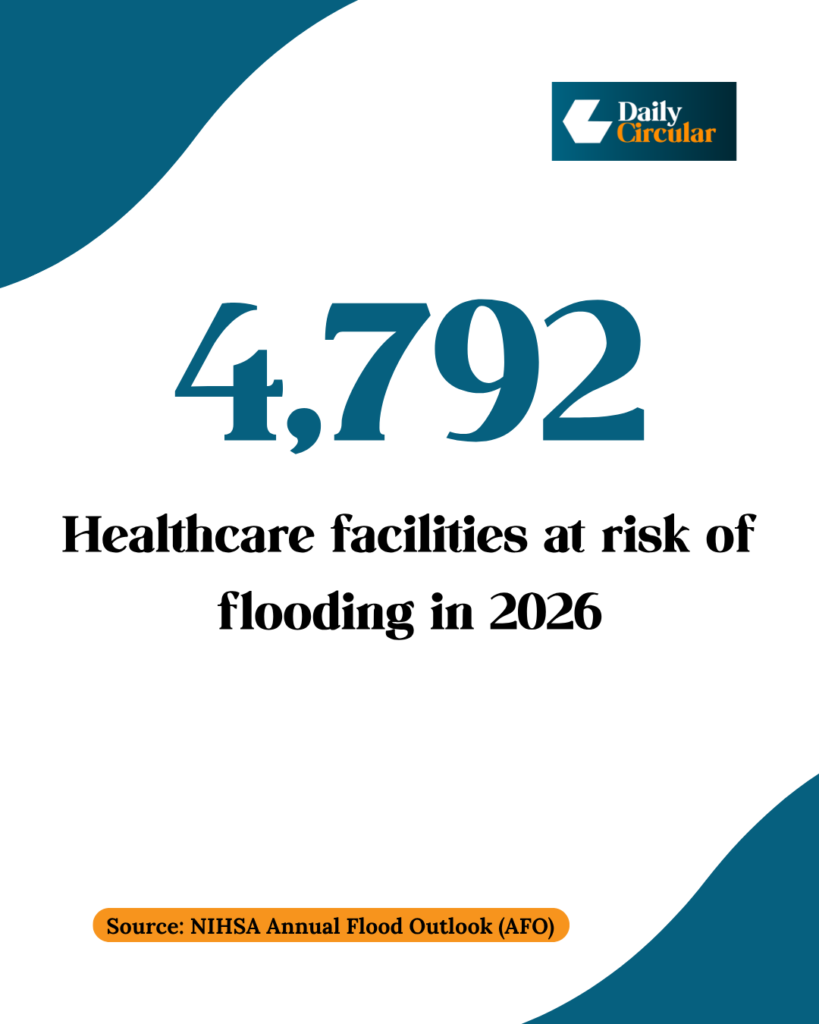
Healthcare facilities face unprecedented threat. The AFO identifies 4,792 healthcare facilities as at risk of flooding. When hospitals flood, they cannot function. Patients cannot receive care. Medical supplies are destroyed. Diseases spread in flood aftermath, precisely when healthcare capacity is most needed. The loss of healthcare access during flooding season directly translates into increased mortality from treatable conditions.
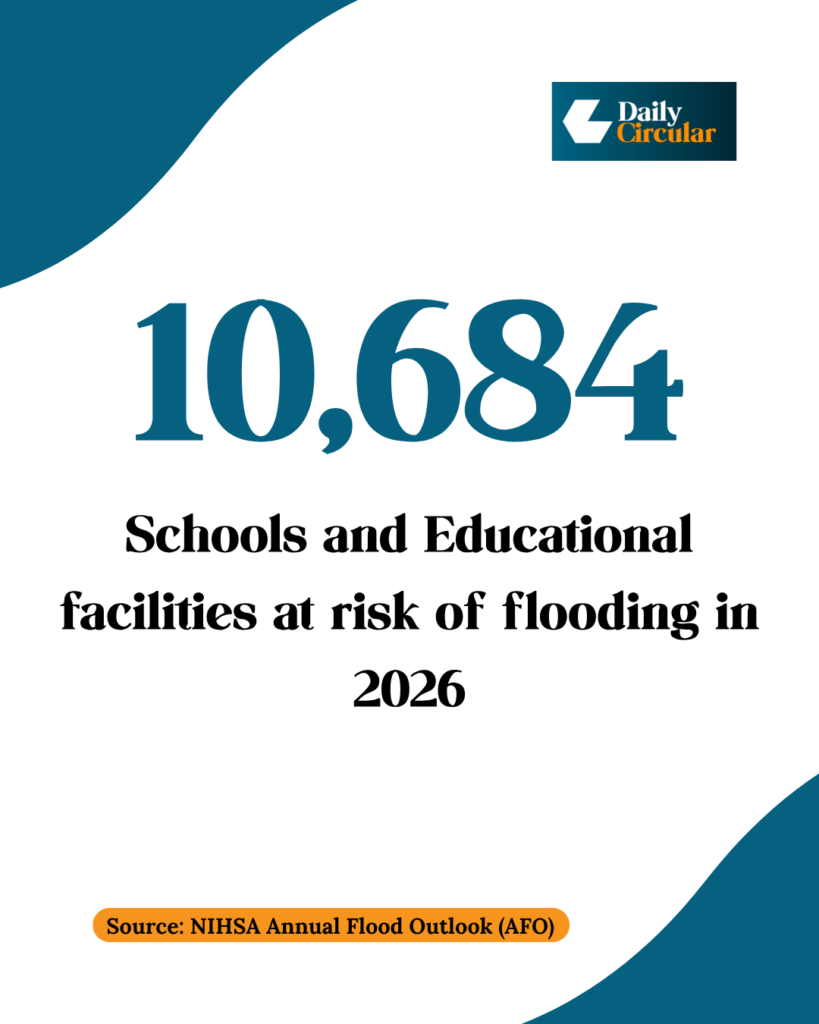
Educational facilities face similar vulnerability. The AFO identifies 10,684 schools and educational facilities as at risk. When schools flood, they close, sometimes for months. Students lose critical learning time. In the 2022 floods, thousands of schools remained closed for extended periods. Educational disruption compounds poverty by interrupting learning trajectories of the poorest children.
Roads and transportation networks face damage that extends impact far beyond flooding zones. When major highways become impassable, supply chains break. Food cannot reach markets. Medicine cannot reach hospitals. The economic ripple effects extend across the entire nation. Port operations halt. Commerce stalls.
Urban hotspots: Where flooding becomes deadly
While rural areas face agricultural devastation, major cities face a different catastrophe. Urban flooding in Nigeria is not merely about water levels; it is about infrastructure collapse, disease outbreak and the concentration of vulnerability in dense population zones.
Lagos stands at the top of the vulnerability list. The city’s geography makes it naturally vulnerable: it sits on low-lying coastal terrain, much of it only metres above sea level. Rapid urbanisation has created extensive informal settlements in areas that should never have been developed, including along waterways, in swamps and on floodplains. When heavy rainfall coincides with high tides, the city becomes a water trap.
The AFO identifies Lagos as facing high flood risk. When Lagos floods, the impact extends beyond the city itself. Lagos is Nigeria’s economic engine. Port operations halt. Supply chains break. Commerce stalls. The national economy contracts. The 2026 forecast predicts that Lagos may experience above-average rainfall, with early onset and delayed cessation, creating extended wet conditions.
Abuja, Nigeria’s capital and the seat of government, also faces vulnerability. The city was planned without adequate drainage provision for extreme rainfall events. Rapid expansion has outpaced infrastructure development. The AFO flags Abuja as at risk, particularly in areas of informal settlement where drainage is non-existent.
Other major cities identified include Ibadan, Port Harcourt, Kano, Kaduna, Benin City, Onitsha, Abeokuta and Warri. Each faces its own vulnerability profile, but all share common problems: inadequate drainage, rapid unplanned expansion and inadequate emergency response capacity.
The drought that follows: A secondary disaster
The AFO’s scope extends beyond the flooding season itself. It warns of a secondary disaster that receives less attention but affects millions: post-flood drought.
The 2026 forecast predicts that dry conditions and drought risk will emerge after the flooding season concludes. This creates a catastrophic cycle. Floods destroy crops and contaminate water sources. As floodwaters recede, drought conditions follow, preventing replanting and forcing communities to rely on contaminated water during the critical period of disease outbreak risk.
This cycle has played out repeatedly. The 2022 floods were followed by drought conditions that intensified food insecurity. Farmers had lost seeds and could not replant. Water sources were contaminated. Communities faced hunger even as the physical waters had receded.
The AFO notes that this pattern creates compounding vulnerabilities. Communities recover from flooding only to face drought. The cumulative effect is that 2026 will be a brutal year for Nigeria’s poorest populations: flooded in mid-year, drought-stricken in late year, and hungry throughout.
The challenge ahead: Response and preparedness
The 2026 Annual Flood Outlook provides unprecedented clarity. It identifies 30,707 at-risk communities by category of risk. It maps vulnerable infrastructure including 4,792 healthcare facilities and 10,684 schools. It provides monthly forecasts. It offers advance notice of five to six months before peak flooding season begins.
Yet this clarity will be tested against Nigeria’s historical pattern of inadequate response. Pre-positioned emergency supplies remain insufficient. State evacuation plans exist on paper but not in practice. Drainage systems remain blocked. Building codes remain unenforced on floodplains. Coordination between federal and state agencies remains fragmented.
The question before Nigeria in 2026 is not whether the warnings are accurate or timely. The question is whether a nation that has received years of warnings will finally translate warning into action, early evacuation, emergency preparedness and systemic change. History suggests it will not. But the cost of that failure will be measured in lives, in displaced families, in destroyed crops, in damaged schools and hospitals, and in hunger that extends far beyond the flooding season.