

By Tolu Ogunlesi
PAPSS is the Pan-African Payment and Settlement System, launched by Afreximbank on 13 January 2022.
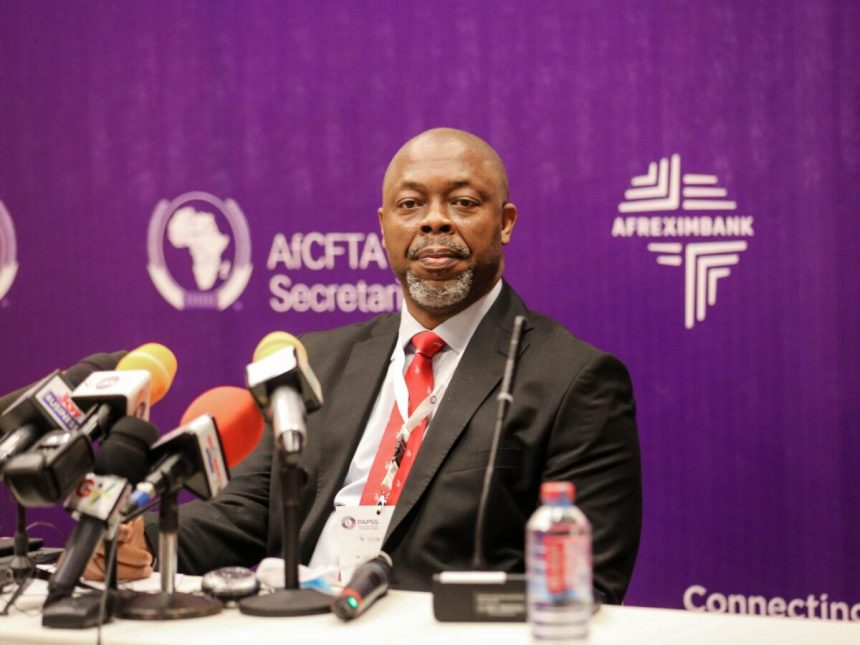
Mike Ogbalu III, a Nigerian banking and fintech veteran (ex-UBA, Ecobank, First Bank, and Interswitch, where he ran the Verve Card business before joining Afreximbank to run PAPSS), was in Lagos recently to meet with journalists and editors.
It’s an interesting time for PAPSS as it transitions from implementing its first strategic plan (2022–2026) into a second plan, kicking off in 2027.
“Phase one was about spread, our phase two is going to be all about deepening,” Ogbalu says.
Here are the highlights from the briefing:
The problem: a fragmented continent
Africa has 54 countries, each with its own trade policies and customs arrangements, and 42 currencies. It is also the continent with the lowest levels of intra-continental trade in the world – only about 15–20% of the continent’s total trade happens within its borders, versus 50–70% for Asia and Europe.
The solution: first AfCFTA, then PAPSS
To solve that, the African Union and key partners created the African Continental Free Trade Area (AfCFTA), a single market for the continent that, as Ogbalu says, “forces us to trade with ourselves.”
“Then the payment question comes up: how do we pay? Are we going to depend on external payment platforms? Payments are an excellent tool of exchange, but they’re also a tool of control.”
And that’s where the gap revealed itself: the need for an African payment system.
Ogbalus says, “AfCFTA has done an excellent job in harmonising rules of trade. The missing piece is the payments system that will catalyse the trade.”
So AfCFTA created the conditions for PAPSS to emerge, and PAPSS has emerged as the payment infrastructure backbone that will make AfCFTA a reality.
How PAPSS works
PAPSS is a payment and settlement system that allows payments to originate in one African currency and terminate in another African currency, while entirely bypassing third-party transit currencies such as the US dollar or the euro.
The PAPSS ecosystem brings together a wide range of players: central banks, commercial banks, payment service providers, payment switches, fintechs, and mobile wallet operators, among others.
In addition to its wholesale and retail real-time payments offering, PAPSS has now launched a currency marketplace, which allows institutional participants to trade African currencies directly. This means an airline, a multinational brewer, or an insurer can now transfer funds or repatriate profits across its African operations without requiring the US dollar. Ogbalu says this is the reason many global airlines have not quit the continent, despite facing USD repatriation challenges.
PAPSS has also launched a pan-African card scheme, the PAPSS Card. PAPSS makes it available to any country free of charge, allowing the benefiting country to handle card pricing and share revenues with PAPSS. For a country like Nigeria, which already has a domestic card scheme (like Verve), the PAPSS Card will operate as a local card at home and as a PAPSS card abroad. For countries without their own domestic card schemes, PAPSS will happily fill that gap.
Key design principles:
- Trust – because this is hard to acquire and easy to lose, and because Africa remains, in many respects, a low-trust environment. (Ogbalu: “We started first of all with trust: African central banks designed the PAPSS Bye-Laws and created four governance organs.”)
- Complementarity, not cannibalisation: PAPSS must not cannibalise existing payment systems or make them obsolete. Instead, it must co-exist with, complement, and even strengthen other payment systems.
- Safety and speed
- A solid legal basis, embodied in a comprehensive set of central bank-created Bye-Laws that serve as the guiding governance and operating framework.
- A solid financial basis: Ogbalu says that to launch the PAPSS pilot, Afreximbank allocated $500 million in funding to guarantee settlement finality, and has since expanded this funding to $3 billion.
- Key embedded compliance features: A dispute resolution mechanism; an AI-driven fraud management system; compliance with Anti-Money Laundering (AML) regulations, and with global sanctions listings.
- Indigenous, yet meeting all global safety and operating standards.
Governance and transparency
The four governance organs of PAPSS are as follows:
- A Governing Council as the highest decision-making organ, currently comprising 15 central bank governors as voting members, as well as representatives of Afreximbank, AfDB, AU, and AfCFTA. Ogbalu notes: “We’ve given every regulator visibility on every transaction going into and out of their market, so all the central banks have administrative access into our system. They don’t need to wait for us to submit any reports to them.“
- Payment Systems Oversight Committee: directors of payments from the Governing Council’s central banks, holding powers of direct oversight on operations.
- The Board of PAPSS: distinguished African financial experts.
- The Management team, led by Ogbalu.
Radical changes
- Two of the most radical changes PAPSS has brought to pan-African payments are in processing time and cost, both cut by more than 90 per cent. Where payments from one country to another used to take three to five days, Ogbalu says PAPSS has “been averaging seven seconds transfer time since we launched, from sending to receiving,” a 99 per cent reduction, and well below its 120-second guarantee.
- On cost, he says PAPSS has brought this down “by 90 to 95 per cent,” charging only a fraction of what used to be standard.
Momentum is growing
- 30 countries connected so far, represented by 24 central banks
- About 200 financial institutions connected, as well as 16 switches (10 of them national)
- 10 of the 30 connected countries joined in 2026
- 2026 has so far seen an increase of over 1,000 per cent in transaction volume compared with the same period in 2025, and a 125 per cent increase in transaction value
PAPSS is creating new opportunities and seeding innovation in the African fintech ecosystem. Ogbalu says they’re seeing fintechs increasingly innovate around financial services and experiences that affect end-users, such as escrow services and remittances. Opportunities are also emerging for new players to act as system integrators, helping commercial banks and payment service providers integrate into PAPSS.
With growth comes increased risk. Ogbalu says the rate of hacking attempts on PAPSS “has more than doubled in the last six months, but we haven’t had a successful compromise. We continue to invest in improving security.“
What does the future look like?
PAPSS is targeting 38 connected countries by the end of 2026, meaning eight more countries need to come on board to hit that milestone. By the end of the second plan’s implementation, PAPSS hopes to have all of Africa connected.
South Africa is the only Big Four country yet to sign up for PAPSS.
“We’re engaging, and the engagements have been positive,” Ogbalu says.
Beyond Africa, PAPSS is extending its reach beyond the continent. It’s now helping the Caribbean Community (CARICOM) design and build a similar system.
“The next step will be to integrate the two systems,” Ogbalu says.
There’s also interest from countries like China, India and Brazil. Ogbalu says that by the first quarter of 2027, all things being equal, PAPSS will be connected to the largest payment systems in China and India.
Mike Ogbalu III, in his words
- “The prosperity of a nation is significantly tied to the volume of trade it does with other countries.”
- “Payments are an excellent tool of exchange, but they’re also a tool of control.”
- “Why should the poorest people and countries pay the most to make payments?”
- “PAPSS, by its design, has almost completely eliminated dependence on third-party currencies to do intra-African transactions.”
- “PAPSS would not be where it is today without Nigeria. Nigeria was the first chair of the Governing Council of PAPSS and continues to be a leader in our rollout.”
- “Nigeria does not always get enough credit for being a [global] leader in the area of payments.”
- “PAPSS has decided that at the core of what it will do is to build a trusted financial market ecosystem and infrastructure that will connect payments across all of Africa and enable the continent to seamlessly make payments.”
- “By Q1 2027, we hope to be connected to the largest payment systems out of China and India.”
- “We want to be able to support every form of money flowing through our markets, whether it’s fiat or crypto.”
- “Phase one of PAPSS was about spread. Phase two is going to be all about deepening. It’s in the deepening you’ll create more value for consumers.”
In Part 2: More on the impact of PAPSS, fascinating insights from its rollout, and key challenges being faced.
Tolu Ogunlesi is an award-winning Nigerian journalist, writer and communications professional. He is a two-time CNN Multichoice African Journalism Award winner and former Special Assistant to President Muhammadu Buhari on Digital and New Media.