

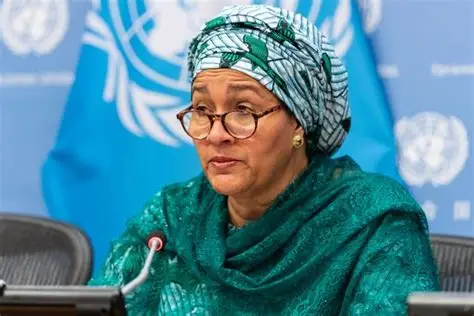
Amina Mohammed, deputy secretary-general of the United Nations (UN), has urged the federal government to establish policies that would enable farmers to profit from local fertiliser production.
In an interview with TheCable in Washington DC, Mohammed, who is also the leader of the United Nations Sustainable Development Group, addressed issues about food security and fertiliser availability for Nigerian smallholder farmers.
In response to the study, Mohammed stated that the government should work with the private sector on domestic measures to improve farmers’ access to fertilisers.
“You have to find a domestic policy that allows for a capacity of production in Nigeria to open that up for farmers,” she said.
“The private sector is not a charity. This is about profit, and that profit benefits our revenues. It gives jobs. And so, let’s not juxtapose the private sector and the government.
“They have to work together to find the policies that will allow a local production to benefit people. This has happened in the oil sector in the country, and we’ve managed to navigate that. Now we’ve got to do so on food security.”
The UN official’s views come as the international economy confronts a new test from the ongoing violence in the Middle East.
According to the International Monetary Fund (IMF), the conflict has harmed Sub-Saharan Africa’s economic future by causing large increases in oil, gas, and fertiliser prices, as well as shipping costs.
The organization calculated that a 20% increase in worldwide food costs may cause more than 20 million people in the region to experience moderate or severe food insecurity.
In order to reduce food insecurity threats, she believes Nigeria must ensure consistent fertiliser supply during the planting season.
She said conflict, “whether in Iran, Zamfara or Borno”, generally exacerbates food security.
“So already we have been dealing with that in Nigeria and the Sahel and Sudan, which is probably the worst affected in the world today,” said.
“What happens with Iran is it exacerbates it, and when we look at that, we are lucky in Nigeria to have the fertiliser plant at the Dangote refineries, we also have in Morocco.
“And so what we need to do is to see how we fill those supplies. We don’t allow a breakdown for the next planting season. This planting season, I believe most people have taken care of it. It’s the next one and the one after that.
“So, you just shore up the policies, make sure that we are working better together through the three tiers of government, because the local governments is where it acts.”
Mohammed emphasised the need of providing local and state governments with the resources they need to serve their constituents.