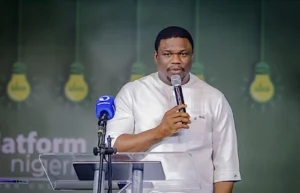



At the recent Nigerian Bar Association conference in Enugu, South Africa’s firebrand opposition leader Julius Malema delivered more than a speech; he delivered a wake-up call. His words, though blunt, carried the weight of history and the urgency of Africa’s present struggles.
Malema’s central thesis was clear: Africa must stop being dependent on the West. “We remain under the shadows of our former colonial masters, and this dependency is killing our future,” he declared.
His point is not without merit. Despite decades of independence, many African economies remain tethered to foreign aid, multinational corporations, and policies dictated by institutions headquartered far from the continent.
From the exploitation of raw materials to the debt traps imposed by global lenders, Africa continues to experience a form of neo-colonialism dressed in the cloak of globalisation. Malema pointed to the painful irony of African nations rich in resources yet poor in development, because those resources are exported cheaply and refined abroad.
“We cannot call ourselves free when our minerals feed European factories while our children go hungry,” he told the audience.
The editorial lesson here is straightforward but difficult: Africa must look inward. Self-reliance cannot remain a slogan; it must be a policy. Countries like Nigeria, Ghana, and South Africa have the intellectual, industrial, and agricultural potential to meet most of their own needs, but political will is often lacking.
As Malema stressed, “The day Africa feeds itself, clothes itself, and builds for itself, that is the day we can speak of true independence.”
Another lesson Africa must learn is that of unity. Malema reminded the audience of the vision of Kwame Nkrumah, Julius Nyerere, and other Pan-Africanists who saw continental solidarity as the antidote to foreign manipulation. Today, regional rivalries, weak institutions, and selfish leadership have made the African Union more symbolic than functional. “If we do not unite, they will divide us, and once divided, we are finished,” Malema warned.
Malema also placed responsibility on Africa’s elites. Too often, African leaders have been complicit in sustaining Western dependency by choosing personal gain over national interest. Corruption, weak governance, and lack of accountability allow foreign companies and governments to exploit Africa with ease.
As Malema said pointedly, “We cannot keep blaming Europe while our leaders steal from us and sell our future for cheap bribes.”
The path forward is neither simple nor quick. It requires investment in education, infrastructure, and technology; it requires leaders who prioritise the collective good over private wealth. Most importantly, it requires a continental mindset that sees Africans not as Nigerians, Kenyans, or South Africans first, but as Africans working towards a common destiny.
The lesson is as much for the young generation as it is for leaders: Africa must break the chains of dependency, not by rhetoric alone, but by action, building industries, strengthening institutions, and demanding accountability.
Breaking free from dependency will not be easy. It requires courage, bold reforms, and unity across borders. But as Malema reminded, Africa’s strength lies in its people, its resources, and its shared destiny. The West will not hand over respect or equality willingly; Africa must claim it.
The time to act is now. Malema’s call is not just rhetoric; it is a roadmap. Africans can either continue on the path of dependency or take charge of their future. The choice will determine whether the continent remains a pawn in global politics or emerges as a true force of its own.