



Presidential aide shares personal history of mother’s petty trading; argues informal sector remains economy’s backbone amid public backlash
The Special Adviser to the President on Media and Public Communication, Sunday Dare, has defended the First Lady, Senator Oluremi Tinubu, following widespread public criticism of her remarks encouraging Nigerians to venture into low-capital businesses such as selling akara, roasting corn and making kuli-kuli.
Speaking during an interview on Mic On Podcast on Saturday, Dare argued that critics have misunderstood the core message of the First Lady’s remarks, which centred on micro-enterprise, self-reliance and the dignity of labour. He shared his own personal history as the child of a petty trader to substantiate his position.
“Look at me. Wherever I am today, my mother sold akara,” Dare revealed. “Wherever I am today, my mother sold bananas. I carried bananas in a tray on my head to markets in Jos, Plateau State. My mother sold oranges, and through that, they were able to train me.”
First Lady’s remarks trigger backlash
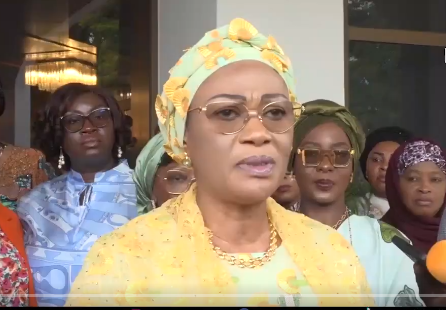
The controversy began on Wednesday when First Lady Tinubu addressed State House correspondents following the second-quarter meeting of the Renewed Hope Initiative with wives of state governors at the State House in Abuja.
Remi stated:
“We’re trying to give hope, and to start akara business doesn’t take a lot of money. To start roasting corn, or somebody even said kuli-kuli doesn’t take much. We didn’t give them a loan; we gave it to them as a grant.”
The remarks, released in a video that circulated widely on social media, sparked sharp criticism from citizens who described them as disconnected from economic realities. Critics pointed to soaring food prices, high fuel costs and rising inflation as factors making such small businesses difficult to start.
Dare defends informal economy
Dare argued that the informal economy forms the foundation of Nigeria’s economic resilience and should not be dismissed.
“When you look at the informal sector of our country, its resilience continues to lift this economy. You find it predominantly everywhere, and also in the north, they’re also significant,” he stated.
The presidential aide cautioned citizens against looking down on small-scale trades.
“What is wrong with that? If that was right 60 years ago, what is wrong with that now? Because it’s about what capital you have. When you grow these small businesses, you start small,” Dare said.
Dare clarifies the First Lady’s message
Dare emphasised that the First Lady’s message was not to confine youths to petty trading indefinitely, but to foster an entrepreneurial mindset.
“You must not miss her point. Her point is that whatever it is, try and do something, have some level of entrepreneurial skill. The point she is making is whatever it is, be engaged in some kind of enterprise,” he stated.
Mixed reactions on social media
Online reactions to both the First Lady’s remarks and Dare’s defence remained divided. Some social media users defended the businesses themselves, arguing that akara and similar trades have historically lifted families out of poverty. One user described akara as “one of the most lucrative businesses in Nigeria,” noting that many families have used the trade to train children and acquire property.
Others, however, maintained that the issue was not the nature of the businesses but the broader economic context. A social media user argued:
“Nobody is mocking akara, roasted corn, or kuli-kuli. Those are honest businesses. The problem is that Nigerians are asking for a better economy, more jobs, and lower prices.”