


Mining sector reforms take centre stage as SMDF-EMERGE targets exploration gaps, formalisation, and investment growth to curb Nigeria’s illegal mining losses
By Aisha Kabiru Mohammed
In the dusty heat of a busy market in Oyo State, south-western Nigeria, men drive in with heavy cement bags tied to motorcycles. The bags are filled with lithium ore that would be sold to the market’s hordes of unlicensed traders and miners who have migrated there from different parts of the country.
A journalist at Premium Times uncovered this market where purchasing lithium was as easy as buying a basket of tomatoes. His investigation into Nigeria’s artisanal lithium mining market led him to Abuja Leather, a community in the Itesiwaju Local Government Area of Oyo State.
Abuja Leather is not an isolated case. Hundreds of similar sites exist across Nigeria, feeding an informal mining economy that continues to deprive the country of billions in revenue.
Nigeria is estimated to lose up to $9 billion annually through unregulated extraction and the smuggling of gold and critical minerals. Between 2016 and 2018 alone, the country reportedly lost more than ₦353 billion (over $900 million) to illicit mining activities. Industry watchdogs have also highlighted the role of foreign buyers, particularly Chinese actors, in facilitating trade-based money laundering and the systematic undervaluation of minerals, often through local intermediaries.
A new bride in solid minerals
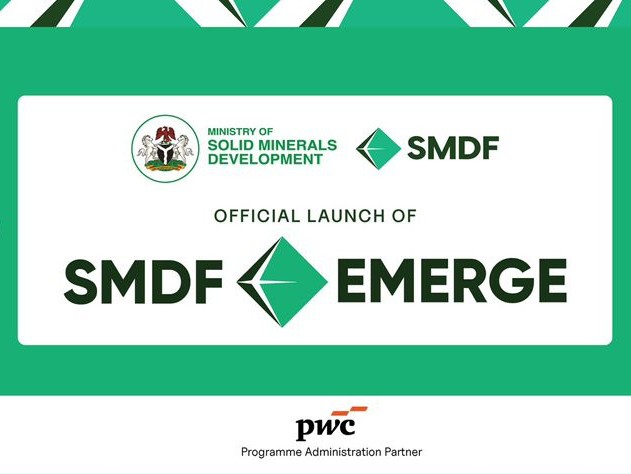
Against this backdrop, the Solid Minerals Development Fund (SMDF) on the 10th of June 2026 launched the Early-Stage Mineral Exploration and Research Grant Endowment (EMERGE), to “provide catalytic grants, technical support, and research funding to advance early-stage exploration, critical-minerals development and processing, and geoscience research, building a pipeline of investment-ready, bankable projects.” Supporting the Fund as programme administration partner is the professional services firm, PwC.
In attendance at the event, held at the Niger Hall of the Transcorp Hilton, Abuja, were sector stakeholders, including the Chairman, Senate Committee on Solid Minerals, Sen. Akpan Ekong Sampson; Chairman, House Committee on Solid Minerals, Hon. Gaza Jonathan Gbefwi; the Honourable Minister of Solid Minerals Development, Dr. Henry Dele Alake; representatives from the Central Bank of Nigeria, as well as from industry associations and academia.
“Nigeria is the new bride in solid minerals. We are largely unexplored, but we do have potential. All the world powers are coming for our mineral wealth, and that new bride will not go without a dowry.”
With this analogy, Hajiya Fatima Shinkafi, Executive Secretary and Chief Executive Officer of the SMDF, captured both the opportunities and vulnerabilities facing Nigeria’s mining sector. Indeed, the launch signals a bold attempt to address one of the structural weaknesses driving illegal mining in Nigeria.
Beyond policing and enforcement
In his address, Honourable Minister Alake commended the work of the SMDF and its Executive Secretary. “She’s done a very good job in the last couple of years, and she has stabilised the SMDF. She’s consolidated it perfectly, such that it has become a go-to department or agency in the entire sector,” he said. “Now, she’s making a very strenuous contribution to stemming the illegal mining in the solid mineral sector through her agency’s activities.”
He added, “When you want to combat terrorism, insecurity, or banditry, these are asymmetrical wars. They are not conventional wars where armies face each other. Unconventional wars require unconventional methods.”
One message emerged clearly from both speakers: Nigeria’s mining sector cannot be secured solely through policing and enforcement.
Major challenges plague the early stages of mineral exploration in Nigeria, including funding gaps and paucity of reliable data. As a result, large areas of the country remain underexplored, leaving valuable mineral deposits undocumented and vulnerable to informal extraction. This is the gap that EMERGE seeks to fill.
The programme is designed to provide co-funding for early-stage exploration activities. By reducing the financial risks associated with exploration, the grant aims to encourage investment and generate reliable data on Nigeria’s mineral resources. EMERGE will also create opportunities for collaboration between industry and academia: universities, research institutions, and master’s and PhD students.
The scenes from Abuja Leather reveal a sector where wealth is often extracted faster than it can be regulated. EMERGE represents an effort to address that problem at its source. By investing in exploration, research, and local capacity, the new grant programme seeks to build a formal mining ecosystem capable of eliminating and superseding the informal networks that continue to dominate parts of the industry.
If successful, EMERGE will not only uncover Nigeria’s mineral wealth; it will also help ensure that more of the sector’s immense economic value remains within the country.
Aisha Kabiru Mohammed is a communications professional and freelance journalist writing from Abuja, Nigeria.