

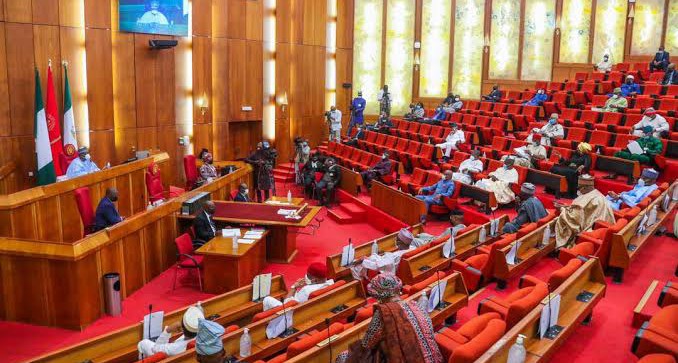
The Nigerian Senate has amended its standing rules to restrict eligibility for presiding and principal offices to lawmakers who have served at least two consecutive terms.
The amendment was adopted on Tuesday through a voice vote presided over by Senate President Godswill Akpabio following a closed-door session that lasted about three hours.
Under the revised rules, only senators with a minimum of eight years of continuous service can contest for the positions of senate president and deputy senate president. The changes also tighten eligibility for principal offices, requiring lawmakers to have served two consecutive terms immediately before nomination.
The Senate further amended Orders 4 and 5 to reinforce the ranking system for leadership selection. Order 4 maintains that nominations for presiding offices must follow ranking, while Order 5 introduces the new two-term requirement for principal offices.
The amendment effectively excludes incoming senators who were not part of the 9th and 10th assemblies from contesting key leadership positions in the current National Assembly.
The move comes amid speculation that former senators, including Hope Uzodimma, Ifeanyi Okowa, and Ovie Omo-Agege, may seek a return to the chamber ahead of the 2027 leadership contest.
Senator Adams Oshiomhole, representing Edo North, opposed the amendment and was the only dissenting voice during the voice vote. His attempt to raise a point of order was overruled by the Senate President.
Before the revision, any ranking senator — defined as one who had served at least one term — was eligible to contest for presiding offices.
The Senate also introduced additional procedural changes, including fixed times for plenary and committee meetings, limits on committee memberships, and the creation of a new committee on reparation and repatriation.
WHAT THIS MEANS
The amendment reshapes the pathway to Senate leadership by prioritising experience and continuity over open eligibility. While it may strengthen institutional stability, it also narrows opportunities for newer lawmakers and could influence political calculations ahead of the 2027 leadership contest.