

The dispute between a Lagos parent and a textbook author, now under police investigation, has raised questions about educational standards, free expression, and the use of law enforcement in civil disputes.
What began as a social media post by a Lagos parent reviewing her child’s school textbook has escalated into a wider discussion on educational standards, child safety, and online criticism in Nigeria.
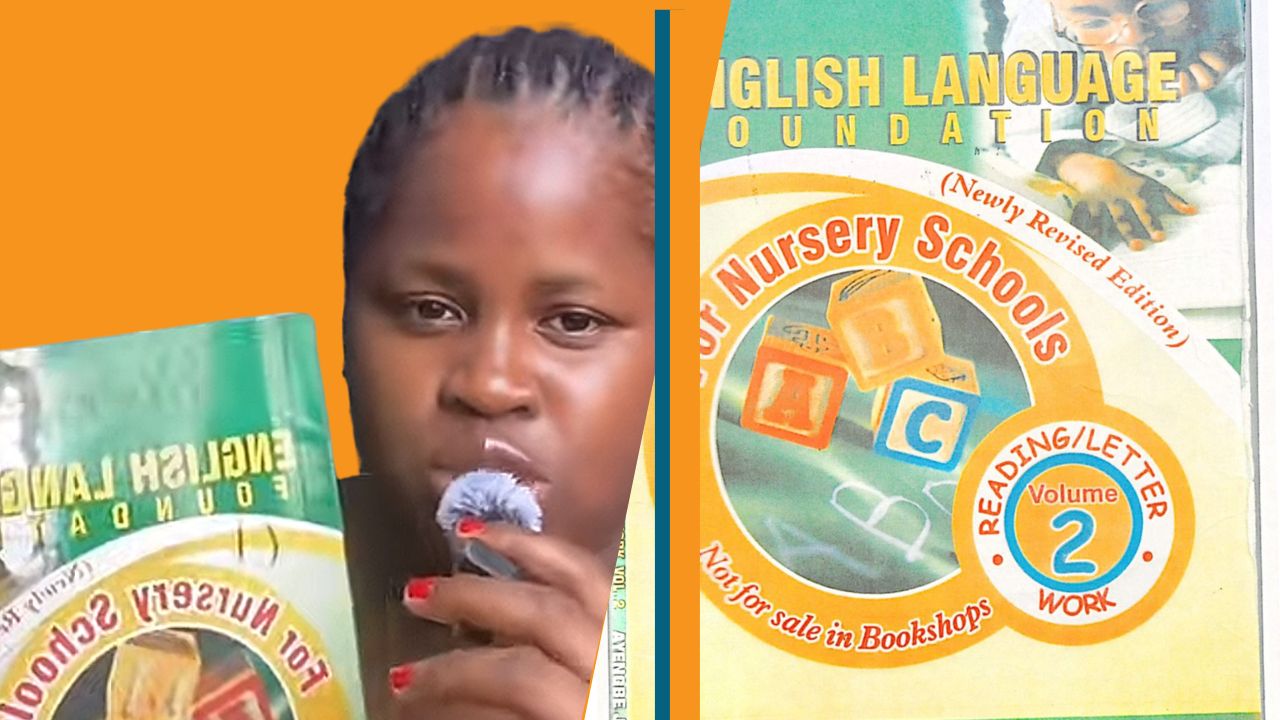
In April 2026, Maryqueen Udoka, a Lagos-based parent and content creator, posted a video on social media expressing concern over a nursery school textbook, “English Language Foundation for Nursery School.” While holding a copy of the textbook, she expressed profound concern over what she described as “disturbing” and “violent” content being taught to young children. Within days, her video reached thousands, drawing the attention of parents, state regulators, and eventually, the police.
The story at the centre of the dispute
Udoka’s concerns centred on a passage titled “The Old Man and the Dog,” which describes an incident involving punishment of an animal after it failed to guard a piece of meat. Udoka argued that such graphic imagery of animal cruelty was not only violent but lacked any redeeming moral value for children at a foundational stage of their education. The book, according to her was being utilised as core instructional material for children under the age of five at a school in the Ojo Local Government Area of Lagos.
Udoka said her objection was based on maternal concern, adding that she raised the issue to seek clarification on the suitability of the material.
“As a first-time mum, my children are my priority… I read this and came online to ask if this is the kind of book they are reading now. It doesn’t sit well with me,” she stated.
She further clarified that she was not doing it for content but only wanted to ask questions as a parent seeking clarification on her child’s curriculum
Beyond the narrative content, the textbook also drew criticism over language use, with some reviewers pointing to grammatical inconsistencies such as “a big meat” instead of “a big piece of meat” and the colloquialism “slept off” instead of “fell asleep.”
The Author’s defense
The author, Ebhohimen Ayengbe, defended the book as a collection of simplified folk tales written for children, adding that such stories often contain moral lessons.
“As I’m seated here, I will still tell you that there is nothing wrong with what I wrote… It is a matter of differences in opinion,” Ayengbe asserted, adding that “it’s not a criminal book,” he said.
Ayengbe’s defense also centered on the protocol of grievance. He said the issue should have been raised through the contact details provided in the book rather than on social media.
“I’m not a social media type. The lady didn’t buy the book on social media; my number and address are on the book. She couldn’t get to me through any of those means, but she chose to go to social media to discredit my work and my book,” he stated.
He further claimed that “everybody is just listening to the lies that the lady is telling the world,” and noted that the book had been in circulation for years without issue.
Police involvement
The dispute escalated after the author filed a petition with the Nigeria Police Force at Zone 2 Command in Onikan, Lagos. The petition included allegations of conspiracy, defamation, and cyberstalking.
Following the petition, Udoka released another video on April 25th, claiming to have received threats and numerous calls. This, she explained, drove her to remove the original video out of fear.
“Good day, Nigerians. I think this period now, my life is being threatened. Everybody around me now, the police people are carrying them, investigating them because of the video I made about this book,” she explained in a follow-up Tiktok post.
Inibehe Effiong, a human rights lawyer, who took up her case said the petition was an attempt to intimidate a parent raising concerns about educational materials.
On April 30, 2026, Udoka, accompanied by Effiong, honored the police invitation. During the meeting with the Assistant Inspector-General of Police (AIG) Moshood Jimoh, Effiong presented a copy of the textbook and pointed to the preliminary position of the Lagos State Government, which confirmed that the book was not an approved instructional material. Effiong stated:
“We will be reporting with our client as law-abiding citizens and out of respect for the institution of the Nigeria Police Force, not because we believe that Mary Queen committed any crime or that there’s a basis for the involvement of the police in this matter”.
Effiong maintained that Udoka’s actions were a protected form of public interest review and that the author would have to justify instigating the police against a parent who was simply looking out for her child’s education.
He later dismissed the allegations in the author’s petition as “utterly baseless and irritating”. No charges were immediately filed, and the matter was adjourned to May 7, 2026
Government and public response
The controversy prompted a swift response from the Lagos State Ministry of Basic and Secondary Education. The Ministry, through Permanent Secretary Abisola Dokunmu-Adegbite, clarified that the “textbook is not among the approved and recommended instructional materials authorised for use in public, or approved private schools across the state.” The Ministry reiterated its strict policy ensuring that learning resources are age-appropriate, morally sound, and align with the educational standards and values of the state.
Public reaction has been mixed, with some supporting the mother’s right to raise concerns and others arguing that the issue should have been handled privately. While some observers agreed with the author that direct communication should have been the first step, many others, including Senator Natasha Akpoti-Uduaghan, expressed concern over the alleged intimidation of a parent raising legitimate concerns about quality of educational materials. The senator called for proper scrutiny of all educational materials and emphasized the need to protect parents who raise alarms about the quality of instruction their children receive
Where things stand now
The case is currently in a state of regulatory and legal limbo. While the police investigation at Zone 2 continues, the school where the book was purchased has reportedly withdrawn it from its curriculum. Petitions have also been submitted to the Nigerian Educational Research and Development Council (NERDC) demanding a national probe into the book’s suitability.
The dispute has renewed attention on textbook approval processes and regulatory oversight in basic education. On 27 April 2026, the Federal Government announced a National Textbook Ranking System aimed at improving transparency and quality assurance in textbook approval. The system is set to commence in September 2026.
Education Minister Dr. Tunji Alausa stated
“The ranking system will introduce transparency, order and quality assurance into the textbook approval process while aligning Nigeria’s education system with international best practices.”
Under this system, the NERDC will establish committees to conduct “rigorous reviews of textbooks and evaluate them based on clearly defined academic and pedagogical standards.”